PAGE CONTENTS
Objectives
This activity investigated the possible telecommunication services and applications that could be offered from Very Low Earth Orbit (VLEO), taken to be altitude below 300km in altitude where atmospheric drag becomes a dominant satellite design consideration. After selection of the most promising services and applications, a system study was performed and system requirements for the satellite communication systems that could offer the identified services were derived. The activity outcome was to understand the potential viability and benefits of future VLEO telecommunications missions, and to propose the subsequent technological developments needed to enable the use of VLEO systems for satellite communications.
Challenges
A key aspect of the project was to examine 8 different applications for their technical and financial challenges. These included underground communications, smart data relays, high speed internet access to fixed terminals, high speed internet access to mobile terminals, super store and forward, critical-type communications, quantum key distribution and aircraft communications. There was a specific emphasis on understanding the impact on the satellite platform (and hence payload) when operating in VLEO, taking into account propulsion trade-offs or aerodynamic drag requirements combined with accommodation requirement for antenna, solar panel or other appendices. In addition, an understanding of the environmental effects of radiation, atomic oxygen and electrical charging and therefore the impact on the lifetime of the satellite was developed. Finally, the activity addressed the launch, deployment and orbital maintenance aspects of such systems in VLEO.
System Architecture
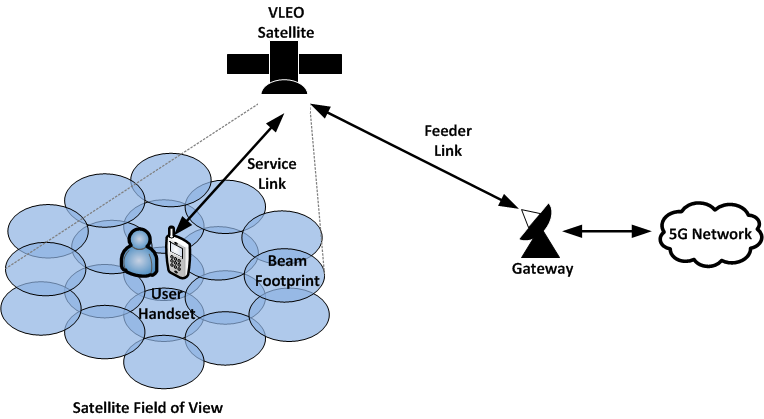
A constellation was selected which will provide good coverage between latitudes of ±55° (as these latitudes cover >95% of the Earth’s population). This consisted of 33 planes of 70 satellites each inclined at 55° which will cover a large number of potential users, with extended service in northern highly populated areas. The constellation will be able to provide an average 3.8Mbps downlink data rate per beam to a conventional mobile phone handset, with each satellite supporting 320 beams. The flexibility of the payload allows this rate to be increased if not all beams are in use.
Plan
The project was a 12 month project from the kickoff to the end of the activity (delivery of draft final report and other deliverables). It had 3 milestones: the Communications Applications Review, the Mid Term Review and the Final Review at the end.
Current Status
The project has been completed