PAGE CONTENTS
Objectives
The purpose of the activity was to measure the actual performance of the new VHF Data Exchange System (VDES) satellite downlink component under realistic conditions in the Arctic and at other locations. At the time of contract award, the downlink waveforms were not specified and no satellite was available.
The two main objectives of this activity were
- to demonstrate the feasibility of the VHF data exchange via satellite in a real operating environment.
- to demonstrate the functionality and real life performance of the VDE-SAT waveforms defined by international working groups in IALA and ITU for data exchange via satellite in VHF maritime bands.
The maritime community supported by International Association of Marine Aids to Navigation and Lighthouse Authorities (IALA), International Telecommunication Union (ITU) and International Maritime Organisation (IMO) have embarked on the development of a new maritime data exchange mechanism identified as VHF Data Exchange System (VDES) to replace some of the existing analogue maritime VHF channels with digital links. The VDES is meant to provide robust communications between ships and shore stations as well as ship-to-ship data exchange as part of the future maritime e-Navigation initiatives. The maritime industrial community involved in the development of terrestrial communications of VDES, has expressed their interest for a satellite component as an integrated part of VDES.
Challenges
At the time of contract award, the satellite downlink signals were not specified and no satellite infrastructures was in place.
The main challenge of the project was to provide VHF satellite downlink capacity leased to ESA for 6 months by Space Norway. Space Norway specified and procured a SDR VDES payload from Kongsberg Seatex, a novel deployable 8 dBi Yagi antenna and a high bitrate uplink from the LEO satellite manufacturer UTIAS. To maximise flexibility the initial payload software was a 150 kHz wide Arbitrary Waveform Generator. The Norwegian Space Centre in close cooperation with the Norwegian Coastal Administration provided access to the NorSat-2 AIS satellite platform for the VDES test payloads.
A second challenge was to identify and install measurement equipment and conduct a test campaign on a representative vessel operating the the Arctic beyond 70 N. FFI worked closely with the Norwegian Coast Guard to have installed the equipment on their inspection vessels KV Harstad operating in the Arctic. FFI also analysed the received data in great detail.
The third challenge was to develop representative ship receiving equipment, raw recording signal recording equipment and demodulation software. Kongsberg Seatex developed special equipment and receive software for the test campaign.
The fourth challenge was to work closely with the IALA standardisation group and develop the VDE-SAT system design and in particular the physical layer definition.
Space Norway took a Design Authorit wrote a major part of the specifications.
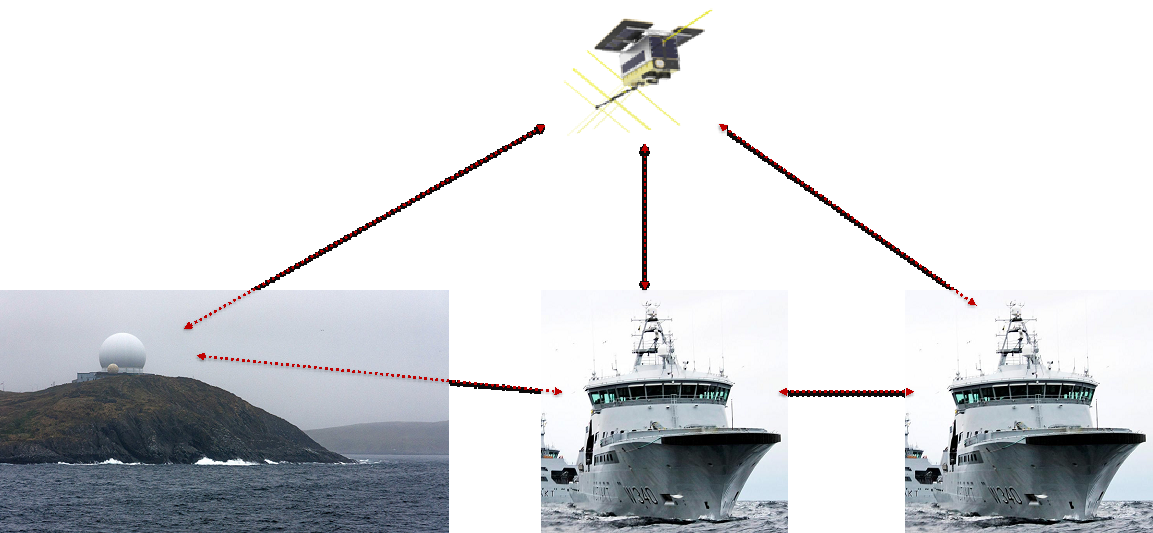
System Architecture
To efficiently measure the VDE-SAT downlink performance under real conditions, the VDES SDR payload was programmed as an Arbitrary Waveform Generator and three VDE-SAT test waveforms occupying 150 kHz bandwidth were uploaded to memory. A CW signal was added in one of the Doppler guard bands for propagation measurement purposes.
A standard AIS front end and antenna was used to feed an IF digitizer that recorded I/Q raw data to disks. The I/Q recorded signal were demodulated using a Matlab software demodulator. The demodulation software was upgraded many times, and the stored data reprocessed using improved algorithms.
The demodulator provided auxiliary data such as SER, offsets, Ec/N0, signal levels that was used to for the statistical post processing.
The propagation environments causes fading due to specular reflections and for the icechart broadcast demonstration a link layer FEC was added to provide acceptable quality.
Plan
The project is a one-phase project. The following milestones apply:
- Baseline Design Review: review and approval of requirements, use case selection and top-level end-to-end system design for the VDE-SAT Demonstration Service
- Critical Design Review: to be held prior to the start of system implementation. The goal is to review and approve the detail design of sub-systems used to provide VDE-SAT Demo Service.
- Test Readiness Review: to be held after completing the implementation, integration and functional verification of sub-systems.
- Test Acceptance Review: To be held after carrying out the VDE-SAT test campaign.
- Final Review
Current Status
NorSat-2 was launched into a 600 km LEO on 14th of July 2017. The Space Norway VDE-SAT payload is a secondary payload on NorSat-2. It is the world´s first VDE-SAT payload in space.
During the activity the Consortium has deployed receive equipment, produced by Kongsberg Seatex, on the coast guard vessel KV Harstad, carried out the world´s first tests on VDE-SAT and has also analysed the measurements recorded during November 2017. 103 passes were measured from the satellite to KV Harstad in the Arctic, and a fixed terminal were located at Andøya, mainly intended for monitoring and reference purposes.
The project has reached its objectives. The final review was held on 26th of June 2018 by demonstrating the distribution of ice-charts via the VDE-SAT downlink from NorSat-2. Ice-chart were received and decoded at KSX premised in Trondheim.