


PAGE CONTENTS
Objectives
The aim of this project is to develop a propagation analysis tool helping the system designer to evaluate the impact of the atmosphere on a telecommunication link involving

The propagation expert can select various models and input datasets for each effect.
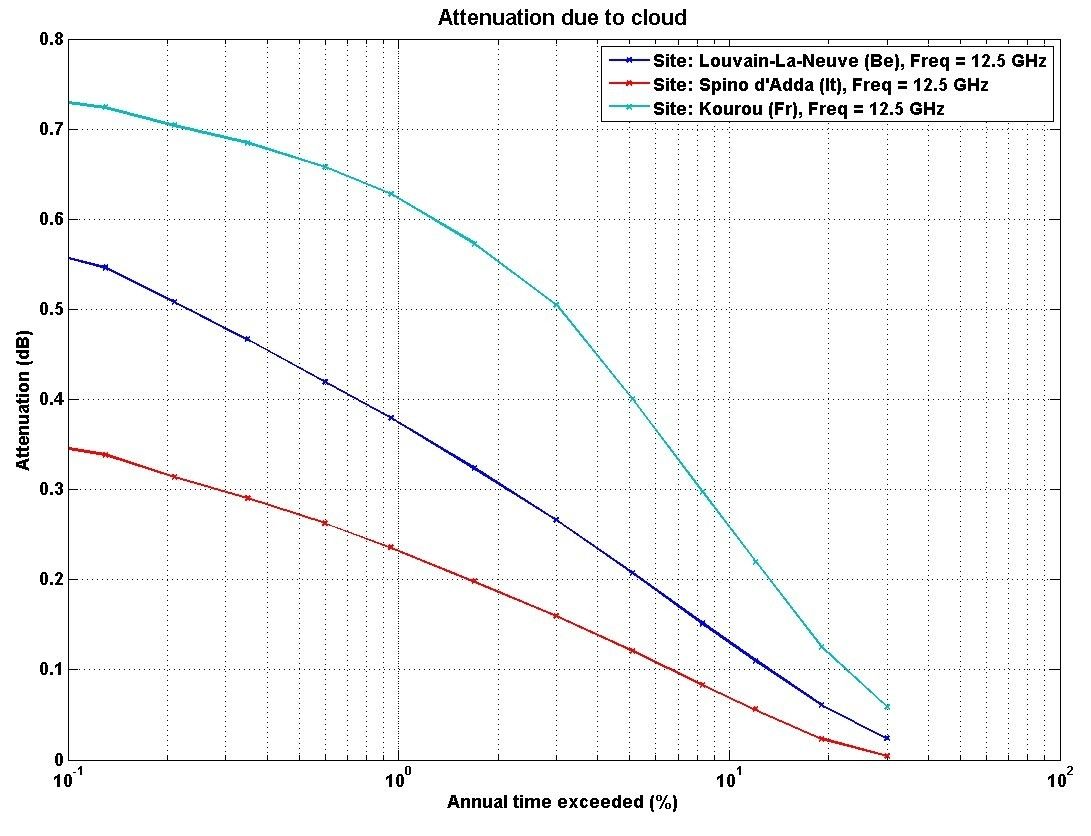
The output of the calculation contains graphs if applicable (Figure 2), ASCII files and Matlab files embedded in HDF5 format.
Challenges
The key issue addressed by this project is to offer to a large variety of users, including system designers as well as propagation experts, a user’s friendly software for the calculation of the degradation due to the atmosphere and the environment.
Plan
The project, initially planned for 24 months, has been further extended by a CCN to a duration of 40 months due to the complexity of the software and the large number of effects to implement. The project is composed by 7 work packages. After a review of the models (WP1000), the models chosen for the various effects are developed and adapted (WP2000). The software requirements are determined and a first MMI interface is proposed during WP3000. The next phase is the software design and implementation, with the web application coding and the calculation module coding (WP4000); the following phase being devoted to validation and testing (WP5000). The last phase is the installation of the server and the software at ESTEC and the pilot period.
Current Status
The server and the software have been installed at ESTEC on November 15, 2013. During the Pilot Period (January 2014-June 2014), a test version of the software is available on a Uniway server. Interested users can send an email to the contact persons hereafter.
