PAGE CONTENTS
Objectives
The goal of the QUICoS project is to study, define, implement, and evaluate, in a satellite-based network testbed, possible enhancements in congestion control, flow control and retransmission mechanisms to be included within the UDP-based QUIC protocol, which is the basement of HTTP/3. These enhancements are driven by the most recent versions of TCP which have demonstrated good performance on satellite networks (TCP Cubic, TCP BBR, TCP Wave). In this way, an innovative and IETF compliant realization of the QUIC protocol can be defined, able to obtain good performance on both satellite, and terrestrial networks.
Challenges
Future Internet applications will use, more and more, end-to-end encryption and a connection-less UDP transport, which are key elements of the QUIC protocol. For this type of traffic, existing satellite accelerators (PEP) and other components along the data path (i.e. middleboxes, adaptive queues, etc.) cannot work properly. Furthermore, the QUIC IETF standardization is not explicitly considering possible shortcomings and inefficiencies when satellite-based links are used (especially GEO). Finally, several TCP-based optimizations (available also at the lower level of several operating systems) are lost when using current QUIC implementations and shall be redesigned.
System Architecture
The resulting design of the QUIC protocol, network nodes and endpoints (clients and servers), are included into a real-time Linux-based network testbed, which will extensively leverage virtualization, orchestration and monitoring technologies, by a proper integration and adaptation of existing Open-Source multi-platform solutions. A preliminary high-level architecture of the testbed, which represents the main deliverable of the project, is reported in the following figure.
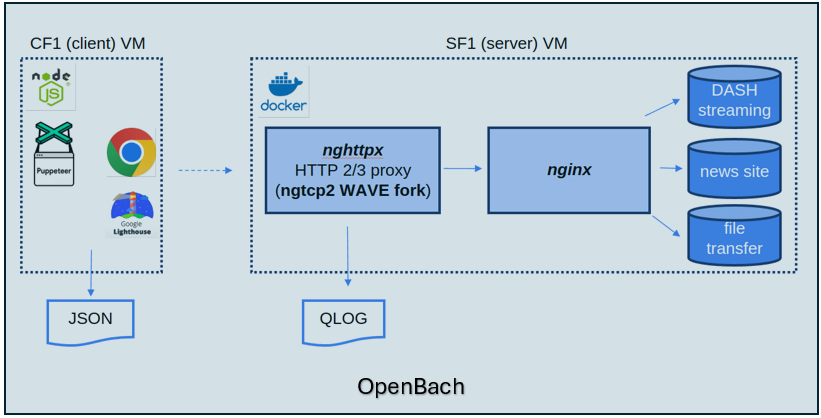
Some of the Virtual Machines deployed within the testbed contain real and emulated clients and servers, deployed in different containers and running in different Operating Systems, on top of which the developed QUIC congestion control can be enabled using real services and Web Browsers (i.e., Chrome). Furthermore, a realistic model of the transport network including complex network elements (e.g., CoDel buffers) and SatCom emulation is considered (e.g. OpenSand), including handovers, between clients and servers. Finally, configuration, execution and tracing of experiments for the testbed, KPI extraction and real-time monitoring capabilities (Management and Orchestration) are performed via OpenBach.
Plan
The project duration is 24 months, and three main milestones are foreseen:
- Baseline Design Review (BDR, KO+9mo)
- Critical Design Review (CDR, KO+15mo)
- Final Review (FR, KO+24mo).
Current Status
The project has completed all technical activities and has performed the Final Review meeting.