PAGE CONTENTS
Objectives
The main objectives of the project are as follows:
-
Design novel Congestion Control (CC) mechanisms for the QUIC transport protocol, which deliver acceptable performance over both satellite and terrestrial networks.
-
Prove the effectiveness of the new mechanisms in relevant GEO/NGSO scenarios.
Both verification and validation campaigns are performed to show that the designed solution satisfies the technical requirements and to evaluate the effectiveness compared to existing options. A goal is to attain similar or higher performance than can be achieved using a PEP with TCP. A set of demonstration campaigns use commercial satellite links for both GEO (e.g., Eutelsat Konnect, SES ASTRA) and NGSO (Starlink), and consider migration scenarios (satellite to terrestrial network switching).
The key results of the project are contributing to the Internet Engineering Task Force (IETF), the principal Internet standards development organisation.
Challenges
The recently defined QUIC protocol (RFC9000) has been widely deployed across the Internet. This uses TLS 1.3 to encrypt the end-to-end communication. This prevents using techniques to mitigate the differences introduced in satellite systems (e.g., PEPs) and therefore introduces performance limitations (RFC9065). Instead, the project proposes to change the QUIC sender to optimise transfers over satellite using the QUIC transport protocol.
System Architecture
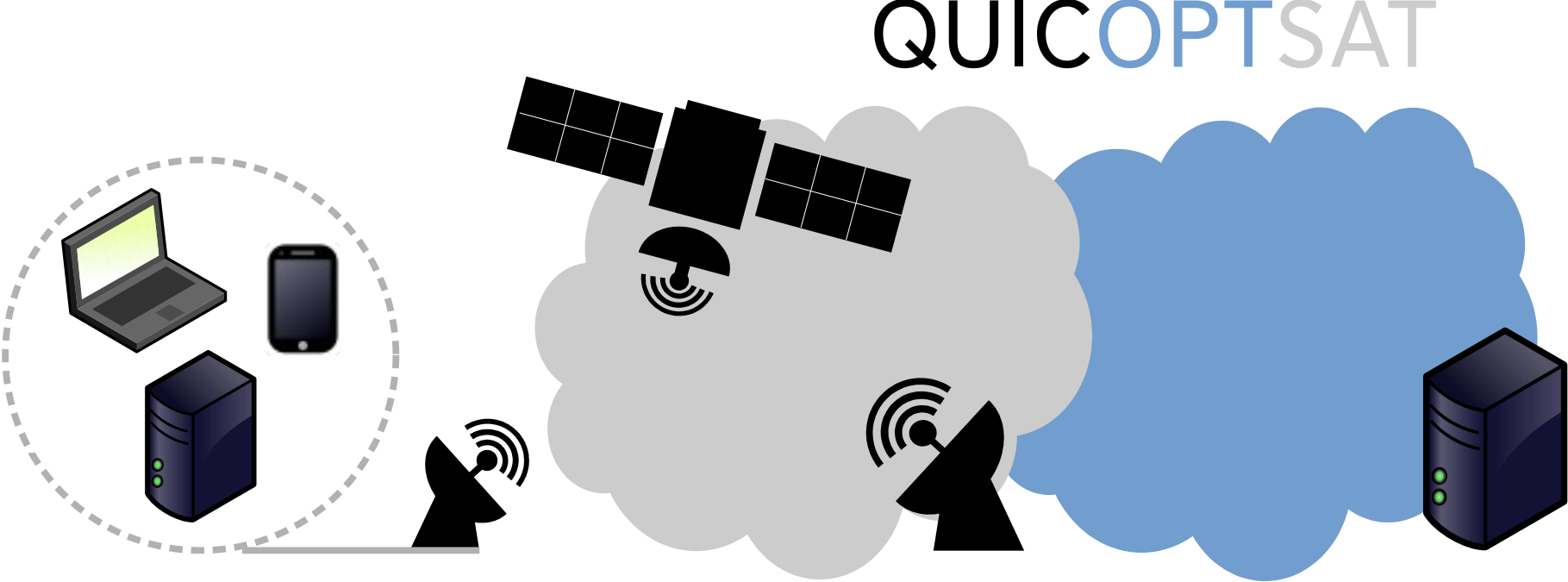
The project has implemented the congestion control mechanism in two QUIC stacks: A fork of the CloudFlare Quiche, and a fork of Picoquic. These implementations have been validated and then evaluated using a range of applications operating over commercial satellite links for both GEO (e.g., Hylas, Eutelsat Konnect, SES ASTRA) and NGSO (Starlink). A range of non-satellite paths have also been evaluated and many also experience benefit, as well as considering migration scenarios where the path changes between satellite to terrestrial networks. Configuration and KPI recording is implemented through a web-interface (GUI).
Plan
The project has three phases:
-
Phase 1: Definition of a technical baseline and preliminary validation of the mechanisms using simulation campaigns in ns-3. This was used to derive the initial design.
-
Phase 2: Development of a consolidated technical baseline in a real-world QUIC implementation followed by in-depth analysis over emulation testbeds.
-
Phase 3: Demonstration over real-satellite services using real applications.
Current Status
Phases 1 and 2 have been completed: The project has finalised a technical specification (Careful Resume), supported by simulation analysis and evaluation. This has been shown to significantly improve the performance and reliability of the Internet, especially for users of high-bandwidth-delay-product paths – such as those provided by some cellular services and by broadband satellite providers.
The project has successfully contributed an Internet-Draft (draft-ietf-tsvwg-careful-resume) specifying Careful Resume to the IETF TSVWG working group. This has been adopted as a work item and is currently progressing towards publication as an IETF Standards Track RFC.
The final stage of the project evaluates satellite performance of the implemented QUIC protocol stack.