PAGE CONTENTS
Objectives
The immediate need for high power solar arrays for nano satellites initiated the Power Cube project, which has been carried out under an ESA ARTES contract with Dcubed GmbH as prime contractor (project management, subsystem development, assembly, testing), in close partnership with the companies German Orbital Systems GmbH (market overview, reference mission requirements, testing) and AZUR Space GmbH (solar cell development), as well as the academic partner Technische Hochschule Deggendorf (materials and structures R&D).
The aim of Power Cube is to develop a scalable deployable solar array for nanosatellites, which can be stored within a volume inferior to that of a CubeSat Unit (1U) and can generate 100W at EOL (End of Life).
Challenges
The main challenge of the project is to fulfil these main requirements:
-
Minimize the array’s stowed volume through efficient packaging
-
Demonstrate reliable deployment
-
Achieve sufficient deployed stiffness
-
Demonstrate scalability of the concept, to enable its use on larger CubeSat and SmallSat platforms
-
Provide an economically viable solution
System Architecture
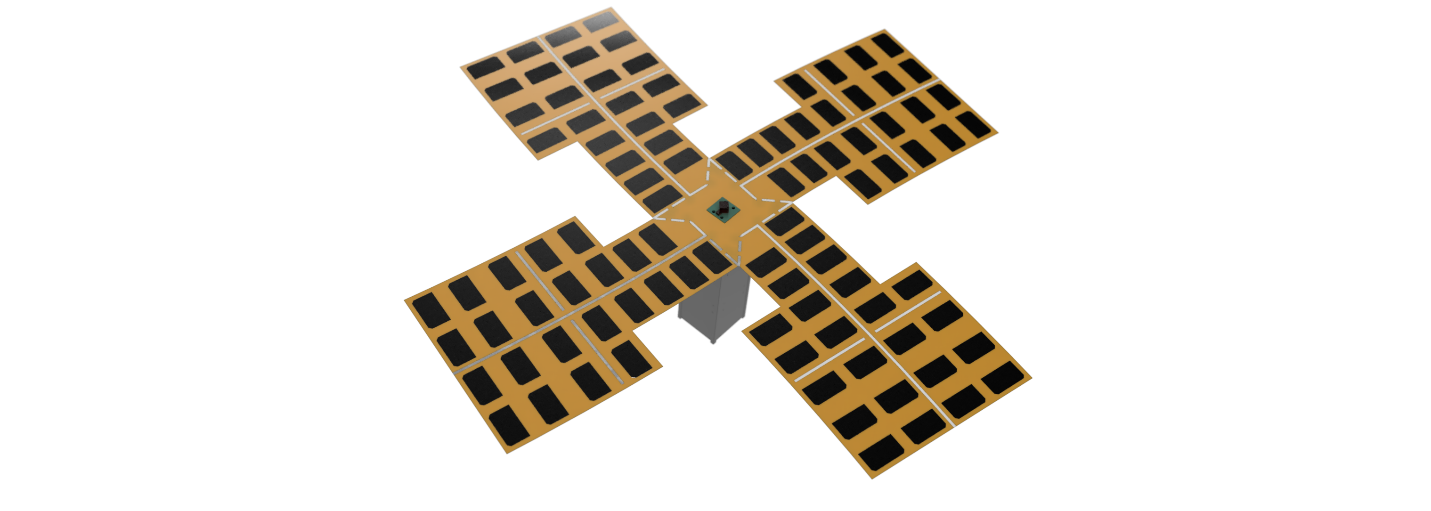
The system architecture consists of an origami-folded solar array, including a dual-matrix carbon fiber substrate, a flexible PCB electrical layer, and 30%-efficient triple-junction solar cells. A spring-loaded extraction mechanism pushes the solar array out of the 1U cube to initiate its deployment without interference from the rails of the CubeSat. The hold-down and release mechanism uses COTS actuators from Dcubed.


Plan
The project, carried out by a 4-member consortium, included the following phases:
-
Concept definition: state-of-the-art review and conceptual design, leading to architecture selection
-
Concept consolidation: design, analysis, and critical breadboarding activities leading to a verified design
-
Engineering model development: production of a full-scale, functional engineering model of the solar array
-
EM test campaign: an extensive test campaign to assess the survivability and performance of the solar array under simulated operational environment, including vibration, shock and T-VAC
-
Design upgrade and verification: implementation of lessons learned from the test campaign and verification with a delta test campaign, focusing on shock testing, deployment in T-VAC and Sun simulator testing.
At the end of the activity, TRL 6 has been achieved.
Current Status
The PowerCube project was kicked off in March 2021. After an extensive development and breadboarding phase, a full-scale engineering model was developed and underwent a thorough test campaign in 2022. Lessons learned from the test campaign were implemented in the following phase of the project, leading to a delta test campaign that was completed in October 2024. After a final review in December 2024, the project is currently completed and closed.