PAGE CONTENTS
Objectives
The OPTIMUS test bench establishes a foundation for next-generation optical communication services by demonstrating robust, user-driven capabilities in scheduling, data delivery, and network monitoring. It enables seamless registration of OGS, Network Operations Centers (NOCs), and satellite operators via a lightweight, harmonised process that ensures interoperability across diverse optical systems. By implementing a “NOC of NOCs” architecture, OPTIMUS centralises planning and resource management to maximise pass reliability and data throughput. The platform integrates Human-Machine Interface, planning algorithms, real-time monitoring, and networking modules into a cohesive framework, supporting both single- and multi-OGS scenarios under realistic operational conditions.
OPTIMUS also serves as a reference for standardisation and can host advanced use cases such as quantum key distribution and quantum communication experiments. Through rigorous requirement refinement, design finalisation, and targeted validation tests, the project raises the solution’s Technology Readiness Level and prepares it for seamless integration into operational environments – laying the groundwork for scalable, cost-effective Optical Communications as a Service.
Challenges
The project navigates three key challenges: integrating a still-maturing Disruption Tolerant Networking (DTN) protocol end-to-end – requiring protocol conversion and satellite-simulator support; coordinating diverse subsystems (planning, HMI, DTN, HCC, monitoring) developed by multiple teams using agile methods and clear workflows; and balancing cost-driven design constraints by leveraging open-source software, consortium expertise, and careful trade-offs to contain development, licensing, and integration expenses.
System Architecture
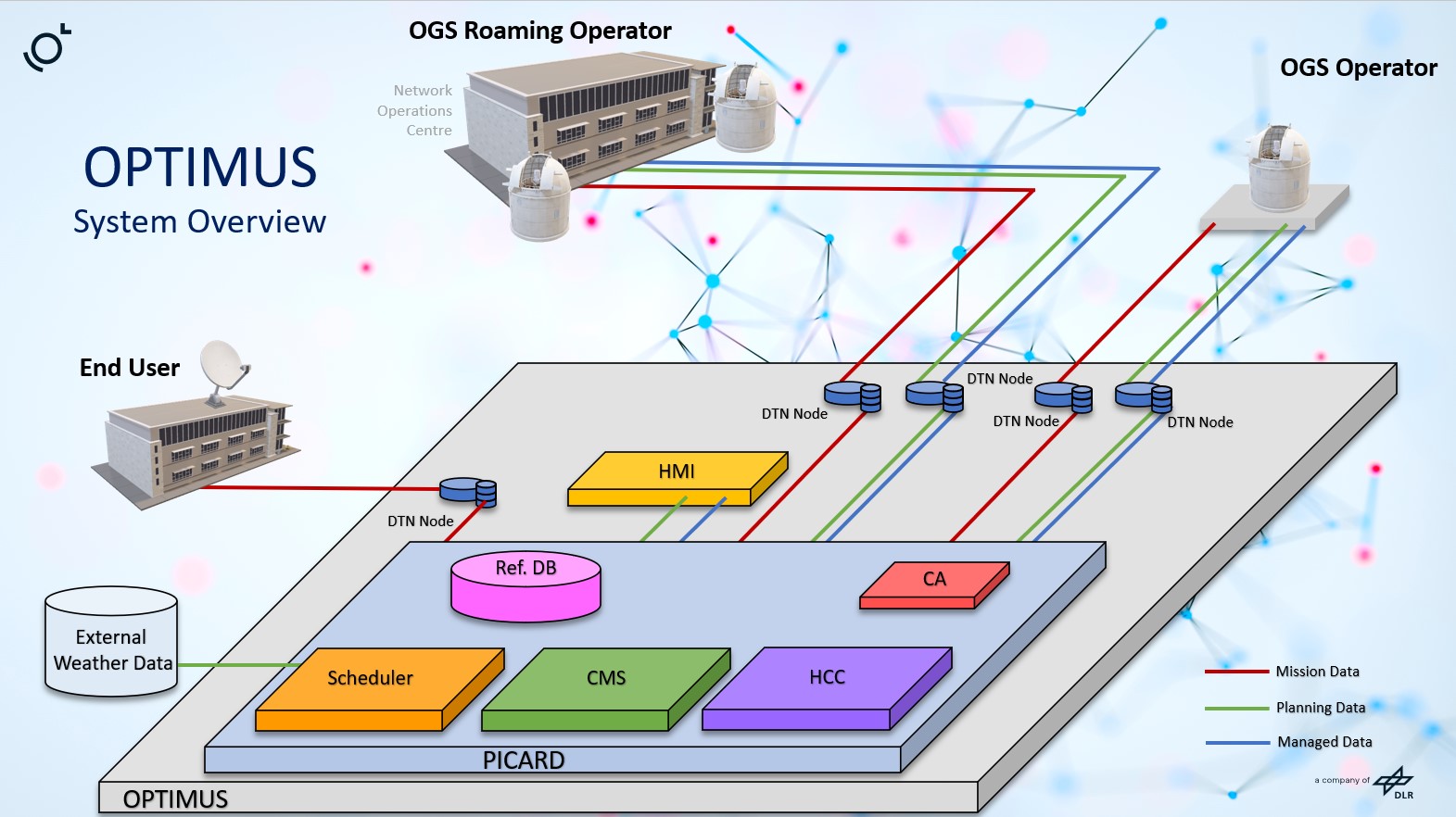
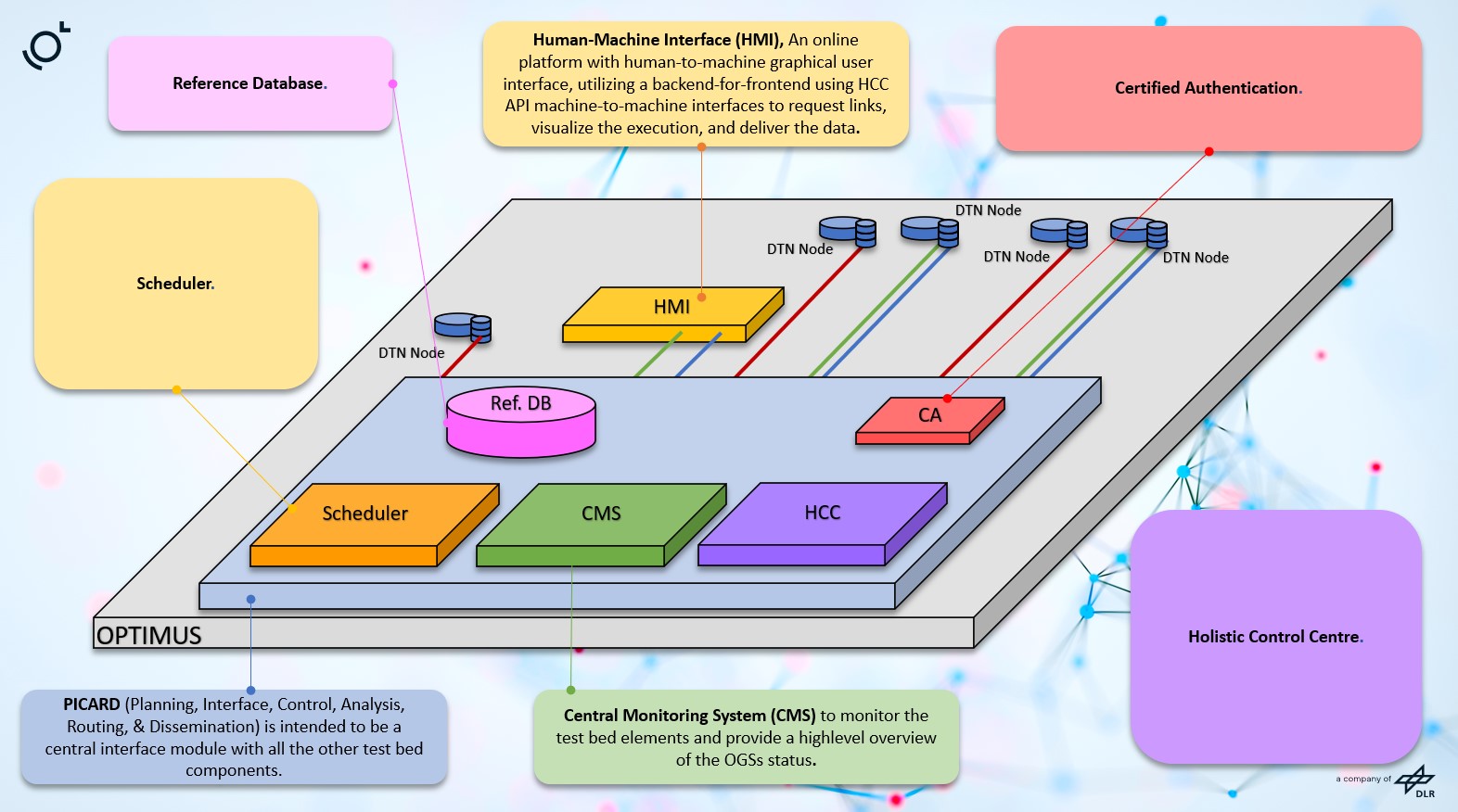
The Testbed adopts a modular, service-oriented architecture comprising five key components interconnected by secure, standardised interfaces:
- Human-Machine Interface (HMI) serves as the entry point for operators and customers, providing registration, scheduling, simulation control, and data retrieval.
- Scheduler & Optimisation Engine processes pass requests, applies link-budget and cost-based ranking, and handles dynamic rescheduling. It exposes REST endpoints and publishes scheduling events to an internal message bus.
- Holistic Control Centre (HCC) serves as a middleware as it provides within OPTIMUS the ability to dynamically connect OGS or OGS-networks. OGSs can connect to the entire system as new services and HCC provides the needed infrastructure to provide coherent configurations, security and so on.
- Emulator consumes scheduling events to drive spacecraft-to-ground interaction scenarios under configurable impairments (latency, packet loss, handover), streaming telemetry results to the monitoring layer.
- Central Monitoring System (CMS) subscribes to health and performance topics on the message bus, aggregates metrics in a time-series database, and pushes alerts and trend data to the HMI.
A DTN integration layer underlies data transfers, segmenting and forwarding bundles over intermittent links. The architecture enables independent development, easy scalability to multiple operators, and robust validation of optical communication workflows.
Plan
The project unfolds in five phases, each ending with a formal milestone review:
- Preparation – Project Kick-Off (KO) and State-of-the-Art/Trade-Off studies, concluding with the Preliminary Design Review (PDR).
- Design – Architecture and ICD alignment, ending at the Critical Design Review (CDR).
- Build – Module implementation and system integration, culminating in the Factory Test Readiness Review (FTRR).
- Test – System and interface validations (including remote OGS), fixes applied, ready for the Test Readiness Review (TRR).
- Operate – Operational demonstrations and final handover at the Final Review (FR).
Current Status
The project is in the Preparation phase, having completed the Kick-Off and initiated State-of-the-Art studies and technology trade-off analyses. Core activities include defining detailed user scenarios, refining high-level requirements, and setting up development environments. Upcoming tasks focus on finalising the Preliminary Design Review inputs, solidifying the ICD framework, and aligning stakeholder workflows to ensure a smooth transition into the Design phase.