PAGE CONTENTS
Objectives
The project is concerned with the assessment of advanced optical reconfiguration concepts based on multiple-frequency conversion (OMC) for application in broadband transparent telecom repeaters. This is supported by the design and development of an engineering model of an Optical Multi-frequency Conversion Unit (OMCU) and its test in the environment of an Opto-Microwave Analogue Repeater (OMAR) breadboard.
The activity was split in two phases. The objective of Phase 1 is to identify applications and opto-microwave analogue repeater (OMAR) concepts making best use of the OMC concept, and to define a demonstrator representative of these applications.
Phase 2 is aiming at developing and testing this demonstrator.
Challenges
The overall challenge is to demonstrate and assess the benefits of advanced optical reconfiguration concepts based on multiple-frequency conversion (OMC) in broadband transparent telecom repeaters applications.
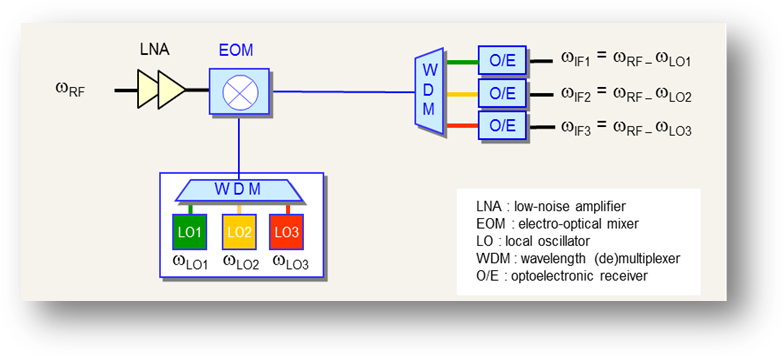 Principle of optical multi-frequency conversion (OMC)
A first challenge is to identify telecom missions and payloads where microwave photonic system concepts can provide enhanced features and/or new capabilities. So-called OMAR (Opto-Microwave Analogue Repeater) are to be elaborated for enhancing the features and reconfiguration capabilities of future broadband telecom satellites.
Then, the challenge is to design and develop a representative model of such an Optical Multi-frequency Conversion Unit (OMCU) with RF performance equivalent to those of conventional transparent repeaters, and to test it in the system environment of an Opto-Microwave Analogue Repeater (OMAR) breadboard.
Plan
The activity is split in two phases.
The objective of Phase 1 is to identify applications and opto-microwave analogue repeater (OMAR) concepts making best use of the OMC concept, and to define a demonstrator representative of these applications.
Phase 2 is aiming at developing and testing this demonstrator. The OMAR demonstrator features a representative OMCU model, other units being developed at breadboard level.
The demonstrator is to be integrated and arranged in configurations representative of target applications. The overall functionality of the OMAR demonstrator is to be demonstrated and validated. The test campaign to be run at sub-system level includes all the conventional RF test items. The measured performance must be assessed versus the target performance and theoretical predictions.
Current Status
The project has demonstrated innovative payload concepts making full use of RF photonics, wavelength-division multiplexing and optical switching technologies. This has been achieved through the development of a representative model of an Optical Multi-frequency Conversion Unit (OMCU) and its test in the system environment of an Opto-Microwave Analogue Repeater (OMAR) breadboard.
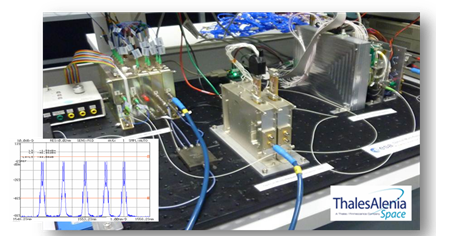
Integrated OMAR demo with the 5-LO optical spectrum
The demo has been arranged in configurations representative of multi-beam payload and flexible payload applications. The overall functionality is successfully validated in Ka-band and Ku-band but these concepts find applications in a broader range of payloads.
An extensive test campaign has been run at photonic repeater sub-system level which included all the conventional RF test items, namely RF gain, noise figure, linearity, gain flatness, gain stability, group delay variation, phase noise. The measured performance were found to be compliant with the target requirements, with only minor deviations with respect to theoretical predictions. Preliminary thermal tests have also been run.
Disruptive photonic payload concepts and technology have been developed and brought to higher maturity, with representative models of photonic payload equipment, including photonic FGU and frequency-converters and photonic routing solutions. The technology is ready for further development and shall be available for in-orbit demonstration (IOD) in the short term.