PAGE CONTENTS
Objectives
Optical ground stations currently can only be operated and hosted at premises where a technical supervision team is available, as failure recovery does frequently require specialised technicians. This is both intensive in operational expenditures and inhibits the preferential deployment to remote sites where perturbations from ambient light are lower.
This activity aims at replacing the unplanned failure recovery with planned preventive maintenance, complemented with predictive maintenance capability generated by a machine learning process, to anticipate potential failures of the optical ground station and to maximise operational availability of the asset enabled through a central, intelligent ground station controller.
The objective is to design and prototype such a controller, which is a computer control system managing all ground station subsystems and provides quantum key material to the user without the need for technical supervision, thus making the optical ground stations more self-sufficient.
The controller shall be able to interface with all common subsystems of an optical ground station and be able to autonomously execute satellite passes, downlinking data or generating quantum key material without any external connection. To that end maximum use of automation and artificial intelligence shall be made to anticipate, prevent, or correct non-nominal operational states and plan preventive maintenance.
The controller is tested and validated with two different optical ground stations.
Challenges
The design and prototyping of the computer control system for self-sufficient optical ground stations faces several challenges:
Some uncertainties are linked to the computational power that will be required to run the M&C system and the predictive maintenance algorithms. Furthermore, the suggested simplified hardware platform might lack robustness usually found in enterprise systems and might therefore prove unsuitable for the availability and reliability requirements of the IZN-1 station.
Another unknown is how easily the telescope pointing controller can be interfaced to the different mounts planned to be used for testing. Due to the time-criticality of these interfaces for achieving the required tracking performance, particular care must be taken during the design and development phase.
A further question is the availability of the different telescopes foreseen for the testing. The planning of the activities on these ground stations must be aligned with the scheduling of the present project.
System Architecture
The generic expected structure of an optical ground station expected to be controlled is presented below.
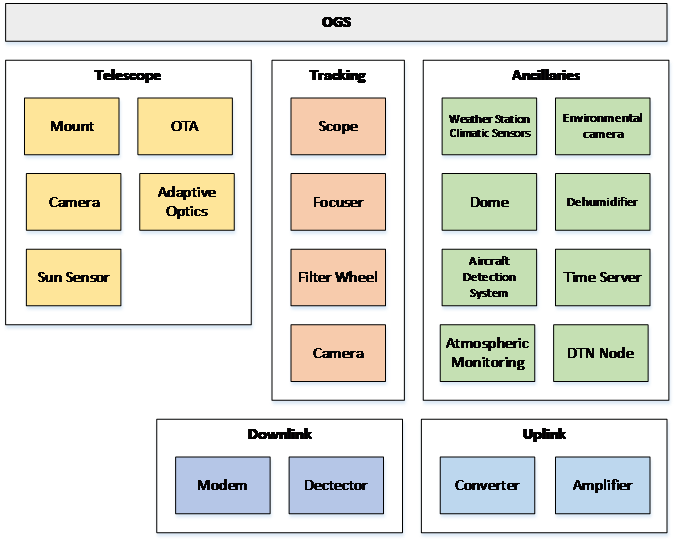
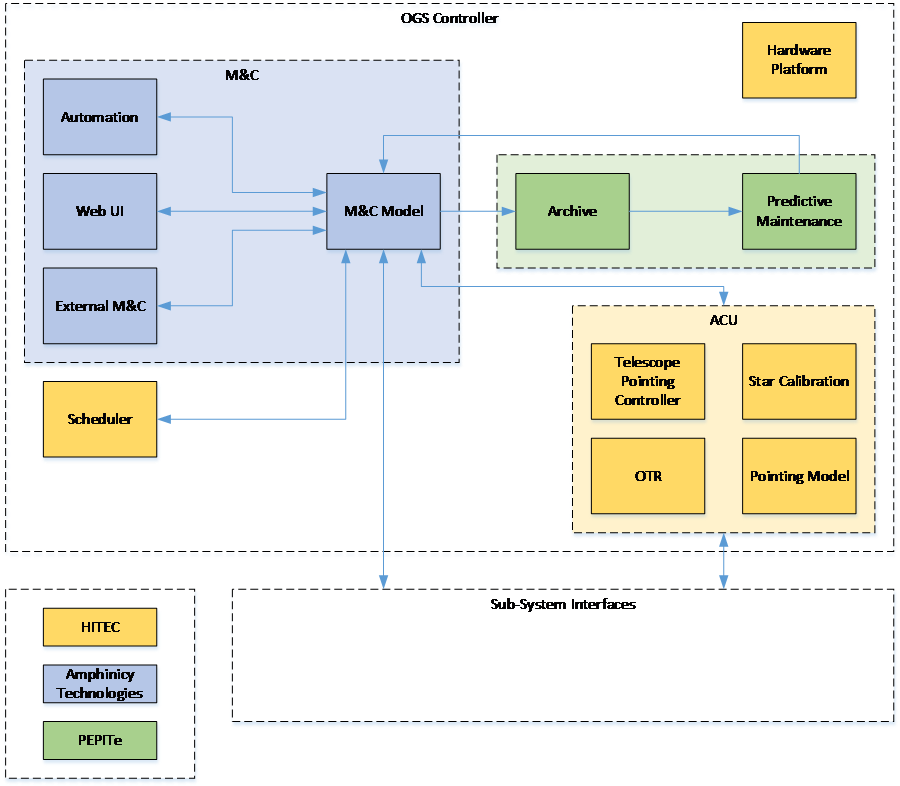
The optical ground station controller will be adaptable to ground stations with various subsystems and capable of evolving alongside them. This includes adjustments to automation, monitoring parameters, and control directives as the optical ground station subsystems develop over time. This process of adapting an optical ground station controller is called ‘tailoring’ and typically involves changes of automation scripts, of the monitoring and control model and of the user interface.
The proposed architecture of the optical ground station controller is presented below:
Plan
Milestone 1 – Kick-Off Meeting. Completed on September 5, 2024
Milestone 2 – TBR: Technical Baseline Review. Due Date: First quarter of 2025.
Milestone 3 – CDR: Critical Design Review. Second quarter of 2025.
Milestone 4 – SAT1: Site Acceptance Testing 1. First quarter of 2026.
Milestone 5 – SAT2: Site Acceptance Testing 2. Due Date: Third quarter of 2026.
Milestone 6 – FR: Final Review. Due Date: Fourth quarter of 2026.
Current Status
-
Contract Signed in July 2024: Advanced payment made.
-
Kick-off meeting on September 5, 2024.
-
Documentation:
-
TN01: Survey and Assessment “State-of-the-Art”: Ongoing
-
CVM: Technical Specification: Ongoing
-