PAGE CONTENTS
Objectives
The study is relevant to the next generation broadband telecommunication service (VHTS) based on Single Feed Per Beam, developing an Engineering Model (EM) of a demanding innovative feed system operating from 17.7 GHz to 51.5 GHz providing simultaneously user and feeder link service.
The Feed system development has been addressed considering its application in operative scenarios:
-
Provision of multi-media services at high data rate.
-
Compatibility with small user terminals.
-
High/very-high throughput supported by payload on board a geostationary satellite.
-
European service area with focus on national mission needs.
-
multi beams system solution in Ka/K band for user link and Q/V band for feeder link.
-
Users coverage over Europe and Gateways concentrically aligned over the users coverage
-
Medium size satellite platform compatible with medium/large class of launchers
-
Board tracking system planned
-
Compatibility with innovative electric propulsion system platforms
-
Payload having a target mass of 400 Kg and a target power of 4 KW
The main design objectives have been:
-
To guarantee proper RF performance over an extremely wide spectrum range
-
Tunable approach to be easily customized for a given antenna system
-
Compact envelope to be accommodated in a feed cluster
Challenges
At current state of the art a feed system involving the User and Feeder bands has not been developed.
The main design challenge is to guarantee in a compact envelope (cross-section within 45 mm) RF performances over so different bandwidths (K/Ka vs Q/V) in terms of proper radiation patterns, Ohmic losses, XPD, Isolation, tracking capability.
System Architecture
The selected modular architecture of optimized feed system is composed by 3 main subsystems:
-
Quadriband subsystem: it includes a smooth-wall quadri-band feed-horn and the coaxial OMJ which separates the K/Ka-band signals from the Q/V-band ones (user bands (K/Ka) are extracted (injected) in the external part of coaxial structure meanwhile the feeder bands (Q/V) are propagating in the inner coaxial part)
-
K/KA recombination network: it separates the K and Ka-band signals. It consists of the cascade of a recombination turnstile OMT that couples the signals entering at the four rectangular-waveguides connected to the quadri-band sub-system to a common square waveguide. The recombination turnstile OMT consists of a turnstile junction in square-waveguide loaded with four chamfered L-junctions. The K/Ka band polarization/frequency-diplexing network consists of an asymmetric OMJ with two longitudinal slots used to couple the K-band signals to two rectangular waveguide arms
-
Q/V recombination network: it separates Q and V band and polarizations. It is composed by the cascade of: an irises polarizer, a wide band OMT and a diplexer
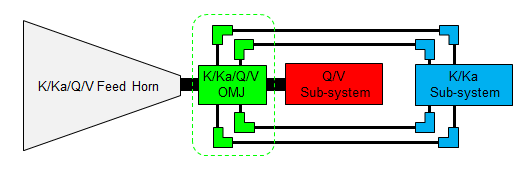
The selected feed system baseline direct configuration has 6 active ports:
-
2 active ports for user link (1 polarization for K band and 1 polarization for Ka band)
-
4 active ports for feeder link (2 polarization for Q band and 2 polarizations for V band)
-
2 loaded ports for user links and no ports for tracking.
Plan
The Study is characterised by seven major milestones marking the development of the technical tasks:
MS1: System Requirement Review (SRR)
MS2: Preliminary Design Review (PDR)
MS3: Critical Design Review (CDR)
MS4: Manufacturing Readiness Review (MRR)
MS5: Test Readiness Review (TRR)
MS6: Test Review Board (TRB)
MS7: Final Review (FR)
The project Work Breakdown Structure (WBS) is reported in the following figure.

Current Status
The project started in October 2020; the SRR was held in February 2021, has been completed in October 2023 with the Final Review.