PAGE CONTENTS
Objectives
The first objective of the project is to review the satellite trunking markets so as to identify the usages and their trends, to forecast the size of these markets and their specificities by 2025 and thus be able to define the technical requirements of a future system.
The second objective consists, after having made the relevant trade-offs, of designing satellite systems able to respond competitively to the requirements of these trunking services. The development and exploitation of these systems will have to use innovative techniques and technologies to offer competitive solutions.
The last objective is to establish, after an analysis of the existing gaps, the technological roadmaps enabling the European and Canadian industry to propose attractive and competitive solutions by a 2025 timeframe
Challenges
The key challenges of the project are :
- a good identification of the service requirements and their trends and the possible impacts in the architecture of the systems.
- a right definition of system architecture and in particular the perfect match between the needs and the resources of the systems.
- the demonstration that global constellations offer a competitive solution and generates profits.
System Architecture
The solution to meet the needs of the two most promising market segments (aeronautical & maritime) by 2025 is :
- a space segment based on a LEO or MEO constellation, providing a global coverage, with innovative satellites: digital payload, agile spot beams, regeneration,…
- a user ground segment operating in Ka-band with several types of terminals for planes and ships,
- a feeder ground segment including gateways/feeder stations operating in Ka-band or Q/V-band and connected by a Distribution Network to Access Points to terrestrial networks and Network Control Centers
The project proposes the design and optimization of two systems:
MEO constellation
- 24 satellites in 3 inclined planes (50°) at an altitude of 8063km (5 orbits/day).
- A payload (500kg / 5,6kW) fitting in the Thales Alenia Space EliteBus 2000 platform.
- 80 gateway stations on 20 sites.

LEO constellation
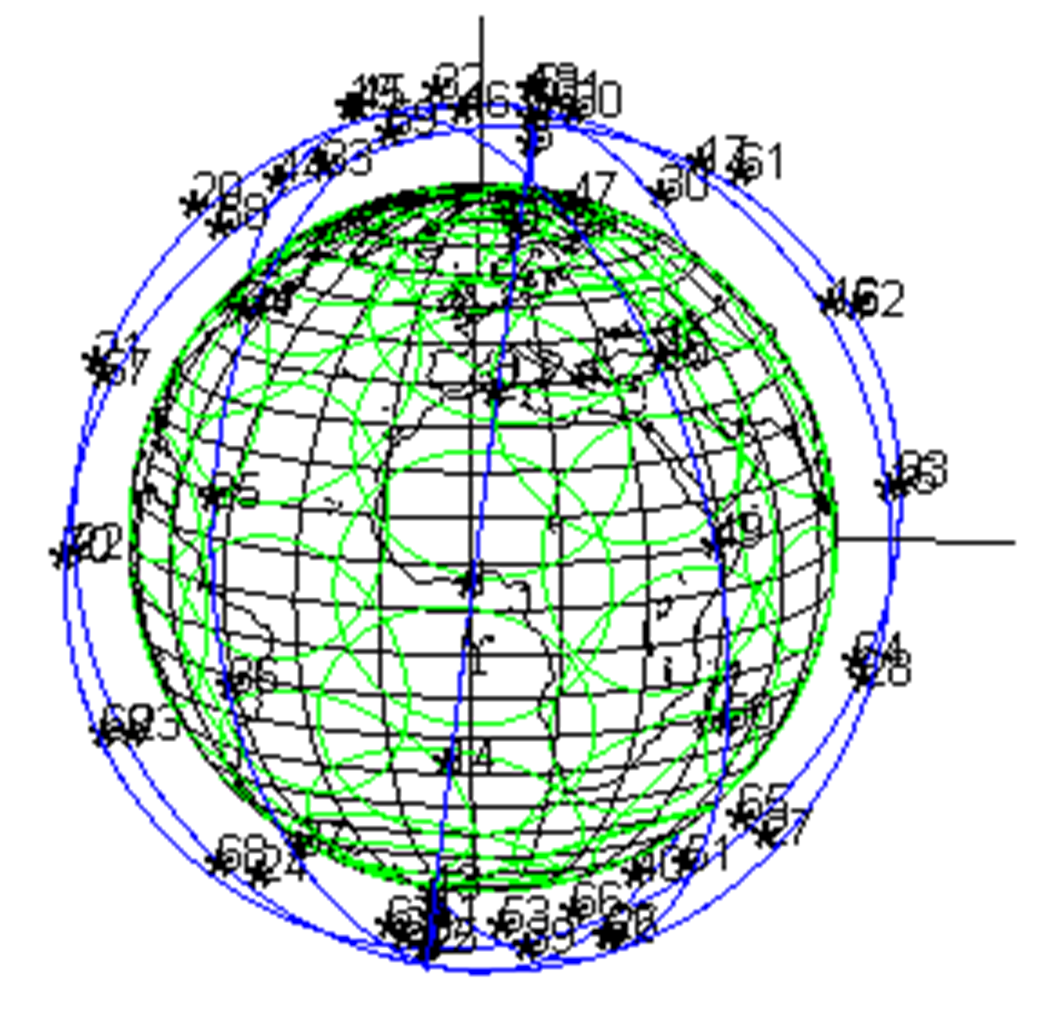
- 70 satellites in 5 inclined planes (83°) at an altitude of 1450km (12½ orbits/day).
- A payload (600kg / 5,5kW) fitting in the Thales Alenia Space EliteBus 2000 platform.
- 45 gateway stations on 9 sites.
Plan
The project is organized in four tasks. Task 1 is the market review and definition of the requirements. Task 2 is the identification of relevant system architecture and technologies. Task 3 is a detailed system design and the recognition of the key technologies. Task 4 includes the gap analysis and the establishment of the recommended roadmaps.
Current Status
Study completed
Companies