
PAGE CONTENTS
Objectives
The objective of the “Multi-Service Mission Opportunities (MSMO)” study is to derive promising mission concepts that exploit the upstream integration of telecommunication services with other space-based applications, with the aim of identifying new end-user services which so far do not exist.
In summary, the main objectives of the study are:
- To identify new end-user services that emerge from the upstream integration of telecom and non-telecom applications. All space-based applications are within the scope of the activity, from Earth Observation up to Space Situational Awareness;
- To identify enablers for the upstream integration of such applications, at Space, Ground, User and Launch Segment;
- To define technical solutions for implementing the identified missions within 5 years;
- To identify gaps, at technical and non-technical level, for the implementation of the mission, and propose a roadmap to address these gaps.
Finding new end-user services and enablers are the main challenges of the study. Enablers are functions and technologies that allow either the share of resources (e.g. platform hosting different payloads, star trackers used for tracking debris, radar signal encoding information, …) or also, that allow the new integrated end-user services (e.g.: mobile phones receiving on-board processed satellite data, Inter-Satellite Link, on-board autonomy, high computing power enabling low latency,…).
Challenges
The main challenge of the MSMO mission is to justify the added-value of the identified new end-user services with respect to similar services that today are offered via downstream integration.
From a technical perspective, the main challenges are:
- Joint radar/Telecom signal modulation
- Compressed sensing
- high computing power
- Fast on-board processing time
- RF interference mitigation
- 5G mobile users to satellite communication
From a non-technical perspective:
- ITU regulation for different RF applications sharing the same frequency band
- Financial and privacy issues
- TRL of innovative technology components
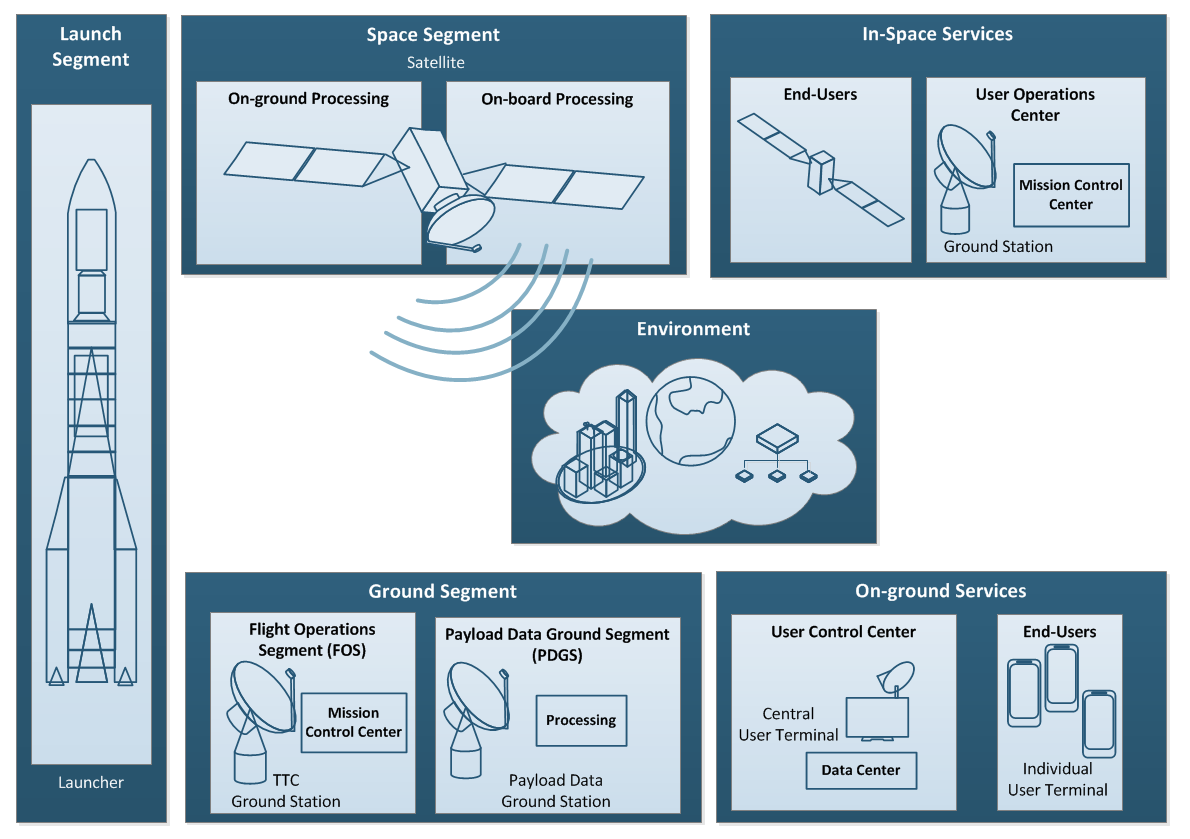
System Architecture
An MSMO mission concept is defined by:
- Telecom application(s)
- Non-telecom applications(s)
- End-user service
- Integrated functions
The generic elements of a generic MSMO mission concept are:
- Space Segment
- Payload
- Platform
- On-board autonomy
- Ground Segment
- Flight Operations Segment (FOS)
- Payload Data Ground Segment (PDGS)
- User Segment
- Centralized User Segment
- End-Users
- Launcher Segment
Plan
The study is structured in 4 phases, with a milestone at the end of each phases:
Phase 1: Identification of Mission Concepts
Aimed to identify potential mission concepts based on a synergistic analysis between the proposed new end-user services and the identified enablers for upstream integration. A workshop with ESA is planed to brainstorm on the proposed mission concepts.
Phase 2: Preliminary Design
Preliminary design of the candidate concepts, with Concurrent Design sessions. 4 mission concepts down-selected based trade-off analysis
Phase 3: Detailed Mission Concept and System Architecture
Detailed design of the candidate concepts, with Concurrent Design sessions, including identification of technical solutions.
Phase 4: Gaps and Regulatory Issues
Aimed to identify technical and non-technical gaps (in specific, financial issues). 2 mission concepts down-selected based trade-off analysis.
Current Status
The study started in March 2021. The successful Final Presentation took place in November 2021.