PAGE CONTENTS
Objectives
The MASSIVE project aims to design and develop a Satellite Gateway able to manage a large number of uncoordinated terminals.
The project objectives are in reference to the state-of-the-art protocols and solutions based on the E-SSA protocol. They can be summarized as the following:
- At least 50% improvement in the system overall capacity, or equivalently in the spectral efficiency, allowing the maximization of the number of terminals which can be managed with narrower bandwidths, up to a few millions terminals;
- Counteracting the harmful Doppler effect, enabling the use of terminals operating over LEO (or MEO) satellite constellations;
- Lightening the implementation complexity of the terminals by relaxing requirements over frequency accuracy / phase noise and power even though that may require more processing at the GW side.
Challenges
The key challenge of the project is being able to design, develop and test in an affordable way the following topics on which the project is focused as an enhancement of already deployed E-SSA protocol:
- Higher order modulation (at least QPSK);
- TDM waveform organization (instead of the CDM foreseen by the S-MIM standard);
- Oversampling reduction;
- Multi-stage despreader approximating MMSE spread spectrum detection and evolved demodulation algorithm;
- Evolved preamble searcher, to cope with the adverse Doppler effect especially in LEO/MEO scenarios;
- Modifications and enhancements of the existing MBI facilities: Traffic Generator, E-SSA Terminal, Channel Emulator, to meet project requirements.
System Architecture
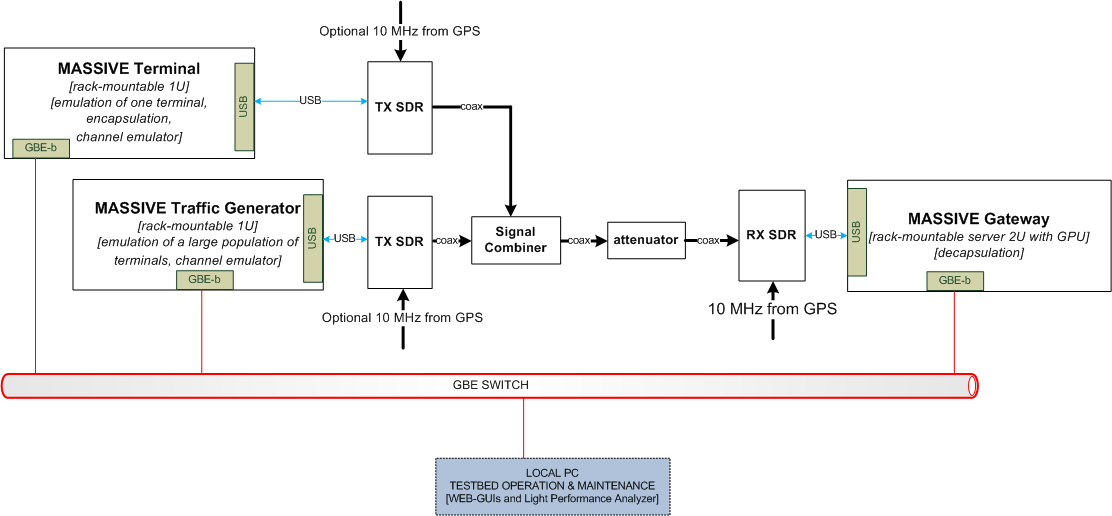
The architecture of the system to be developed in the project can be derived from an overall and a gateway-focused point of view. The overall physical architecture is the following:
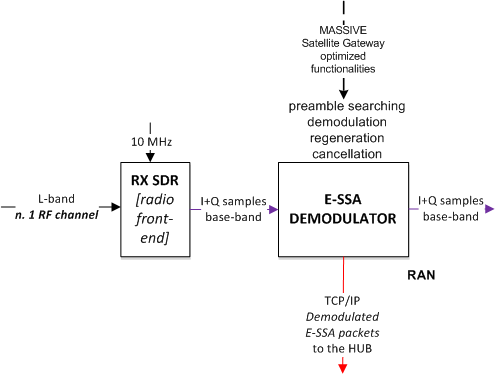
Focusing on the gateway side, the main functionalities and architecture are condensed in the following:
Plan
- The first phase includes the definition of use cases, scenarios and requirements and is completed by the solution assessment and the architecture design;
- The detailed design of the solution and SW development phase compose the second phase: during that, the envisaged technical innovations with regard to the state-of-art protocols and solutions are considered in order to enhance the currently available E-SSA test-bed;
- The final phase includes the validation of the solution by means of test procedures to be performed on the MASSIVE test-bed previously set up with the HW included in the MASSIVE kit-list.
Current Status
The project activities have been completed with the finalization and acceptance of the validation phase.