
PAGE CONTENTS
Objectives
The objective of the activity is to develop a phased array antenna, suitable for low Earth orbit missions on CubeSat and small satellite platforms. The antenna allows directed communication in Ka-Band, with separate apertures provided for transmitting in the 17.7 to 20.2 GHz and receiving in the 27.5 to 30.0 GHz range. The design is highly modular, with individual tiles of up to 1U. The antenna can either be integrated “as is” on the satellite or used as “blueprint” and adapted as required me meet specific mission needs. For ease of integration, antenna hardware breadboards and a generic software stack for beam‑steering are provided. All hardware is designed using commercially available components and standard manufacturing processes.
Challenges
Ka-Band frequencies are used terrestrially, e.g. in upcoming 5G networks; this motivated various semiconductor manufacturers to provide “beam former” chips in this frequency range. In turn, this allows to implement highly integrated, compact, and power efficient phased array antennas. However, there are only very few chip solutions that match the specific frequency plan on a satellite, and thus finding the right combination of components and matching them with a wide-angle antenna element is challenging.
System Architecture
The antenna is implemented as a flat panel, consisting of an antenna element layer, cold plate, beam former layer and mounting plate, with all components integrated into the stack-up (see figure).
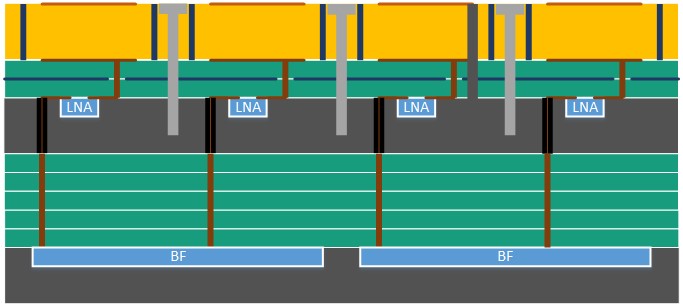
Each array is composed of a configurable number of antenna elements, with 4 antenna elements controlled by one highly integrated beam former IC. Optional amplifiers are used in between antenna element and beam former for improved G/T and EIRP performance. Distributed combiner/splitter networks connect the beam former to the RF interface connector; no up- or down-conversion is integrated, for maximum compatibility with the satellite’s communication system.
Plan
The project is structured into 6 main work packages:
- WP1000: Technical Specification
- WP2000: Select Baseline
- WP3000: Breadboard Design
- WP4000: Implementation
- WP5000: Verification
- WP6000: Outcome Assessment
Work packages are mainly executed in sequence, with key milestones at the end of each WP.
Current Status
Project kick-off was in April 2024 and the activity is expected to run 30 months, until October 2026. Finalised specification and baseline design are expected in early 2025. This is followed by several prototype hardware builds in 2025 and an extensive testing campaign in 2026.
Related Links
Companies