PAGE CONTENTS
Objectives
This project uses enduring unmanned air-stations as an intermediary downlink from LEO/MEO/GEO satellite to ground using high data rate laser links.
The air-ground link uses a narrow-beam RF over the last few kilometres and a lower data rate since the air-stations remain fixed over the ground infrastructure.
Overall objectives:
- Complete a prototype and demonstration of optical links between orbital and airborne elements, demonstrating the tracking and acquisition capabilities of the system and the successful data relay that is the backbone of the service.
- Identify and approach key partners to ensure systems can be produced at scale.
- Validate the operational approach and any licence/ permits required.
- Identify individual customer needs to develop attractive custom-made offers.
Challenges
Free space optical communication is highly susceptible to atmospheric effects. Clouds, turbulence and attenuation can severely affect the viability of optical links. Optical ground station networks propose to mitigate these issues through high spatial diversity. While diversity reduces the probability that all ground stations are obscured by cloud simultaneously, it results in a large network of sites with low utilisation. Also, it does not guarantee a near 100% link availability, especially at high latitude locations, and may give high latency. Uninterrupted communication with satellites in highly inclined orbits at high latitudes requires links that bypass the clouds.
System Architecture
This data downlink service entails the provisioning and supply of:
- satellite laser terminals,
- air-stations using enduring air systems,
- airborne optical transceiver payloads,
- operational support for continuous service, and
- associated ground infrastructure and connectivity
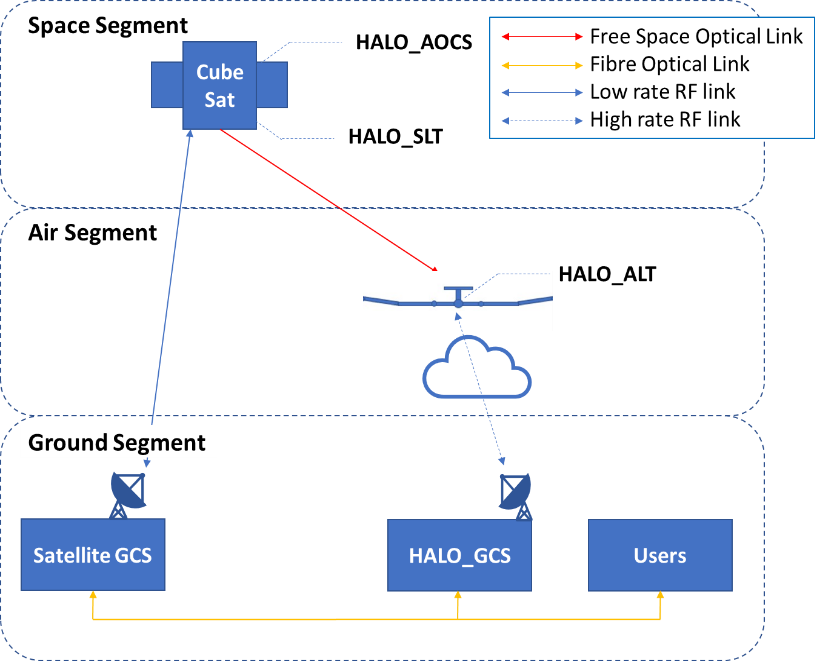
Figure 1 – Concept diagram.
Archangel have a long history with enduring flight operations, including HAPS (High Altitude Pseudo-Satellites), MALE (Medium Altitude Long Endurance) and HALE (High Altitude Long Endurance). The Archangel team have supported unmanned air activities on six continents.
The baseline operation of the HALO system during a single pass is illustrated as shown in Figure 2 below.

Figure 2 – Sequence of operation from the perspective of the transmitter. TX: Transmitter, RX: Receiver.
From the above figure:
- A pass is scheduled and arranged with the user.
- The terminals establish a line-of-sight link for and begin mutual tracking.
- Data is transmitted from the SLT and received by the ALT.
- During data transfer each terminal must track the other to maintain the link.
- Above steps continue until the end of the pass.
Plan
The key elements to be developed in the project phases are:
- Technology Phase: Breadboards and engineering models for the laser transceivers and the AOCS.
- Product Phase: EQM/PFM (sub-products) for the laser transceivers and high performance AOCS
- Demonstration Phase: Satellite Launch, in-orbit demonstration, data transport service provision and operations.
Current Status
The project has completed a partial (1 out of 2) Critical Design Review.
Related Links
Companies