
PAGE CONTENTS
Objectives
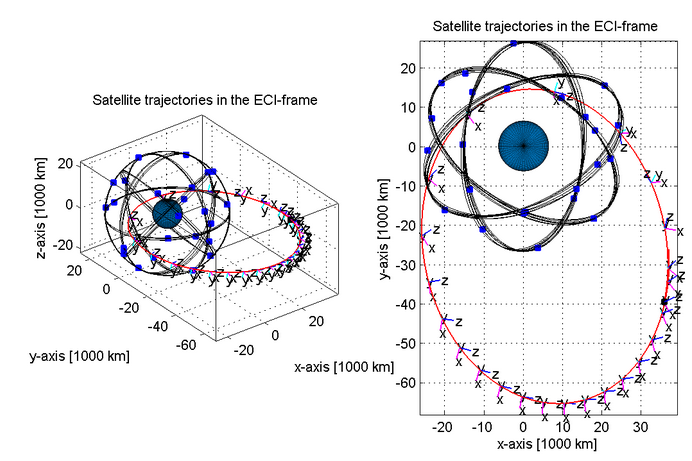
For standard CP telecom satellites, the duration of the GTO-to-GEO transfer is typically in the order of 1 week only. Since continuous ground coverage is a standard requirement, this means that ground-based orbit determination is considered received “free-of-charge”, and there is thus no cost incentive to implement on-board GNSS.
With the introduction of all-EP satellites such as OHB’s Electra, the attractiveness of on-board GNSS comes into a new light. All-EP satellites will have GTO-to-GEO transfer times in the order of 200 days, continuous thrusting, and a continuously changing attitude. Combined, this translates into a significant effort for ground-based orbit determination.
The attractiveness of a GNSS implementation on-board is obviously significantly enhanced, if the system can perform well also during the operational phase in the geostationary orbit. Finally, the mass and cost of the system must be as low as possible in order to justify its implementation on board.
The overall purposes of this study have been to demonstrate the following:
- To evaluate the potential performances of a GNSS Rx during a representative low-thrust GTO transfer and also in the GEO
- To define the GNSS architecture, including optimum antenna placements on the spacecraft
- To establish the cost-effectiveness of such a system versus current ground-based orbit determination systems
Challenges
The key challenges of the project are related to the strongly varying visibility conditions of the GNSS satellites and the orbit determination/orbit propagation precision required to perform meaningful collision avoidance manoeuvres during EP thrusting.
Plan
The project has consisted of three major milestones: 1. A preliminary review at which visibility conditions for various GNSS constellations and transfer scenarios have been simulated. 2. A mid-term review, where the performances of the AOCSW navigation filter have been demonstrated. 3. A final review where final simulation results have been compared to test results from a real-time test bench.
Current Status
The study has been successfully completed in December 2015. No further activities are planned.