
PAGE CONTENTS
Objectives
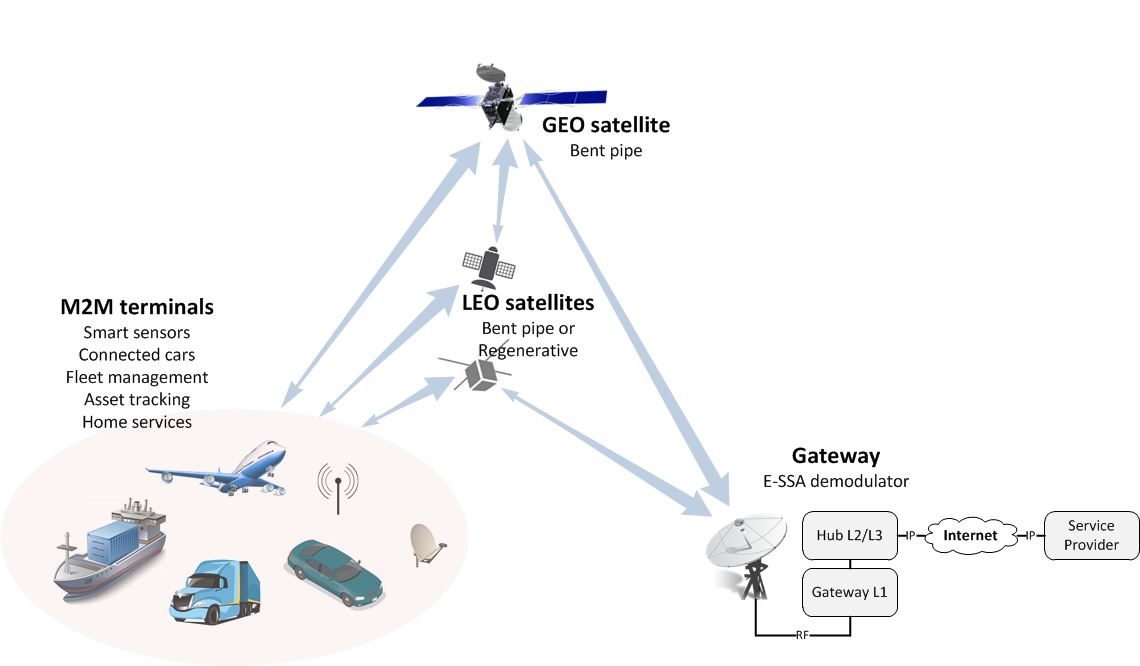
The GEMMA project concerns the design, development and demonstration of innovative gateway and user terminal prototypes able to support and provide M2M services in either geostationary or non-geostationary scenarios characterized by user mobility and high Doppler and exploiting the aid of an ad-hoc Forward Link designed in the frame of the project.
The main objectives of the activity are:
- Based on the relevant state-of-art, to design a new forward link air interface enabling solutions that minimize the M2M terminals’ cost, power consumption and computational complexity.
- Envisage innovative solutions in a gateway prototype able to establish synchronization and detection with M2M terminals characterized by low cost oscillators and operating in systems targeting M2M application with user mobility as main target operation scenario.
- To demonstrate the developed solutions in a representative laboratory environment.
Challenges
The main challenge of the project is to support bi-directional M2M services via low-cost user terminals (i.e. with low EIRP, low quality oscillators and low complexity) in a difficult environment like the satellite communications one, characterized by huge distances and huge Doppler (for LEO scenarios).
Due to the preciousness of the satellite resources, the dedicated bandwidth must be exploited in a very efficient manner, allowing to serve the maximum possible number of user terminals.
A further challenge is coming from the mobile nature of the main target applications. Mobility, in fact, brings with itself potentially strong fading.
System Architecture
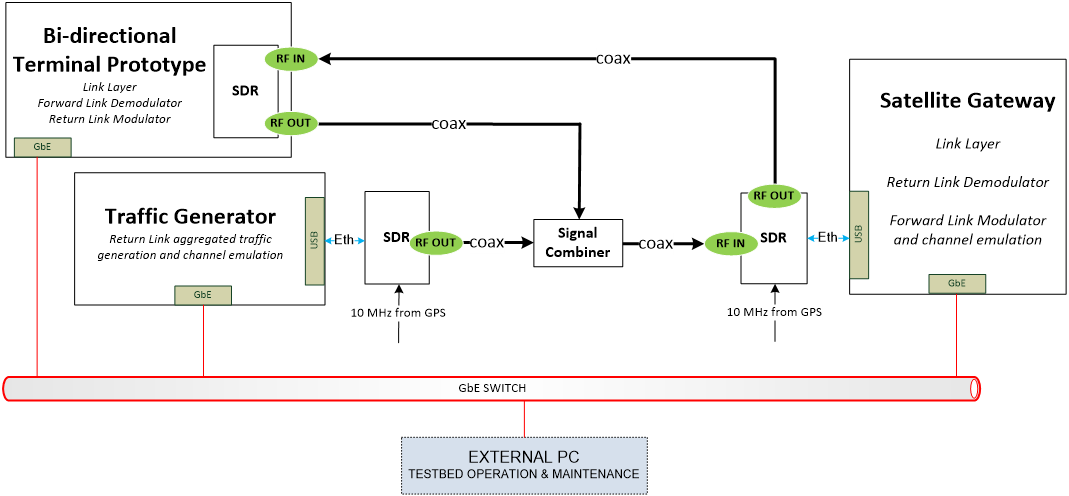
The system designed, developed and demonstrated in the project is a testbed consisting in three main components:
- Gateway
- User terminal prototype
- Traffic generator
The gateway implements both a E-SSA-based demodulator (return link) in charge of receiving messages from a population of terminals and a transmitter able to send data to terminals through the ad-hoc forward link air interface.
The traffic generator produces aggregated traffic, allowing tests in realistic conditions, emulating packets coming from a huge population of terminals. It is also able to modify the generated traffic according to the signaling received (via TCP) from the gateway.
The user terminal prototype implements a simple tx chain for asynchronous transmission and a rx chain allowing to demonstrate the forward link air interface performance.
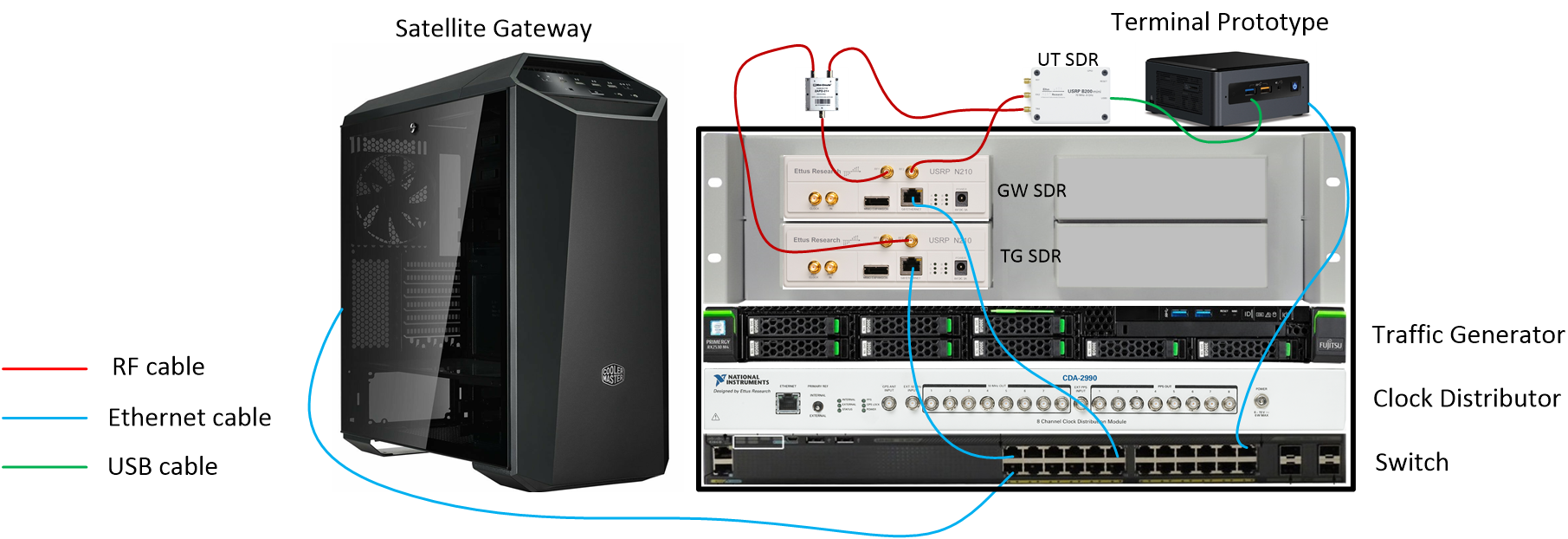
The testbed is based on SDR technology, allowing SW implementation of all the relevant modules. The architecture is provided below.
The following figure shows the testbed HW aspect. It is noted that the testbed can be used in conjunction with the MASSIVE (AO8871) testbed return link demodulator to enhance the performance of the return link.
Plan
During the first phase of the project (ending with the SRR milestone) the applicable scenarios and requirements were defined. Furthermore, a state-of-art analysis was carried out to derive the design guidelines.
The second phase (ending with the CDR milestone) dealt with system design and has produced the system air interface and the related reference performance.
During the third phase (ending with the TRR milestone), SW implementation was carried out and the testbed has been set up.
The last project phase is the validation and demonstration of the implemented testbed (ending with the FR milestone).
Current Status
The project has been completed. Tests have been successfully executed and the testbed features have been demonstrated to ESA.