PAGE CONTENTS
Objectives
The objective of Foresig is to develop a testbed to simulate the performance of a high-throughput SatCom system operating in the Ka-band for the user links and Q/V-band for the feeder links. The SatCom system covers Europe and has by default six gateways located in different parts of Europe. The system includes a Channel Assessment System (CAS) that estimates and predicts tropospheric attenuation, including precipitation, clouds and atmospheric gases. The input data to the CAS are Numerical Weather Product (NWP) data from ECMWF and weather radar data from the Norwegian Meteorological Institute (MET) and OPERA. In addition, user terminal data from THOR 7 and data from several beacon receivers are used to verify the accuracy of the predictions. Based on this information, the link quality can be estimated and predicted for all the links of a SatCom system.
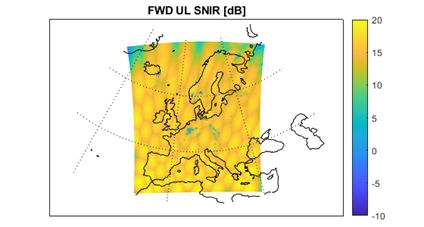
The output from the CAS is used by a Propagation Impairment Mitigation Technique (PIMT) module to optimise the performance of the SatCom system in terms of data throughput, service availability and user terminal energy consumption. The PIMTs included in the testbed are smart gateways (SGWs), ACM and reconfigurable antennas.

In additions, the reduction of energy consumption user terminals can gain by using forecasts is estimated, provided that transmission of data can be delayed up to 12 hours. Analyses of the results from the simulations give an indication of the gain that can be obtained in a real high-throughput SatCom system using PIMTs and channel predictions.
Challenges
Several challenges are related to the data to be processed:
-
Large data files make data transmission, storage and computation challenging.
-
Combining heterogeneous data sources different spatial coverage and resolution, and different temporal resolution, to predict attenuation.
-
Lack of ground truth data for estimated tropospheric attenuation, making optimisation of the models and evaluation of their accuracy challenging.
Other challenges are related to the mitigation techniques, e.g.;
-
Develop intelligent PIMTs using channel predictions with the temporal resolutions available from the APIs.
-
Assessing the actual benefit for SatCom operators implementing the system.
System Architecture
The figure shows the architecture of the testbed.

-
DS1: The data set DS1 consists of NWP data from ECMWF, weather radar data from MET and OPERA, user terminal channel quality data from THOR 7 provided by Telenor Satellite, and beacon data from several receiver located in Norway.
-
CAS: The Channel Assessment System uses DS1 to estimate and predict the tropospheric attenuation for a fixed grid covering the service area for all frequencies of the system. The results are saved in a new data set DS2.
-
DS2: The data set DS2 contains attenuation estimates (nowcast) and predictions for the coverage area. The nowcast data are used in the SatCom system simulator to simulate the communication, and the predictions are used by the Propagation Impairment Mitigation Techniques (PIMTs).
-
SatCom system: The operation of the SatCom system is simulated, using the input from DS2. The results are end-to-end SNIR values, together with other scenario specific results.
-
DS3: The results of the SatCom system simulator are stored in data set DS3.
-
Analysis: DS3 data are used to do statistical analysis of the performance (throughput, availability, energy consumption). The results are stored or visualised.
Plan
The project consists of six outputs:
-
SOTA and design of the Channel Assessment System
-
Design of the SatCom system testbed
-
Implementation of the Channel Assessment System
-
Implementation of the SatCom system testbed
-
Execution of the SatCom system testbed and analysis of the performance
-
Final reporting, roadmap and conclusions
Current Status
The final deliveries containing the software package and final reports were delivered to ESA before the summer 2023. The official end date of the project is planned for late 2023.