
PAGE CONTENTS
Objectives
The EUFRATE project focuses on leveraging Field Programmable Gate Arrays (FPGAs) to develop adaptable, reliable, and cost-effective solutions for mission-critical applications, particularly in space missions and satellite communications. The project emphasizes several key objectives:
-
Flexibility and Reconfigurability: Utilizing reconfigurable FPGAs, the project aims to enable in-orbit updates and error correction through dynamic partial reconfiguration (DPR), essential for adapting to evolving mission needs without physical access to hardware.
-
Dependability: By employing commercial-off-the-shelf (COTS) FPGAs, the project seeks to ensure system reliability in harsh environments, using innovative error correction and fault tolerance techniques to maintain operations even in the event of hardware failures.
-
Cost-Effectiveness: The project balances custom FPGA designs with the practicality of COTS FPGAs, delivering high-performance systems that are both efficient and economical.
-
Scalability: Developing a scalable FPGA-based computing cluster, EUFRATE targets large-scale computing applications, enabling flexible communication and efficient task distribution within the cluster.
-
Satellite Telecommunications: Advancements in satellite communications are pursued through Software-Defined Radios (SDRs) on FPGAs, aiming to create adaptable and cost-effective communication systems.
Overall, EUFRATE aims to address current and future challenges in space missions and satellite communications through innovative FPGA-based solutions.
Challenges
Key challenges encompassed both technical and organizational aspects. Technically, implementing Dynamic Partial Reconfiguration, ensuring seamless communication within the four-board cluster, and achieving the required number of Programmable Functional Units to meet stringent performance criteria were significant hurdles. Organizationally, coordinating efforts across three distinct workgroups and facilitating efficient information exchange posed challenges. Despite these challenges, both technical and organizational aspects were successfully managed, contributing to the overall success of the project.
System Architecture
The system architecture developed is centred around a highly scalable and resilient FPGA-based cluster, utilizing a mixed-mesh topology to optimize communication and performance. Figure 1 show the setup used for testing the system, with one tile implemented for the tests and the Spacecraft emulator as well.
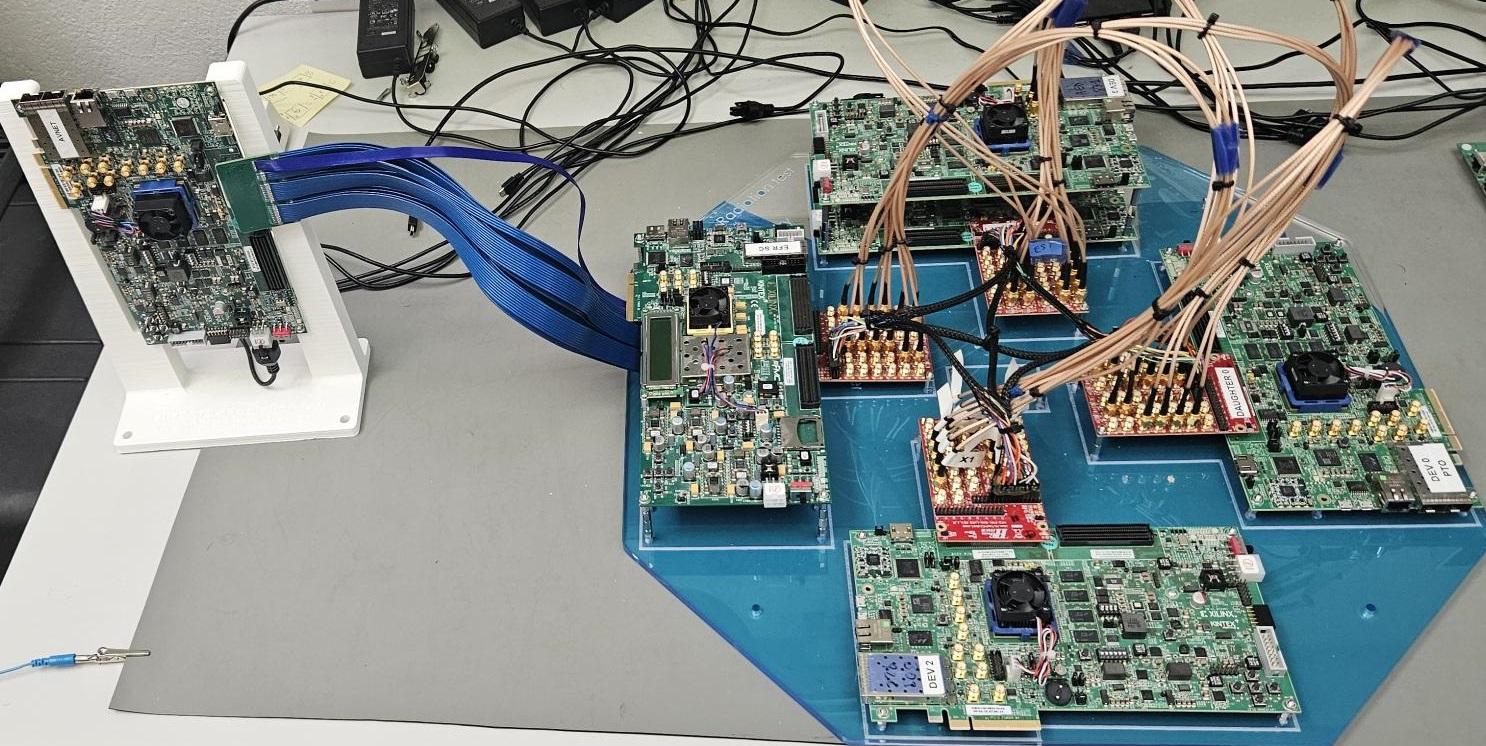
Within each tile, nodes are interconnected using a wormhole router with an XY-routing algorithm, facilitating efficient data transfer through packets. The Aurora protocol, chosen for its scalability and high data rate, handles communication within and between tiles, connecting a maximum of four FPGAs per node to minimize link requirements while maximizing the cluster’s scalability.
The architecture also includes a robust control system using I2C protocol, allowing nodes to operate as either Master or Slave, dynamically sending and receiving data as needed. This setup supports over 100 nodes, ensuring scalability and efficient management of the cluster.
Key components include the Blazes and BaByloN Processing System, featuring microprocessors dedicated to cluster management and application-specific computations, and the TMR Beacon Controller, which monitors the health of the nodes and triggers dynamic reconfiguration when necessary. The architecture also incorporates an array of PFU-based accelerators for handling parallel and compute-intensive tasks, and a DDR4 Memory Controller for managing external memory access. The combination of these elements ensures a robust, high-performance system capable of meeting the project’s demanding requirements.
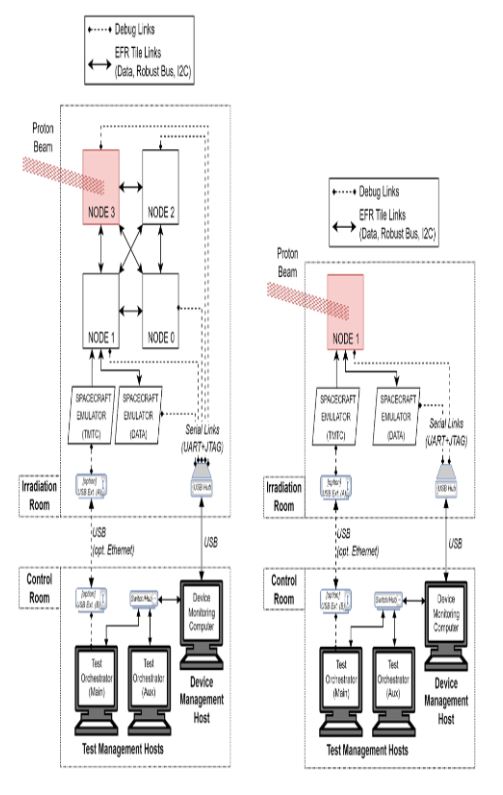
Figure 2 reports the high-level block diagram implemented for the testbed setup.
Plan
The project started on May 31st, 2021; the milestones outline key phases over 24 months. After the Kick-Off (KO), the project progressed through various reviews, including the System Requirements Review (SRR), Preliminary Design Review (PDR), Critical Design Review/Test Readiness Review (CDR/TRR), and the Test Review Boards (TRB). The project concludes with a Final Review (FR) and Final Presentation (FP).
Current Status
The project is successfully completed. The Final Review and Final Presentation have been concluded, marking the end of all planned activities. The design has been finalized and validated through comprehensive radiation tests, which yielded positive results. These tests confirmed the project’s objectives, demonstrating the effectiveness of the proposed solutions. All milestones have been achieved, and the outcomes align with the initial goals, showcasing a robust and reliable design.