PAGE CONTENTS
Objectives
The main initial study objectives were as follows:
- Investigate feasibility of deploying very small (<100kg) spacecraft into geostationary orbit to provide a broad range of both existing and new telecommunication services.
- Include recent developments in launch/insertion, platform technology, payloads
- Assume Telecommunication services implemented (launched) by the start of 2024
- Assume a total mission lifetime of 4 years or less (including Transfer)
- Responsible/safe behaviour in GEO (e.g. RF interference, EOL, Collision Avoidance)
- No ITAR or EAR constraints
- Include a workshop at ESTEC to: (1) Present initial ideas on missions (including a recommended mission), critical issues, enablers and seek feedback; (2) Select a mission application to take forward for further detailed design
- Include economic considerations with regards to the selected mission i.e. shorter development cycles, alternative quality/PA approaches, alternative redundancy schemes at satellite and mission level and insurance considerations
- Identify main capability gaps versus current capabilities
- Identify developments necessary to realise the selected mission, including those leading to a common platform design that could serve a variety of telecommunication missions.
Two of the above objectives were refined as the study progressed, i.e. in particular the spacecraft mass was increased to <300kg, whilst the total mission lifetime was increased to 5.25 years.
Challenges
The mission requirements impose severe constraints on the payload and platform, which drive the mass, power and cost of the payload and spacecraft (limited by the fundamental limits of a very small satellite), in particular:
- Payload Receive (whole area coverage area simultaneously)
- High Availability (a target of 99.9%)
- 100% Duty Cycle
- A standard GEO orbit (high DeltaV/year for station-keeping within the allocated box, enhanced reliability to prevent collisions, EOL graveyard, etc.)
- Min 5 year lifetime
Global payload coverage is not possible via a single very small GEO satellite, so a compromise Ku-Band IoT mission with a smaller regional coverage area was developed.
.
System Architecture
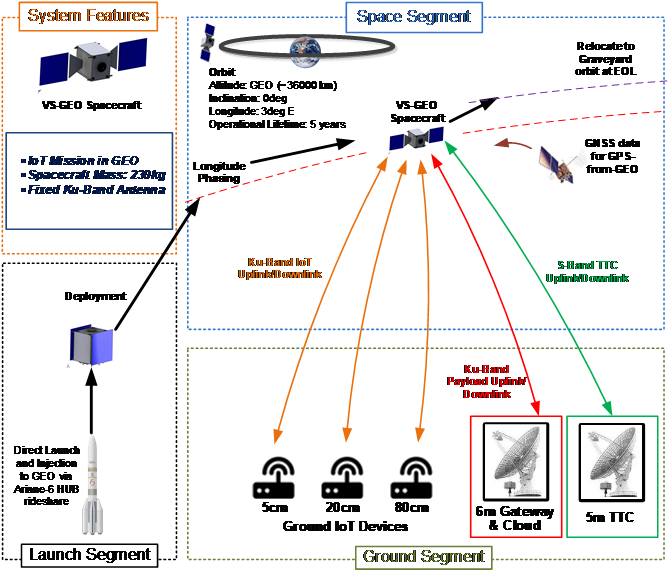
The mission/system architecture (shown in the Figure below) was iterated throughout the study, in line with the overall concurrent mission design iterations, and including the overall lifetime of the proposed mission, from its launch and deployment, up to safe de-orbiting.
The mission architecture consists of a launch, space and a ground segment. The launch segment covers the reference launch on Ariane 64 via a HUB rideshare. The space segment comprises the VS-GEO spacecraft (which is the focus of the mission and space segment design). The ground segment consists of Users (Ground Based IoT devices), plus a Ku-Band Gateway ground station (diameter 6m) for the payload, and also an S-Band TTC ground station antenna with 5m diameter.
Plan
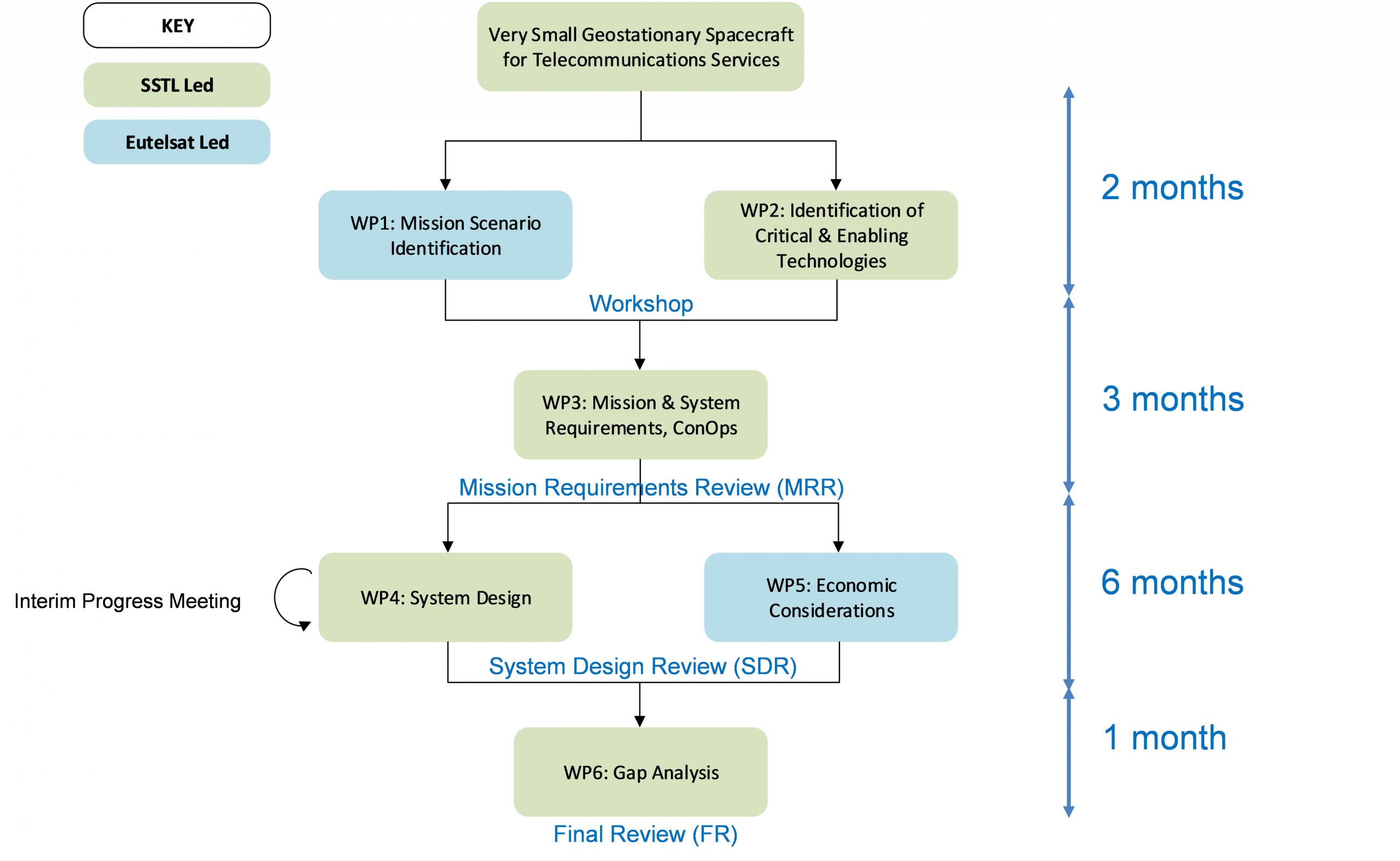
The Figure below summarises the project phases and milestone reviews.
Current Status
The Final Report has been delivered and the project is close to completion (pending the Final Review and the Executive Summary)