PAGE CONTENTS
Objectives
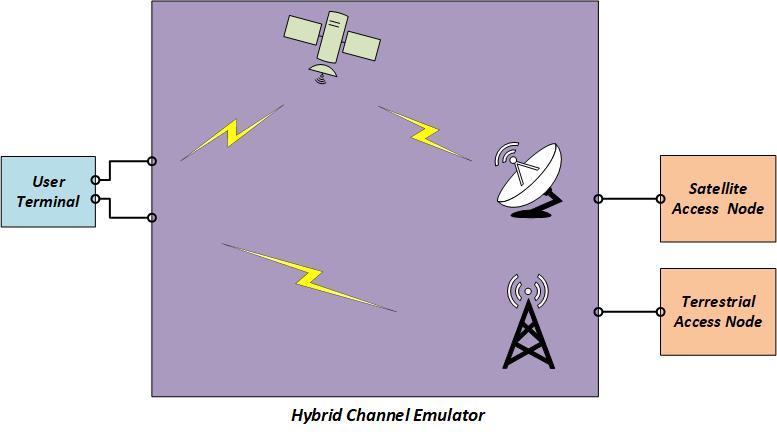
The project objectives are the development and validation of a single solution capable of emulating the radio propagation conditions of two bi-directional 5G carriers (satellite-satellite or satellite-terrestrial). This has the twin challenges of providing an emulator that accurately models the dynamics, and tightly controls the channel impairments, of a wide variety of scenarios, and one that covers frequency bands spanning nearly 30 GHz.
Challenges
Processing large bandwidths requires FPGAs with large resource capabilities. Efficient digital processing design is critical to minimize device FPGA costs.
Given the large bandwidths and wide range of frequencies being handled, the introduction of unintended signal distortion by the channel emulator is a challenge that requires careful design and built-in compensation techniques.
Synchronizing all elements of a 5G network to agree on timing and position of satellites and user equipment in high mobility scenarios.
System Architecture
The proposed solution for the Hybrid Channel Emulator (HCE) is based on three components:
-
An enhanced version of SPCI’s RLS-2100 radio link simulator product.
-
An integrated multi-channel FR1 up and down-converter unit (FR1 UC/DC), which supports frequencies up to 7.125 GHz that cannot currently be supported internal to the RLS-2100.
-
A multi-channel FR2+ up and down-converter unit (FR2+ UC/DC), which supports frequencies in the mmWave band plus the satellite Ku/Ka-band frequencies.
Plan
There are two major development streams. The first stream includes the development of the IF version of the hybrid channel emulator (HCE) together with FR1 up/down converters (UC/DCs). The second stream is the development of FR2+ UC/DCs, where FR2+ is the 3GPP FR2 frequency band (up to 30 GHz) plus the Ku and Ka satellite bands. The outputs of the streams are integrated and tested to provide the final documentation, hardware and software.
A contract extension was granted to develop means for the RLS-2100 to provide ephemeris information to a gNodeB or intermediate entity such that 3GPP-defined messages SIB19 (SIB31) and SIB32, as appropriate, can be transmitted.
Project Milestones:
Preliminary Design Review – July 2021
Final Design Review – September 2021
Critical Design Review – January 2022
Test Readiness Review – June 2022
Project Extension (CCN) – June 2023
Final Review – November 2024
Current Status
The project is complete, and the Hybrid Channel Emulator (HCE) is a commercialized product now, and in the hands of users.
The RLS-2100 Radio Link Simulator, a key component of the HCE, solution is a versatile hardware-in-the-loop tester, allowing users to efficiently test a wide range of terrestrial and non-terrestrial communication scenarios. When applied to 5G testing, the RLS-2100 provides industry leading capabilities, to verify end-to-end communication link performance in the lab.