PAGE CONTENTS
Objectives
The project has created an integrated communication infrastructure to serve the needs of a distributed application devoted to large-scale and fine-grade diagnostics of civil assets, tracks and equipment constituting the national railway environment of a major country like Italy, for the purpose of smart predictive maintenance.
Macro-objectives of the Project are the following:
-
Characterize the properties of the distributed diagnostic application, its main entities in terms of sensors, data gathering nodes (LDU, local data units) and central data processing nodes (CDU, central data units). Derive requirements and KPIs for a communication infrastructure enabled to serve the application.
-
Model, specify, implement and test the communication infrastructure as a 5G network slice, encompassing both terrestrial and satellite access, for LDUs and CDUs. Reliability, resilience, physical/mechanical safety and cyber security are stringent and unavoidable requirements of the above-depicted communication infrastructure.
-
Enhance the latest 3GPP-compliant solutions with novel ad-hoc extensions to deal with orchestration and virtualization of both terrestrial and satellite resources, so as to offer to the diagnostic application a unified, integrated view of communication facilities, that can be invoked in a technology-transparent way, just specifying performance parameters when requesting transfer of diagnostic data between LDUs and CDUs.
Challenges
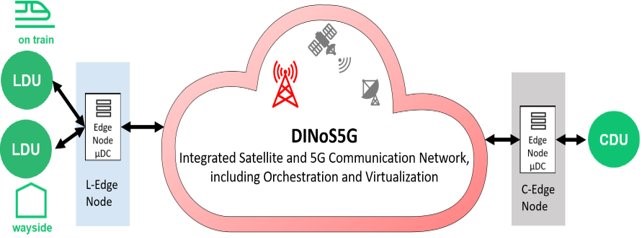
The Project trialled a system consisting in the integration of 5G terrestrial access, Satellite access and core 5G resources, under the umbrella of an orchestrator operational in a commercial 5G network. Integration is pursued by interfacing such orchestrator with satellite-specific management and control components, by suitable interventions on abstraction and virtualization.
The challenge has been to prove that the system is ready to be engineered and scaled up to meet the long-term operational needs of a national railway maintenance and diagnostics application and become the basis for a product business plan
System Architecture
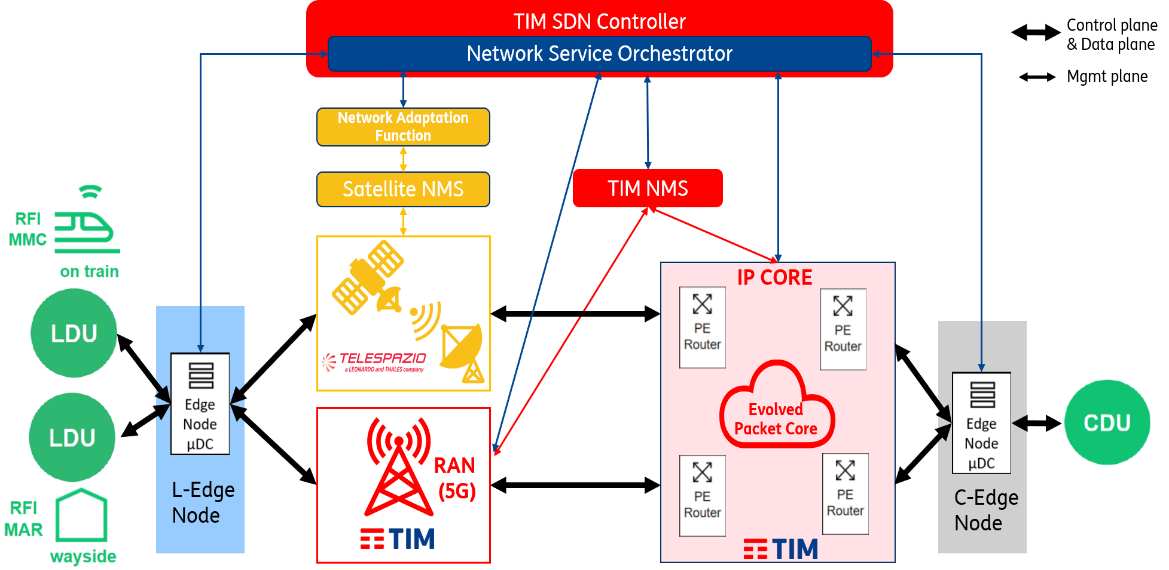
The DINOS5G system architecture is based on the integration in a seamless manner of 5G communications and satellite communications. Depending on whether the Application Nodes (LDUs, CDUs) are located and/or on requirements on data they have to transmit, they can use 5G access or satellite access. The challenge of DINoS5G is that access technology be hidden from the LDUs and from the CDUs by means of Edge Nodes (EN), of type L-EN (LDU-EN) or C-EN (CDU-EN) respectively, that take care of selecting the best suitable network access resources to satisfy runtime application requirements.
Key aspects of the Architecture are:
-
A unified communication platform for the Application Nodes.
-
Seamless integration of 5G RAN and Satellite RAN, with Application Nodes being unaware of the specific technology.
-
The concept of Edge-node and its internal architecture, as the means to implement network abstraction from the viewpoint of the Application Nodes.
-
Integration of satellite communication functionality within the Orchestration and Virtualisation framework of 5G, by means of an Adaptation Function.
Plan
MS1: completion of requirement definition and architecture specification
MS2: overall system integration: technological solution for 5G and satellite access interfaces with wayside sensor network and on-board diagnostic equipment.
MS3: trial set-up and execution.
MS4: trial validation, business model construction and business plan delivery.
Current Status
Integration of network resources from satellite and terrestrial infrastructures has been achieved, in a way that envisioned hybrid communication paradigm can complement 5G terrestrial access with satellite one to guarantee high End-to-End performance, such as availability, quality and continuity as well.
The integration has been achieved at the transport level thanks to a novel introduced element which is the Edge Node, being able to configure and use both access networks to properly address application-level traffic requirements. Intelligent hybrid 5G/Sat resource management has been implemented.
The Edge Node operates as a junction point between three domains, namely the application layer, represented by the LDUs and CDU, the access networks’ data planes and the End-to-End networks’ control planes, in the role of hybrid Terrestrial/Satellite NSO. Such position allows this former to optimize the traffic steering procedures to manage application data traffic as well as configuring both networks accordingly.
The DINoS5G communication platform has shown its potential to operate in heterogeneous scenarios with different terminal devices. The process of network re-configuration is managed close to the terminal nodes, so it is possible to install Edge Nodes very close to LDUs (even in a bundled solution) and let them operate in a way which is completely transparent to the data collection logic.
DINoS5G benefits are in terms of achieved application-level performance, as well as an increment of the flexibility of the target diagnostic platform, allowing dynamically management and prioritization of exchanged data flows.
DINoS5G platform, being decoupled from the data plane, can be adapted to use cases such as smart cities, smart grids management, autonomous driving.