PAGE CONTENTS
Objectives
The objective of this study is to examine the application of OBFN to satellite reconfigurable antenna systems and identify the benefits of this technology. This is carried out in the following manner:
- Identification of the needs for OBFN and how it would fill the gap left by conventional technology solutions.
- The identification of missions that would greatly benefit from the inclusion of re-configurable antenna schemes.
- Identification of applicable OBFN technologies with a selection of the preferred technology based on a set of agreed criteria.
- A detailed assessment of the selected technology against the earlier identified mission requirements.
- A definition of the development strategy for the chosen OBFN technology, and analysis of the commercial benefits of this technology.
The overall logic of the study is shown below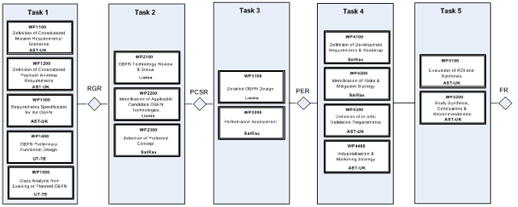
Challenges
For the proposed designs, there are several technological challenges that need to be addressed before a fully functional OBFN can be fabricated. The most important challenges include
- Power consumption,
- Coupling two different waveguide technologies together, i.e. coupling InP to TriPleXTM,
- Fabrication of a full wafer sized TriPleXTM chip,
- Fabrication of a large InP chip.
Size of Optical Chip
Plan
The study addresses each Task1 to 5, and associated Sub-tasks, according to the Study Logic:
- Task 1 – identifies satellite mission requirements, with emphasis on those aspects impacting on the antenna design.
- Task 2 – commences with a review of the current status and planned development of OBFN technology. A trade-off is then carried out, and a preferred OBFN concept selected.
- Task 3 – involves a detailed design of the OBFN based on the preferred concept from Task 2, and with application of the BFN requirements derived in Task 1.
- Task 4 – the definition of the OBFN development approach with provision of a development plan, a technology Road Map and identification of risks with mitigation strategy.
Task 5 – evaluation of the commercial benefits with an indication of the corresponding Return-on-Investment.
Current Status
Project has been completed. A wide range of potential mission scenarios were identified at the initial part of the study to derive a reference scenario for the optical beamforming.
The study has developed optical beamforming concepts that address this reference scenario. The study investigated nine different OBFN options and the pros and cons of each option was analysed. Two promising option were selected for further investigations.
Draft documentation was submitted on 30 June 2014.
Project was completed in July 2014.