
PAGE CONTENTS
Objectives
The objective of the Project is to identify, among commercially available MUX/DEMUXs devices, the technologies best suited for space applications and to test their optical performances resilience in typical space environment.
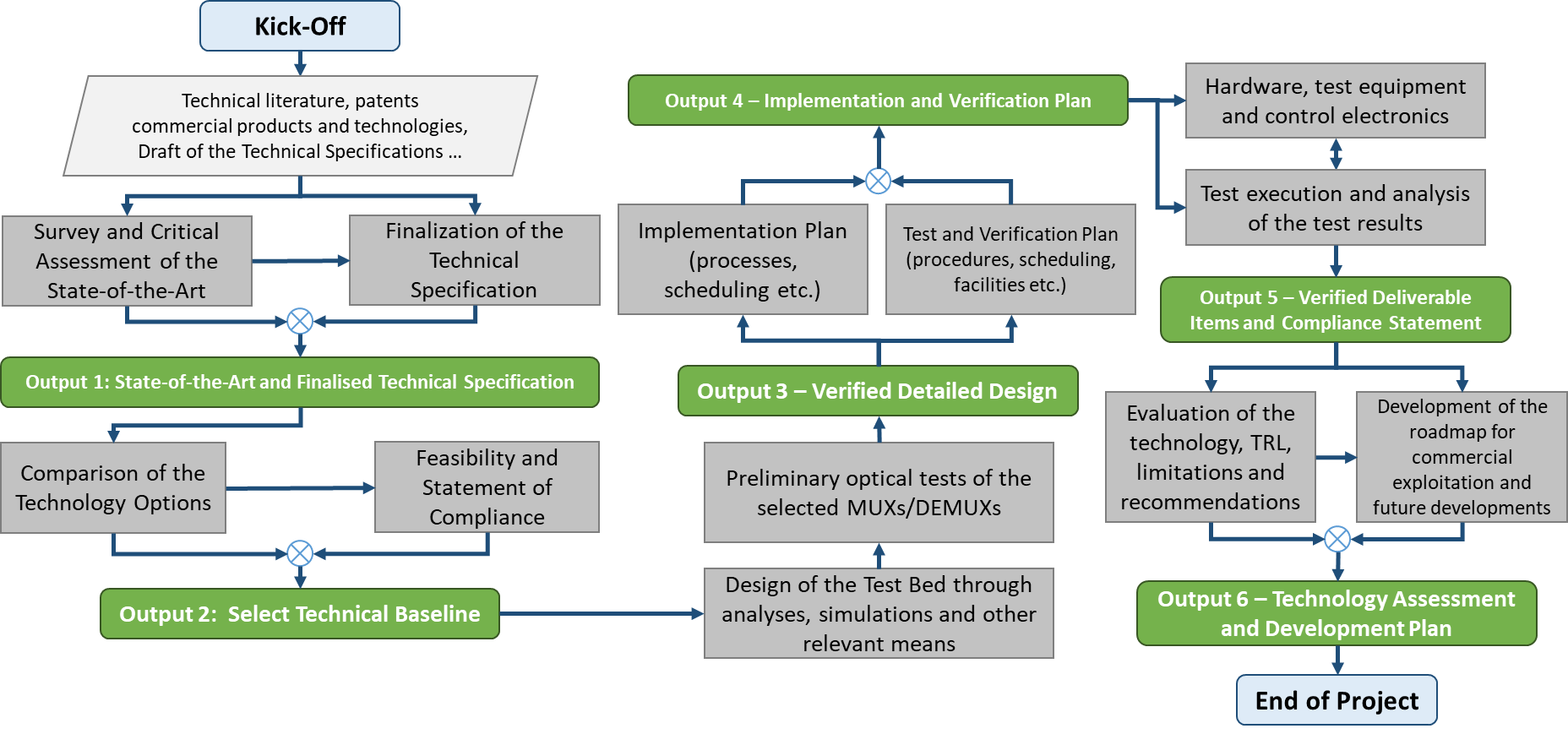
Conceptually, the Project can be divided in 4 steps:
-
A first one dealing with the survey of the state-of-the-art technologies currently available for terrestrial applications and their critical trade-off analysis for space applications.
-
After the purchase of the selected MUX/DEMUXs, they undergo a first optical test campaign, in order to better characterize their performances in normal operative conditions. The results of these tests are then used as nominal reference values to be compared with the performances obtained after the environmental test campaign.
-
Subsequently, the devices are tested through a series of mechanical and environmental tests. Depending on the specific test, the optical behaviour of the devices is also monitored during or after this test campaign. The final tests results will be compared with the performances obtained during the i optical test campaign.
-
Finally, the analysis of the obtained results allows to provide suggestions to the manufacturers to improve their performances and reliability and to determine which devices technologies are best suited to operate in real space environment.
Challenges
The main challenge of the Project is represented by the execution of an efficient test campaign that needs to provide insights about the MUX/DEMUXs reliability in typical space environment with the best possible quality. Ideally, for each detected performance degradation, the specific environmental/mechanical cause should be individuated, and possible solutions should be indicated and discussed with the manufacturers in order to pave the way for the implementation of MUX/DEMUX internal scheme modifications.
System Architecture
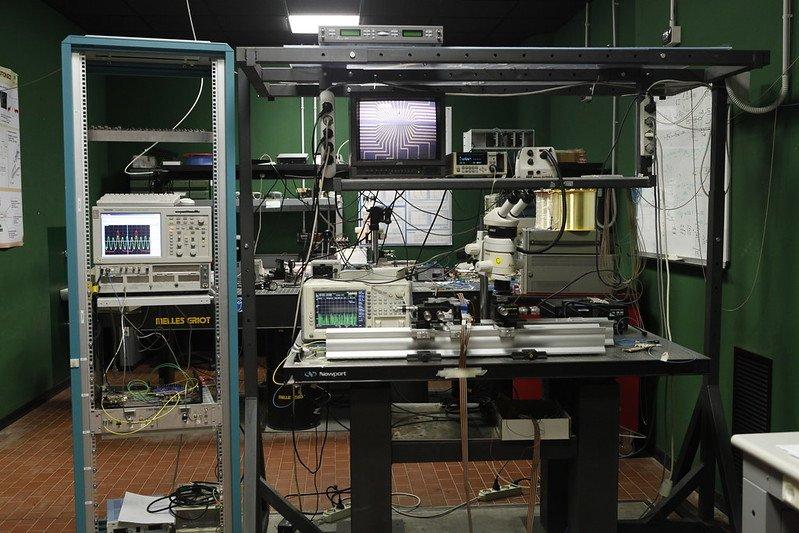
2 testing platforms are involved in the testing. The first one, located at the PoliCom Optical Communications Labs, is used for the preliminary optical test campaign and is equipped with:
-
Pattern generators and error detectors for Bit Error Rate measurements up to 25 Gb/s
-
Optical and electrical spectrum analysers
-
Digital sampling oscilloscopes with up to 40-GHz electrical bandwidth
-
Realtime oscilloscope with 33-GHz bandwidth operating up to 50-GS/s
-
Clock recovery from 1 Gb/s to 25 Gb/s
-
50-GS/s arbitrary waveform generator
-
Two DAC up to 100 GS/s with 35 GHz bandwidth and 6-bit resolution
-
E/O receivers up to 50-GHz bandwidth
-
Coherent receiver for 28 Gbaud transmission
-
Optical waveshapers, WDM multiplexers and filters.
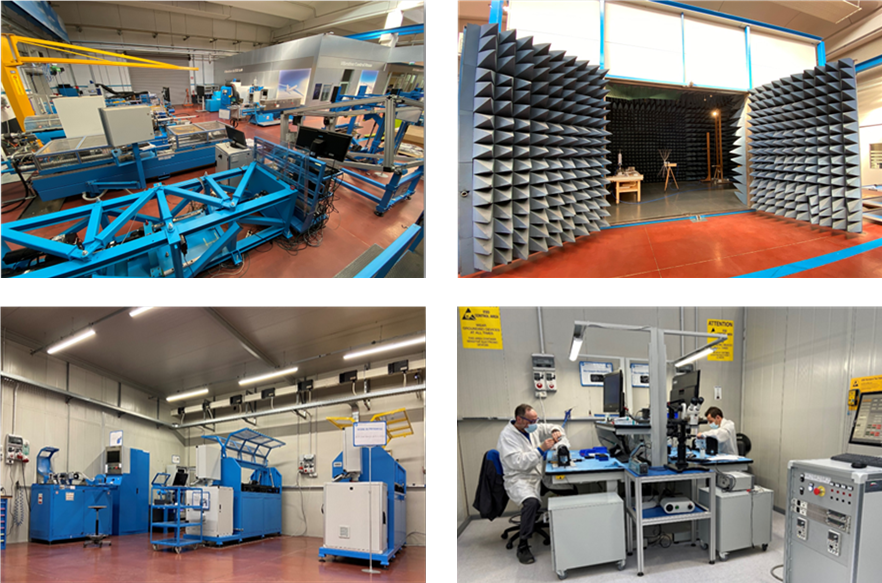
The second one, which includes the environmental and mechanical test facilities, the UMBRAGROUP/SERMS premises allow the execution of:
-
Environmental Test (Humidity, Salt Spray, Icing, Thermal Cycles up to 15°C/min)
-
Limit/Ultimate load Test
-
Dynamic load tests.
-
Fatigue Test
-
Endurance Test
-
Noise Test
-
Vibration Test
-
Operational shock and crash safety
-
Many others
Plan
The Project is divided in 6 technical work packages plus one for management and coordination activities (WP0). These are spread along all the duration of the Project.

-
During this period, 4 Milestones are foreseen:
-
MS1 coincides with the PDR.
-
MS2 is set at the end of WP2 activities.
-
MS3 covers the activities of WP3 and WP4.
-
Finally, upon the Agency’s acceptance of all deliverable items due under the Contract and the Contractor’s fulfilment of all other contractual obligations, the final Milestone MS4 is expected to be fulfilled by May 2025.
Current Status
The Project had its Kick off in December 2023. The Team is currently working on WP1: State-of-the-Art and Technical Specification Definition and WP2: MUX/DEMUX and Technical Baseline Selection activities.
WP3: Design of the MUX/DEMUX Test-Bed and Preliminary Optical Tests activities are due to start in May 2024.