PAGE CONTENTS
Objectives
ASTREA focuses on direct access of small terminals to GEO satellites in frequencies of the C, Ku and Ka-band, ensuring an affordable transmission service for IoT devices, with a bit rate up to some tens of kbit per second.
The expected outcome of the project is a complete prototype platform able to provide this service, including the design and prototyping of a very compact and economic terminal. The expected form factor of the commercial terminal is 20x20x5 cm and the objective of the project is to produce a prototype heading to those size thanks to the choice of suitable part numbers, including flat antennas.
Challenges
The main challenges are associated to a number of technical points to cope with, which shall be assessed and mitigated by the ASTREA project as for instance:
-
Ability of the terminal to lock on the FL with such a negative C/N with a short acquisition time
-
Frequency drift which the RL signal is received with, as E-SSA is particularly sensible
-
Possibility of implementing the terminal using low-cost FPGA
-
Terminal overall costs
-
Maximum number of simultaneous transmitting terminals due to OAED masks
-
Terminal antenna type and gain vs. terminal dimension
-
Frequency and bandwidth regulations
System Architecture
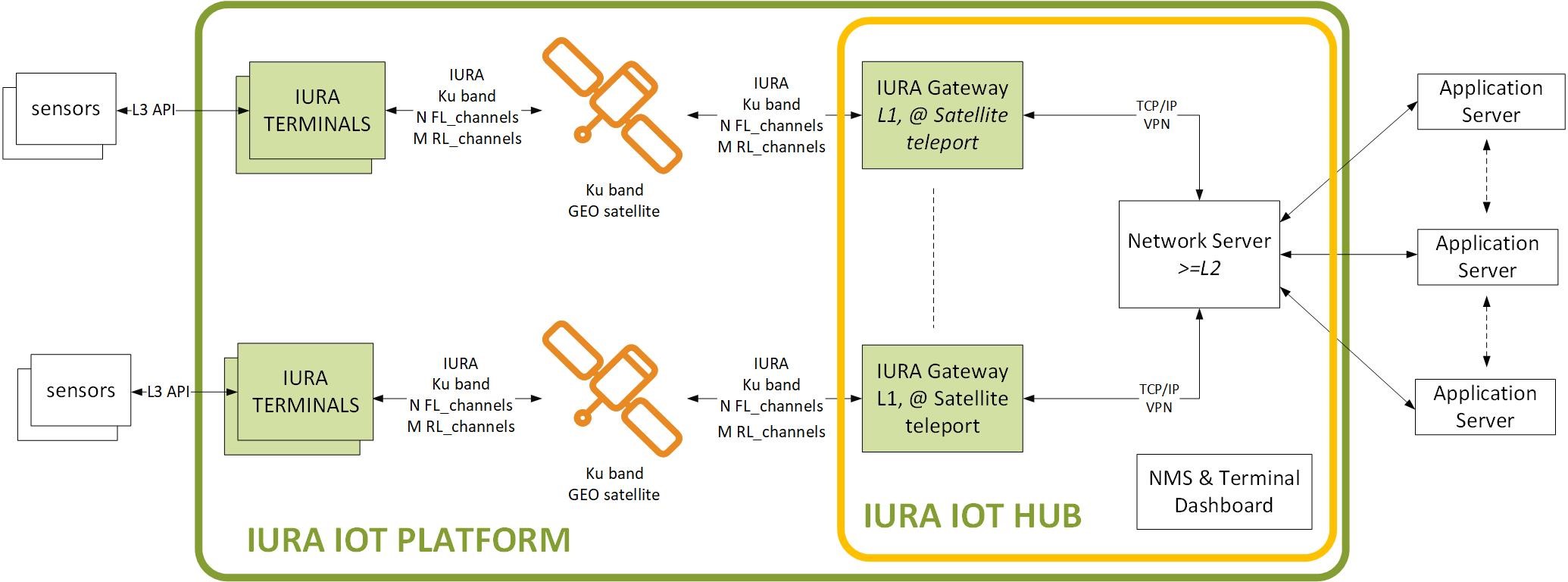
The main building blocks of the platform are:
-
IURA Terminals, the low cost IoT devices
-
IURA IoT Hub, which is composed of the IURA Gateway, the Network server and the Network Management Station (NMS) & terminal dashboard.
-
Geostationary orbit (GEO satellite) component, not part of the product.
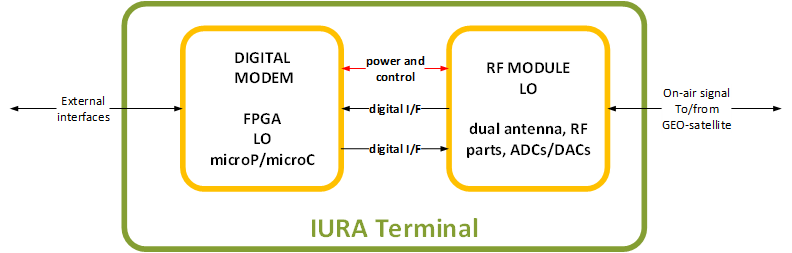
The IURA Terminal is composed of two main parts:
-
Radio frequency (RF) Module, bidirectional communication stage containing all the RF parts required to convert and manage the I/F digital samples to/from the operational frequency
-
Digital Modem, composed of three main parts: FPGA which implements most of the L1 DSP modules on both the FL and RL, microP/microC which hosts the L2 and above protocols (API and/or standard protocols for IoT) and the Local Oscillator.
The IURA IoT HUB is a “turn-key” solution as an evolution of the commercial product named Starfish HUB, a very compact and SDR-based element on a CPU/GPU-based HW platform. It is used to implement the modulator and receiver of FL/RL channels and the counterpart of terminals’ upper layer.
Plan
The project plan foresees a unique phase which includes the following milestones after the KO meeting (T0):
-
Preliminary Design Review (T0+3.5M)
-
Critical Design Review (T0+6M)
-
Software Verification Review (T0+13M)
-
Test Readiness Review (T0+15M)
-
Demonstration (T0+18M)
-
Final Review (T0+19M)
The planned total duration of the project is 19 months.
Current Status
With reference to the project Gantt diagram, the activities related to WP1100, WP1200, WP1300 and WP2100 are currently ongoing. They deal with consolidation of requirements, state of the art and regulations, system design and trade off analysis and preliminary design of the link layer, respectively.
The first milestone meeting, the PDR, is expected in February 2023.