PAGE CONTENTS
Objectives
Power Transfer within Space mechanisms, such as Solar Array Drive Mechanism (SADM), is in principle insured by a contact technology.
These components known as Slip Rings are of two types: Cylindrical and Pancake.
The project was aimed to develop an advanced cylindrical Slip Ring unit compatible with High Voltage bus operating at 400V to cover next generation of High Voltage – High Power Mechanisms. At this operating voltage, the growing demand to increase the power of spacecraft (>10kW) could be achieved providing several benefits. However, the slip ring design must take care of arc discharge phenomena during launch phase and overall spacecraft lifetime.
Therefore the objectives of this activity were to develop, manufacture and test a Breadboard Model in a relevant environment in order to demonstrate the outstanding electrical performances of this new product but also to assess the voltage margin defined by this advanced design.
Challenges
The main challenges of the development are related to :
-
the gas breakdown mitigation due to the operating voltage up to 400V. When the voltage exceeds 200V, the probability of arcing inside the Slip Ring increases dramatically. This phenomenon is maximized at the launch phase of spacecraft when Solar Array is deployed while vacuum level is not in the safe region (Pashen Law). Therefore, an advanced design is carried out to increase the voltage breakdown limit.
-
The temperature, the voltage polarity and the pressure range close to the High Voltage rings are significant parameters that influence voltage margin.
-
Transient effects (switching power/voltage/current) on the power bus that could generate overvoltage and electrical discharge
Dynamic resistance that shall remain as low as possible
System Architecture
The advanced cylindrical slip ring is composed of two main sub-assembly :
-
Rotor sub-assembly : the rotating part of the slip ring
-
Stator sub-assembly : the fixed part of the slip ring
The contact between stator and rotor is ensured by wire brushes, soldered at stator side on a PCB and preloaded to be in contact during all the life time with the track. Rings shape, brushes position and casing will be optimized to enhance electrical performances at high voltage.
Plan
Main project milestones are :
-
Milestone 1 on December 2020: Requirements review for the high voltage slip ring. The details of the architecture were studied and traded-off while considering electrical performances with a specific focus on voltage
-
Milestone 2 on July 2021 to reach the PDR level for the BBM. Based on 3D model including brushes, the slip ring design is optimized to enhance electrical performances to its maximum voltage range capability.
-
Milestone 3 : Completion phase in October 2022. This milestone covers the manufacturing, assembly, integration and testing of one BreadBoard Model in a relevant environment
Current Status
The BreadBoard Model proved to function within 400-500 volts (and 8A) from very low pressures (10-5mbar) to the most critical pressure values (around 1mbar), with a resulting transferred power of up to 40kW (10 forward and 10 return lines).
An accelerated life test highlighted outstanding HV performances without any arc discharge phenomenon, confirming our ability to increase the voltage bus of next spacecraft generation.
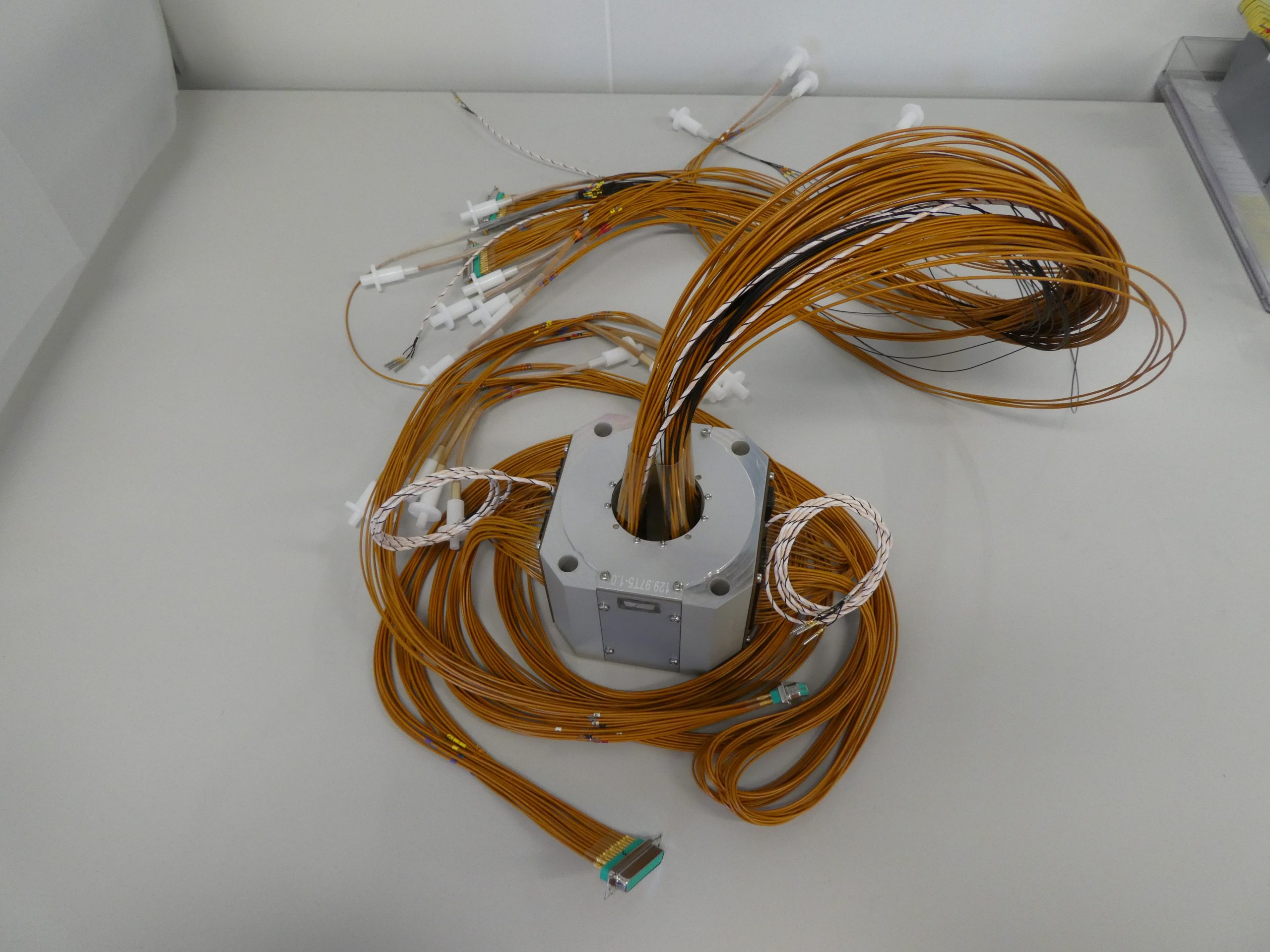
The project final review was held on September 26th 2022. The project is now completed.