PAGE CONTENTS
Objectives
The objective of ANCORSAT is to identify the 5G NR IoT technical requirements in various satellite network scenarios in LEO and GEO, to define specific virtual network functions – at layer-2 and above – that could comprise a satellite network slice, to design and develop an end-to-end testbed to demonstrate satellite IoT use cases for agile 5G network configurations, and to contribute in 5G definition of network slicing architectures.
ANCORSAT aims at the agile and efficient management of satellite network resources, in particular in the return link (connection to gNB on board satellite), but also the ground segment resources (gateway) in both, forward and return link, using several techniques, highlighting a new algorithm for radio resources management in the return link, using simulated annealing when there is congestion, and virtualization techniques in the ground segment (implementation in Virtual Machines).
Challenges
The key challenges in ANCORSAT include identifying and optimizing state-of-the-art technologies for satellite-specific IoT applications, as there are currently no off-the-shelf solutions designed for such use cases. This emerging field requires significant adaptation of existing 5G and IoT technologies to meet the unique demands of satellite networks, such as high latency, dynamic resource management, and seamless network slicing. The lack of readily available tools further complicates efforts to implement and test agile network configurations for satellite IoT services, highlighting the need for innovative, tailored solutions.
System Architecture
The 5G IoT Satellite network is compromised of three main blocks:
-
Radio Access Network
-
Transport Layer
-
5G Core Network
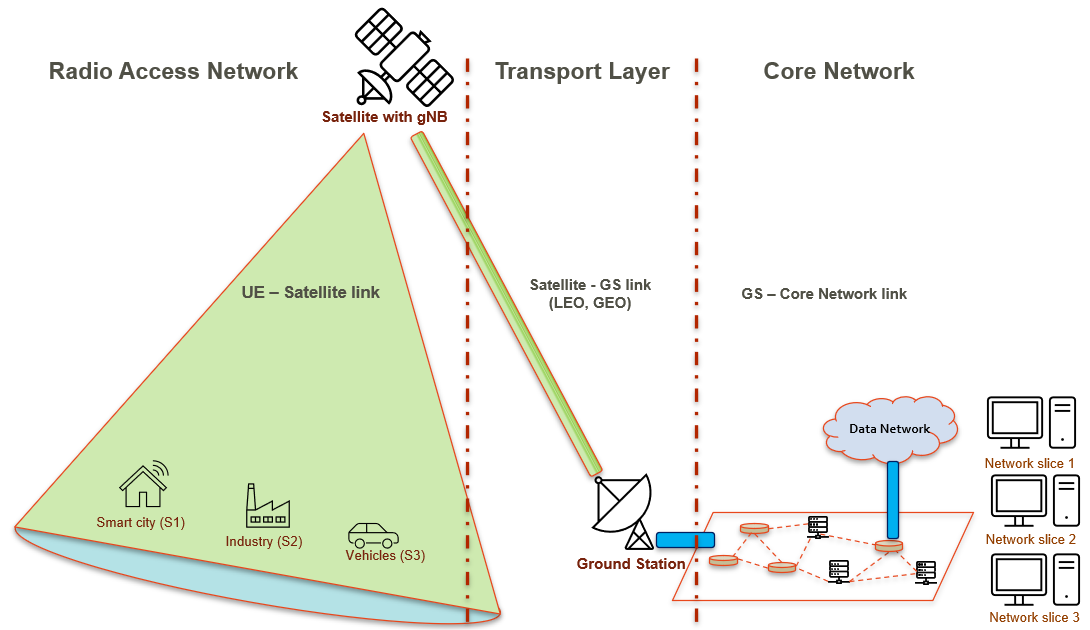
The ANCORSAT testbed was designed to introduce the concepts of network slicing, Network Function Virtualization (NFV) and open-source Management and Orchestration (OSM) within a non-terrestrial communication scenario for IOT devices. The testbed is running on an emulated environment using opensource tools for RAN simulation and the orchestration of the core network functions. The testbed environment is in addition fully customizable and able to support different NTN scenarios (LEO, MEO, GEO) and offers state of the art slice orchestration technologies with the introduction of the inter slice scheduler. The testbed includes the following virtual machines:
-
VM1: Running a simulated environment for the user segment This includes the traffic generator and the ISS.
-
VM2: Running a simulated gNB in regenerative mode and using NETEM for SATLINK simulation.
-
VM3: Running a ground station as modem service. Used for routing and traffic shaping us-er traffic based on network slice ID.
-
VM4: Running control plane NF’s.
-
VM5: Dedicated UPF to 3 network slices.
-
VM6: Dedicated UPF to 2 network slices.
-
VM7: Responsible for the monitoring, management and orchestration of the open5GS NF’s.
Plan
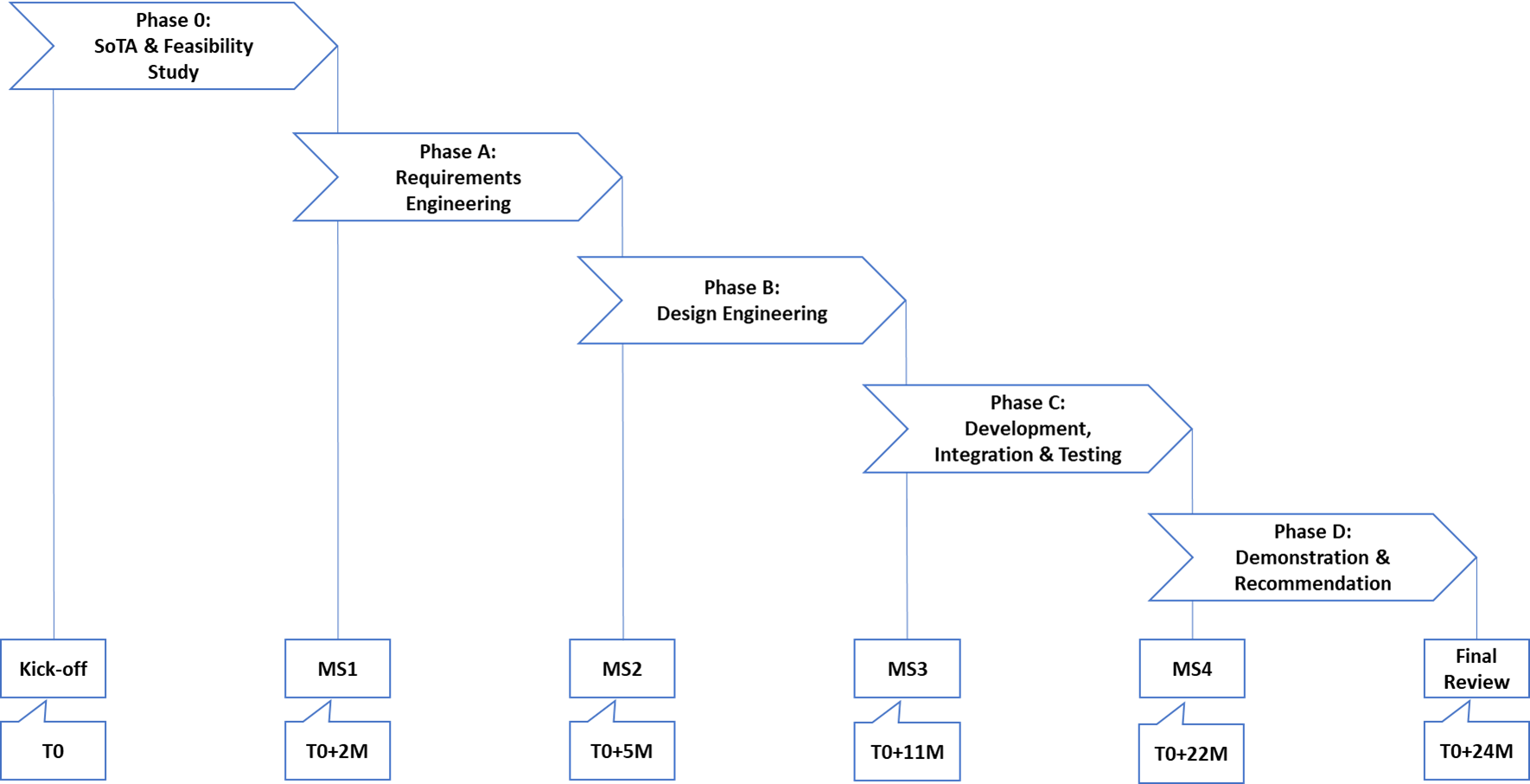
The Project have the following implementation phases:
-
Reference Scenario Definition and State-of-the-Art Analysis
-
Requirements Engineering
-
Design Engineering
-
Testbed Development, Integration & Testing
-
Demonstration & Recommendation
Current Status
The project was concluded successfully in December 2024 with the final presentation held in ESTEC on 3rd of December 2024. The ANCORSAT testbed achieved TRL4 by the end of the project and a product development roadmap was proposed to increase the TRL.
Companies