

PAGE CONTENTS
A flagship optical communications project under the Advanced Research in Telecommunications Systems (ARTES) ScyLight programme
The High thRoughput Optical Network (HydRON) project aims to demonstrate the world’s first all-optical, multi-orbit transport network at terabit/sec capacity, extending terrestrial fibre-based networks seamlessly into space. First presented at the European Space Agency’s (ESA) Council at Ministerial Level in 2019, HydRON will demonstrate the “Fibre in the Sky” for seamless, reliable satellite connectivity.
The project enables the development and validation of required key technologies by European and Canadian industry. It is a crucial mission supporting the next generation of institutional and commercial telecommunication missions, which will require yet-to-be-developed advanced communication capabilities.
Features

Background to HydRON
Satellite communications traditionally offer global coverage, and a significant increase of the reach and capacity of terrestrial infrastructure. This is especially important in remote or sparsely populated regions where the lack of infrastructure limits connectivity.
However today, data produced by satellite constellations has become the driving factor in business. While radio frequency (RF)-based systems, with decades of operational experience and maturation, remain a core technology for satellites, photonics are ideal to deal with the demand for broadband data connections.
Optical frequencies can alleviate the pressure on the RF spectrum by providing several terahertz of available bandwidth, complete with low regulation and interference that already today begin to power high-capacity communications in space.
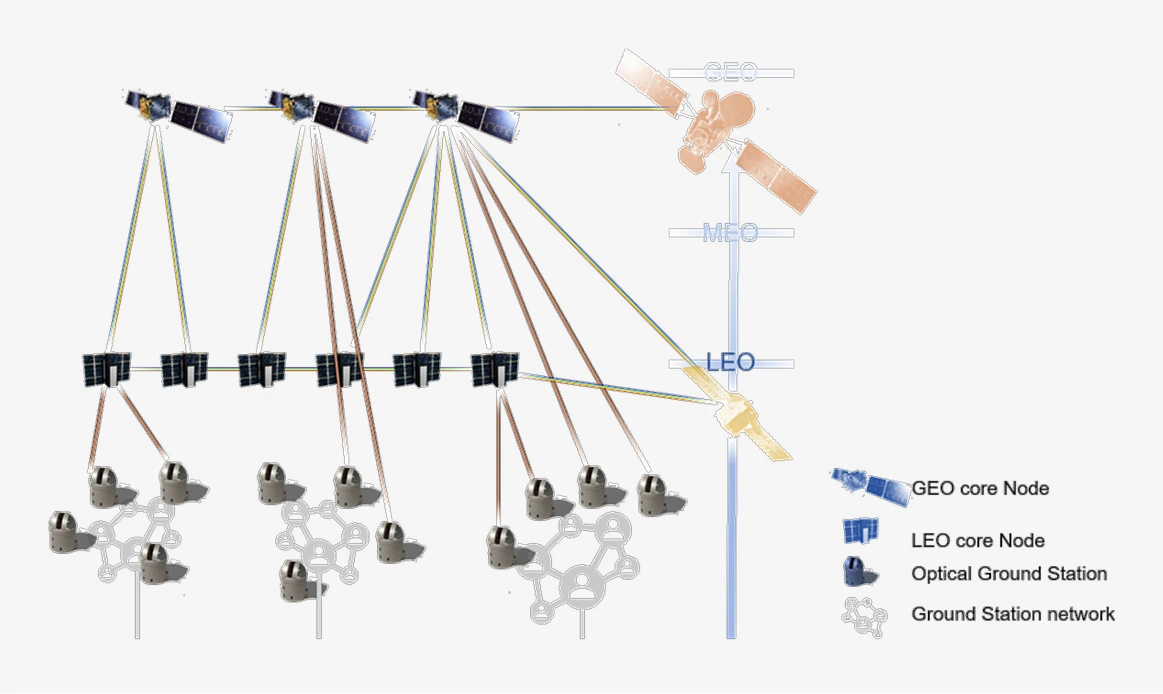
In recent decades, optical satellite communication has not only been successfully achieved from different orbits but has become a key enabler in the form of optical inter-satellite links. Throughout this time, commercial products have been thoroughly developed for space use – for example, lasers, optical terminals and amplifiers – that allow for truly operational missions; an example being the Space Data Highway (EDRS), the first fully working commercial service provided by an optical satellite data relay system.
The future of satellite communication is in light. Modern telecommunication satellites ultimately must become part of global terrestrial high-capacity networks – essentially, they must evolve from custom built satellites to nodes in a multi-orbital network. Their integration will provide an extension of terrestrial telecommunication systems into space, achieving wider coverage and improving the speed of data transfer (latency) as well as connection costs even to remote, underserved areas.
The HydRON project focuses on two main areas: our wider vision for the project, and the Demonstration System. Our vision with HydRON targets the future of optical high-capacity satellite networks with all their necessary technologies, while the Demonstration System focuses on preparing and demonstrating capabilities of a first terabit/sec capacity, fully optical satellite network.
HydRON Vision
HydRON envisages high-throughput optical space networks that address the challenges of bringing connectivity to multiple users across different orbits and applications, showcasing the capabilities of optical communication technology within end-to-end systems.
HydRON’s targeted performance capacity aims to be orders of magnitude greater compared to today’s satellite communications systems, operating at a rate of terabits per second in contrast to gigabits per second. This step requires new photonic space-ready hardware and has the potential to trigger a true revolution of applications, services and connectivity. This is underpinned by the seamless inter-operability of such optical space networks with terrestrial systems or other users, wherever they may physically be. This makes discussions about system standards, interoperability and system architectures key aspects of the HydRON Vision.
Working towards this vision, the objective of the HydRON project is to also define, develop and validate a representative HydRON Demonstration System (HydRON-DS) to demonstrate the feasibility of fully optical satcom networks as well as to reduce the complexity of a full system.
The HydRON Demonstration System (HydRON-DS) is thus focused on the development, deployment, in-orbit testing and demonstration of elements in space and on the ground, which will be necessary for high-capacity data transport and flexible network capabilities to assets and users – whether on Earth or in Earth orbit.
The HydRON Demonstration System
The HydRON Demonstration System is currently in its implementation phase. It is comprised of three independently procured elements, each focusing on validating and demonstrating various aspects of an optical satcom end-to-end satcom network. The first element consists of a low Earth orbit (LEO) constellation of 10 satellites, which can not only link optically with one another, but also to several optical ground stations. This element is implemented as part of a commercial satcom constellation currently in deployment by Kepler Communications (Canada) and will routinely establish optical space-to-ground and ground-to-space links.
The second element of the HydRON Demonstration System will extend the network established by Element#1 into various orbits by placing a payload in geostationary orbit in permanent view of optical ground stations. Element two, implemented by Thales Alenia Space, will form a multi orbit optical network testbed in connection with element one, ant thus allow to test and validate for various network scenarios. The final element will allow external, commercial, optical users, to connect to the HydRON network and route their data through the network, showcasing and validation various service provision scenarios currently considered for future constellations. The call for this Element is open at the time of this writing.
HydRON Evolution
Ultimately, the lessons learned from the implementation of the Demonstration System with our industrial partners will have to pave the way to ubiquitous, high-speed interoperability of future telecommunication systems – built by ESA Member State know-how. For this, we consider it a goal to enable the growth of healthy eco system. HydROn will evolve towards extensions of this network and enable commercial growth by network interoperability, and coordination with partners around the world.
With this, it will be necessary to drive the current state-of the art satellite communication systems – which are only beginning to leverage advantages of hybrid RF and optical communication technologies – towards reliable, low-cost interoperable assets in orbit forming a flexible network.
HydRON’s evolution will thus target the gap between current market realities and technical feasibility of photonics, interoperability based on best practises and agreed upon standards, but ultimately also the needs of resilient, safe and secure communications technologies.
The evolution of HydRON targets to fuel the development and demonstration to enable a high degree of interoperability, reliability and security for a wide range of satcom services – from relaying deep space communication signals to alleviating data bottlenecks in cases of emergencies or on demand.
ESA Specifications for Terabit/sec Optical Links (ESTOL)
The ESA Specifications for Terabit/sec Optical Links (ESTOL) is a joint endeavour between industry, research centres and universities across the Agency’s Member States. Coordinated by ESA’s directorates of Connectivity and Secure Communications, and Operations, and Technology, Engineering and Quality, ESTOL aims to provide a specification for high-data-rate optical links, towards a capacity of terabit/sec, to support the implementation and deployment of future optical satellite networks.
The project fosters the compatibility of the physical air-interface between satellite and ground nodes and serves as a first step towards inter-networking and interoperability between space-based optical networks and terrestrial infrastructure.
Since the middle of 2022, ESA – in partnership with its stakeholders – have held a series of workshops to assess the interface specifications for next generation optical inter-satellite links and optical space-to-ground links. The outcome and conclusions of these workshops as well as ongoing discussions are collected in the current version of the ESTOL document, which can be downloaded in the Contacts & Links section below. Please be advised that this is a live document, which evolves with inputs from its contributors. We warmly welcome new contributors to ESTOL.
ESTOL fosters the development of interoperable commercial products, while making use of available standards from satellite communications and terrestrial networks to maximise the re-use of commercially available products.
These products will


A goal of HydRON, beyond its immediate remit, is to implement ESTOL in the development of future satellite networks and their related technologies. The HydRON Demonstration System will demonstrate the air-interface defined in ESTOL by implementing the free-space optical links in its specification.
RELATED LINKS & CONTACS
CONTACT
Harald Mathias Hauschildt
ESA’s European Space Research and Technology Centre (ESTEC)
Keplerlaan 1
2201 AZ Noordwijk, The Netherlands
+31 (0)7156 58257
Harald.Hauschildt@esa.int
