ESA and Japan’s Space Compass Corporation partner to pioneer next-generation optical communication network

Publication date

25 Mar 2025

ESA, in partnership with Japanese company, Space Compass Corporation, has signed a Memorandum of Intent (MoI) to jointly conduct the feasibility study for Japan’s LAIDEN project and ESA’s High Throughput Optical Network (HydRON) demonstration system.

ESA’s innovative HydRON project sits under the Advanced Research in Telecommunications Systems (ARTES) Strategic Programme Line Optical and Quantum Communications – ScyLight Strategic Programme Line, and aims to deliver terabit-per-second capacity by integrating space-based optical communications with terrestrial networks.

Led by Space Compass, the LAIDEN project is a national project overseen by Japan’s New Energy and Industrial Technology Development Organization (NEDO). LAIDEN will work to develop and demonstrate an Inter-satellite low Earth orbit (LEO) Optical Communication Network System. As part of the project, Space Compass has established a project formation with the National Institute of Information and Communications Technology (NICT), AXELSPACE Corporation and NEC Corporation.

Bringing together two pioneering optical communication initiatives in ESA’s HydRON and Japan’s LAIDEN project, it demonstrates the growing importance and strategic nature of optical technologies, with international cooperation, such as this one, crucial to ensure the role of ESA Member States in the developing market.

Space Compass plans to launch the first commercial geostationary orbit (GEO) satellite and offer optical data relay services with GEO as a part of its in-orbit demonstration. The MoI will focus on creating seamless interoperability between multiple orbital layers, including GEO, Medium Earth Orbit (MEO), and LEO satellites, as well as ground stations. This multi-layer approach promises to enhance global connectivity and create more resilient communication networks for both space and terrestrial applications.

The partnership will advance through three crucial phases: beginning with a technical feasibility assessment for interoperability testing, followed by the development of comprehensive joint test protocols, and culminating in the execution of integrated system validation.

“This partnership exemplifies ESA’s commitment to fostering international collaboration in developing and demonstrating optical communications,” said Laurent Jaffart, ESA Director of Connectivity and Secure Communications. “The showcases how ESA Member States are driving, developing and demonstrating world-class and recognised optical communications technologies to the benefit of our industry and international partners.”

“This MoI with ESA represents a crucial step towards realising a truly global optical communication network,” said Koichiro Matsufuji, Co-CEO at Space Compass. “By integrating Japan’s LAIDEN project with ESA’s HydRON system, we are advancing the technical feasibility of high-speed, high-capacity data relay between multiple orbital layers. This partnership also aligns with our vision of a ‘Space Integrated Computing Network,’ where innovative communication and computing technologies converge to create a more connected and efficient space infrastructure.”
ESA and Austria host world-leading quantum minds to drive space-based quantum information networks

Publication date

24 Mar 2025

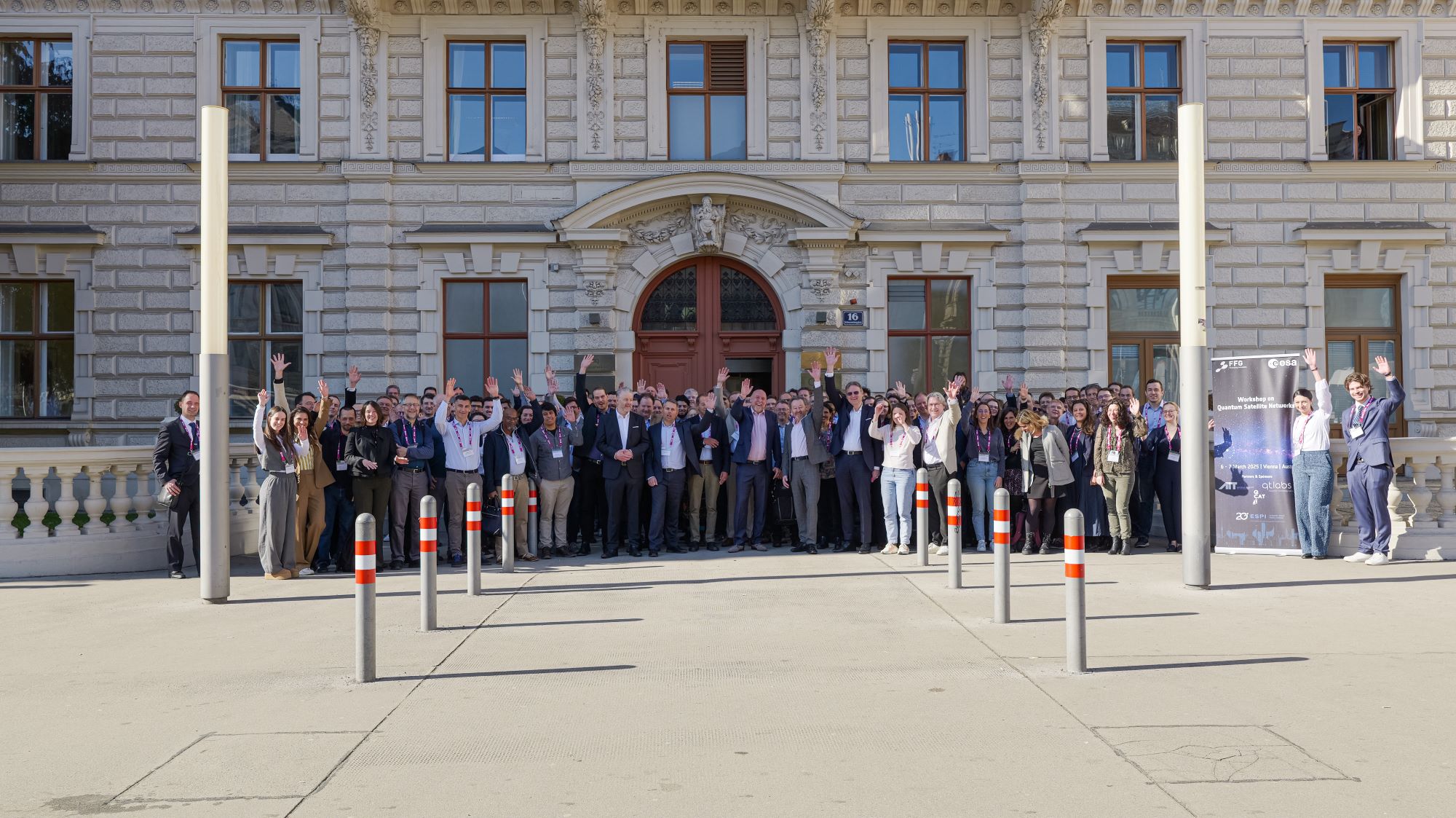
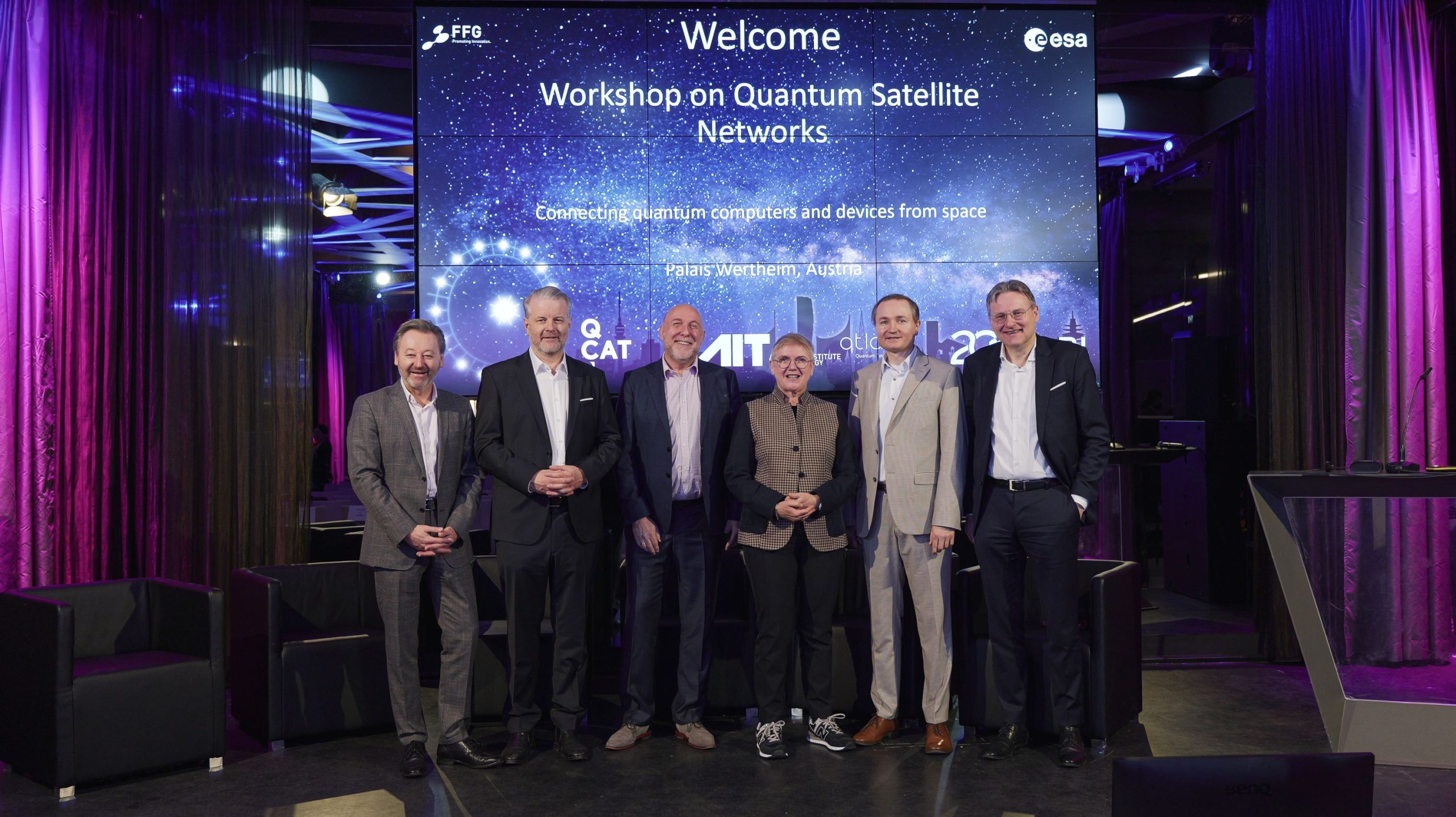
The European Space Agency (ESA) and the Austrian Research Promotion Agency (FFG) jointly hosted a workshop to address the challenges and opportunities in the interconnection of quantum networks, for example, through future scalable quantum computers and devices over large distances. The event on Quantum Satellite Networks, took place in Vienna, Austria, over two days and showcased how the country and ESA are driving ESA Member State quantum capabilities.

The key focus of the workshop included the discussion of future quantum information network architectures and technologies, the role of space and satellites in such architectures, and how to leverage long distance connectivity between quantum devices and processing units. A day prior to the workshop, the Austrian Research Promotion Agency co-organised a Quantum Austria networking event that brought together multi-disciplinary professionals, from technical engineers to policymakers, fostering new partnerships and identifying promising approaches for advancing the Austrian Research Promotion Agency’s vision of satellite quantum information networks.

Austria’s growing influence in the quantum technology sector was highlighted through several domestic organisations presenting innovative solutions for space-based quantum networks. The workshop enabled ideas to be shared from across the quantum ecosystem, with keynotes from Erste Bank, Centre National de la Recherche Scientifique (CNRS) at Sorbonne University, European Space Policy Institute (ESPI), Simon Fraser University, Xanadu, and Alpine Quantum Technologies (AQT).

The event provided the widespread context of space technology and developments for an audience from a variety of business, academic and institutional backgrounds, with some partially new to the sector. Through this, the workshop aimed to evaluate the role of space technologies for quantum network architectures with ESA’s Strategic Programme line Optical and Quantum Communications – ScyLight. One of the objectives of the workshop was to lower barriers and build mutual understanding between these communities. The space context was provided together with the European Commission and industry partners, who jointly develop such technologies through the Security And cryptoGrAphic mission (SAGA) and the European Quantum Communication Infrastructure (EuroQCI) projects.

The workshop also worked to address the challenges faced in the advanced development in multiple critical domains, with pioneering use cases of satellite-enabled quantum networks and the solutions and interfaces that will enable long-distance quantum computing, being shared. Concluding with clear directives for advancing quantum network technologies, the workshop has established a roadmap for future developments in space-based quantum communications.

“This workshop has demonstrated how ESA, our Member States and the Austrian Research Promotion Agency are collectively taking the lead in space-enabled quantum communications. By bringing together key stakeholders in the field to Austria, we also recognise the instrumental role the country has in spearheading this area of the space sector,” said Laurent Jaffart, ESA Director of Connectivity and Secure Communications. “The cross-pollination of ideas between quantum computing and satellite communications represent the growing pace at which our technologies and expertise are accelerating, presenting the opportunity to make a global impact.”

“Austria has established itself as a global leader in quantum research and is now leveraging this expertise to expand its influence in the quantum technology sector. The Austrian Research Promotion Agency plays a pivotal role by fostering a robust ecosystem for quantum innovation and supporting ventures that transform advanced quantum research into practical applications, such as satellite communication,” said Karin Tausz, Managing Director of the Austrian Research Promotion Agency (FFG).

Scientific Director Andreas Kugi from AIT: “We are proud that AIT’s Quantum Communication group has established itself as a strong partner for the European Satellite Technology Industry, particularly through its involvement in the EuroQCI missions EAGLE-1 and SAGA. We are also delighted that our team contributed to organising this fantastic event in Vienna.

ESPI Director, H. Ludwig Moeller said: “Quantum and optical communications are a key innovation, enabling future secure communications, a critical component of European sovereignty, needed more than ever. It is therefore critical for Europe to accelerate the required technology development, including scaling-up as anchor customer of resulting systems and services. Speed and scale matter!”

Rupert Ursin, founder and CEO of qtlabs – a pioneer in long-distance and satellite quantum communication – emphasises the significance of Austria’s position in this cutting-edge field said: “The quality of the programme and the strong participation in this workshop clearly demonstrate Austria’s importance in the development of satellite quantum networks. I am proud that qtlabs is at the forefront of this field, successfully transforming scientific excellence into stable jobs and revenue within an emerging industry here in Austria.”

With its leadership in quantum innovation, qtlabs continues to drive advancements that bridge fundamental research with real-world applications, strengthening Austria’s role in the global quantum technology landscape.

Event partners included the AIT Austrian Institute of Technology, Austria’s largest Research and Technology Organisation, which specialises in quantum cryptography, among other fields; Quantum Technology Laboratories (qtlabs), a European leader in satellite-based quantum communication; and the European Space Policy Institute (ESPI), an independent policy think tank for promoting European space policy on an international and global level.