

The European Space Agency (ESA) and industry partner LuxSpace, a subsidiary of OHB Group, are collaborating on a new generation of microsatellite platforms called Triton-X
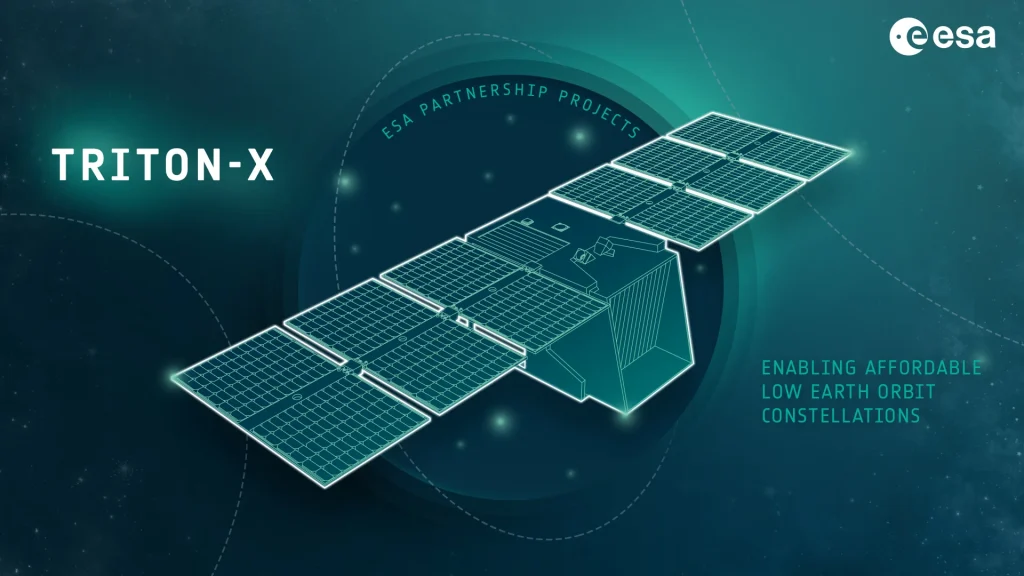
Tailored for low Earth orbit (LEO) missions and designed with a New Space ethos, Triton-X is a modular, multi-mission product line aimed at commercial and institutional users who require fast, cost-effective access to orbit.
As the satellite market evolves, the demand for smaller, quicker-to-deploy spacecraft has grown strongly. Traditional platforms built for bespoke missions are costly and slow to manufacture. In answer to the problem, ESA instituted Triton-X under its Advanced Research in Telecommunications Systems (ARTES) Partnership Project programme to deliver a generic microsatellite platform optimised for fast time-to-market, lower recurring cost, and flexibility across applications, including telecommunications, Earth observation, technology demonstrations and situational awareness.
Triton-X provides European industry with a competitive product line that supports rideshare launches, accommodates multiple payload types, and opens up access to orbit for new players and constellations.
Platform variants and key specifications
Triton-X is designed as a product family with three size classes to accommodate different mission scales.
| Variant | Launch Mass | Payload Mass | Payload Power |
| Light | 45 kg | 12.5 kg | 15 W |
| Medium | 80 kg | 30 kg | 40 W |
| Heavy | 200 kg | 90 kg | 110 W |
These variants enable the platform to serve missions ranging from simple demonstration or IoT satellites to more capable telecommunications or Earth observation microsats.
Industrial Consortium and ESA’s role
LuxSpace serves as the prime contractor for Triton-X, supported by an industrial consortium of partner companies across Europe of which includes APCO Technologies in Switzerland, ARCSEC in Belgium, ASP in Germany, Edisoft in Portugal, EmTroniX in Luxembourg, and ESC in Czechia.
ESA’s involvement is through a Partnership Project under our ARTES programme, helping fund the development and qualification of the platform and de-risking the industrial investment. In May 2021, ESA and LuxSpace signed the contract establishing Triton-X Heavy’s development and qualification phase.
Technology and operational Features
Triton-X emphasises rapid manufacturing, modular design, and standardised interfaces.
The Heavy variant’s payload capacity (90 kg) and power (110 W) allow for significant missions within the microsatellite class. The platform is also positioned to support constellations, where recurring cost, production efficiency and standardisation become key differentiators.
The strategic and economic impacts of Triton-X
Triton-X carries strategic importance for Europe’s space industry
Outlook and opportunities
Looking ahead, major focus areas for Triton-X include: successfully launching the first flight model to validate the platform’s performance in orbit; converting the platform into commercial orders and recurring production to validate the business model and deliver economies of scale; expanding payload types and mission classes (for example: constellations, direct-to-device communications, optical communications) to leverage the modular architecture; tightening the integration with small launcher services and leveraging rideshare environments to reduce deployment costs further and fostering a broader European supply-chain ecosystem around smallsat platforms, manufacturing, ground-segment support and operations.
RELATED LINKS & CONTACS
CONTACT
Michael Witting
ESA’s European Space Research and Technology Centre (ESTEC)
Keplerlaan 1
2201 AZ Noordwijk, The Netherlands
+31 625158619
Michael.Witting@esa.int

Documents
Overview page
Advanced Research in Telecommunications Systems (ARTES)
Overview page
Partnership Projects programme
Overview page