

PACIS 3 is a strategic satellite communications project by the European Space Agency (ESA), carried out as an ESA Partnership Project under our Advanced Research in Telecommunications Systems (ARTES) programme, and in cooperation with Spain’s Hisdesat and the Spanish Centre for the Development of Industrial Technology (CDTI).
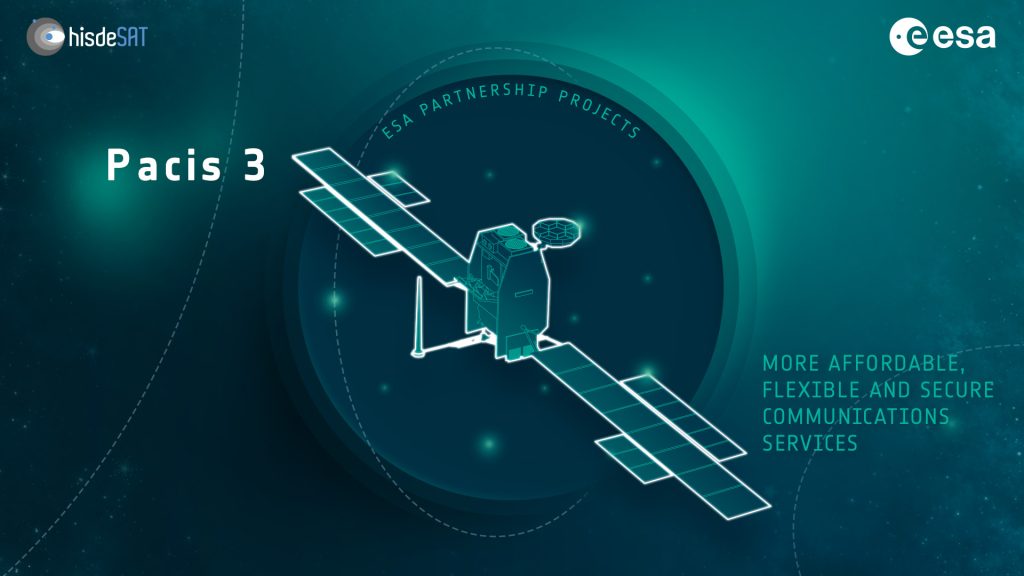
PACIS 3 develops, qualifies and provides in-orbit validation for extremely advanced active-antenna technologies for secure satellite communications. Some of its key goals were:
Some of its key goals were
PACIS 3 supports Europe’s aim of sovereign and resilient secure communications, reducing dependence on non-European providers, improving flexibility and affordability of government satellite services, and maintaining industrial leadership in high-tech satellite payloads.
PACIS 3-enabled payloads – which are currently on board the SpainSat New Generation (NG) programme satellites, SpainSat NG I and II – will provide secure communications services for government, defence, and allied users, with coverage spanning Europe, the Americas, Africa, the Middle East, and Southeast Asia, up to Singapore.
Industrial partners
Industrial leadership is provided by Airbus Defence and Space in Spain as the prime for the PACIS 3 payload, working with a Spanish consortium, including SENER, Indra, GMV, Tecnobit, Arquimea, and Iberespacio. The satellite operator is Hisdesat, under the SpainSat New Generation (SpainSat NG) programme: two new-generation satellites based on the Eurostar Neo platform. PACIS 3 payloads are integrated into SpainSat NG I and II.
ESA’s Partnership Project model enables sharing of risk between the agency and industry and supports end-to-end system development up to in-orbit validation.
Key technologies from PACIS 3
PACIS 3 milestones
RELATED LINKS & CONTACS
CONTACT
Michael Witting
ESA’s European Space Research and Technology Centre (ESTEC)
Keplerlaan 1
2201 AZ Noordwijk, The Netherlands
+31 625158619
Michael.Witting@esa.int

Documents
Overview page
Advanced Research in Telecommunications Systems (ARTES)
Overview page
Partnership Projects programme
Overview page