Neosat is one of the most significant technological initiatives undertaken by the European Space Agency (ESA) to strengthen Europe’s position in the global telecommunications satellite market
Launched under ESA’s Advanced Research in Telecommunications Systems (ARTES) programme, Neosat was conceived to develop and demonstrate a new generation of highly efficient, flexible, and cost-effective satellites in geostationary Earth orbit (GEO).
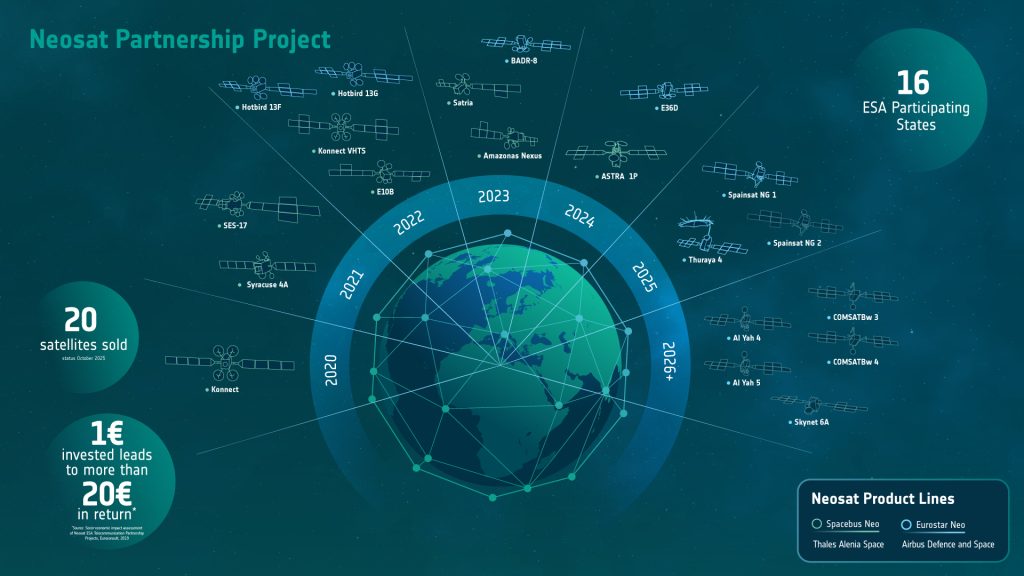
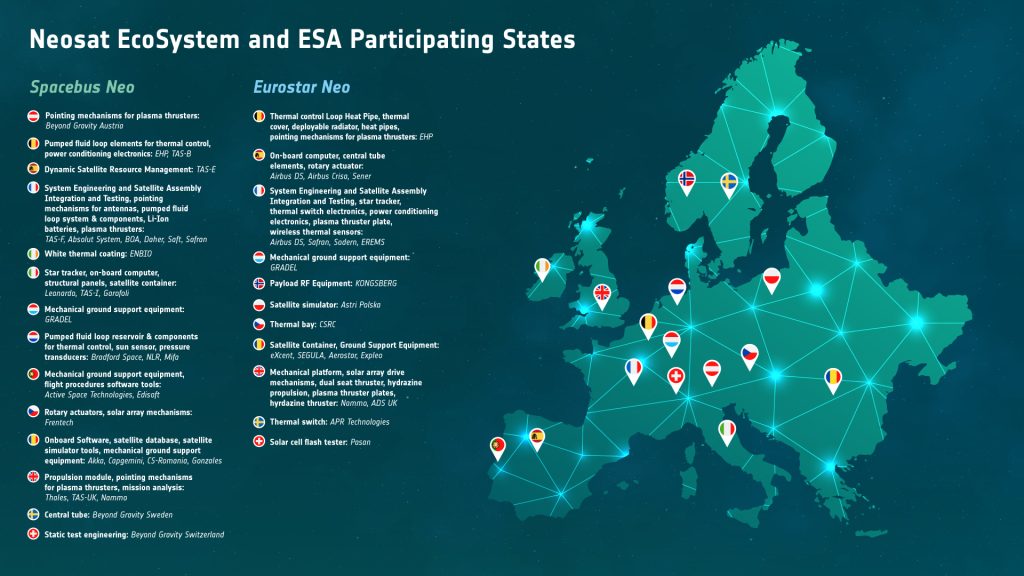
In partnership with leading European aerospace companies Airbus Defence and Space and Thales Alenia Space and industrial partners across 16 Member States, Neosat has resulted in two complementary product lines:
Eurostar Neo
developed by Airbus Defence and Space, with manufacturing spread across the UK, France, Spain, and GermanySpacebus Neo
developed by Thales Alenia Space, drawing on industrial contributions from France, Italy, Spain, and Belgium.
Together, these platforms are designed to meet the growing demand for more powerful and flexible satellites capable of serving commercial and governmental customers while reducing costs and time to orbit. What’s more, the product lines have an economic and strategic impact by enhancing Europe’s industrial competitiveness; supporting sovereignty and autonomy, while for every euro invested Neosat has generated more than €20.
Why Neosat?
The commercial GEO market has undergone a transformation: operators demand more bandwidth, higher power, and better flexibility to adapt to dynamic communication needs. At the same time, competition from non-European manufacturers was intensifying, with companies adopting new manufacturing techniques and digital payload technologies.
With a need to maintain Europe’s technological independence and industrial competitiveness, ESA launched Neosat in 2014, and to equip Europe’s satellite manufacturers with state-of-the-art satellites capable of delivering higher performance, lower cost per bit, and better efficiency, all while supporting greener and more sustainable operations.
The programme was implemented as a Partnership Project under ARTES, co-funded by ESA, supported by national space agencies such as France’s Centre National D’Etudes Spatiales (CNES) and the UK Space Agency, as well as industry.
Objectives of Neosat
The Neosat initiative was built around several key objectives:
Develop two competitive satellite product lines
To foster innovation and maintain competition within Europe, ESA supported the parallel development of Eurostar Neo and Spacebus Neo, each addressing a wide range of missions from small to ultra-high-power satellites (from 7 to 25 kW).Reduce cost and time to market
Neosat sought to introduce modular designs, digital engineering, and lean manufacturing methods to cut costs by 30% compared to previous satellite generations.Enhance power and flexibility
The programme emphasised the use of all-electric propulsion, digital payloads, and scalable platforms to meet evolving market demands for broadband, broadcasting, and government communications.Boost industrial competitiveness
ESA’s investment was structured to strengthen European supply chains and production capacity, ensuring that Europe could compete globally in the commercial satellite market.Support environmental sustainability
By adopting all-electric propulsion and more efficient subsystems, Neosat satellites consume fewer resources and require less propellant, reducing environmental impact.
Neosat’s technological innovations
All-electric propulsion
One of Neosat’s most transformative features is its use of electric propulsion. Traditional satellites rely on chemical propellant for orbit-raising and station-keeping, which adds mass and cost. Electric propulsion, by contrast, uses ion thrusters that are far more efficient, allowing satellites to carry more payload and reduce launch mass by up to 40%.Digital and flexible payloads
Both Eurostar Neo and Spacebus Neo integrate digital processors and beam-forming technologies, enabling operators to reconfigure frequency plans, coverage areas, and power allocation in orbit; a crucial capability in a rapidly evolving communications landscape.Scalable modular design
The Neosat platforms are designed for scalability. Operators can tailor power, payload capacity, and mission life to suit specific needs; whether for regional coverage, broadband connectivity, or high-throughput missions.Advanced thermal control and power systems
Innovations in lightweight radiators, advanced solar arrays, and high-efficiency batteries have enabled Neosat satellites to deliver up to 25 kW of power while maintaining thermal balance and reliability.Manufacturing efficiency
Through digital design tools, standardised interfaces, and lean production methods, the Neosat programme has cut manufacturing cycles significantly, enabling faster delivery from contract to launch.
Milestones and Achievements
2014
ESA formally launches the Neosat programme under ARTES.2016 – 2018
Design and qualification of Eurostar Neo and Spacebus Neo subsystems.2020
The first Neosat satellite, Eutelsat Konnect (Spacebus Neo), completes integration and testing.2021
Eutelsat Konnect enters operational service, becoming the first Neosat platform in orbit.2023
Airbus announces full operational capability of its Eurostar Neo production line, with satellites such as Hotbird 13G and SES-17 successfully launched.By 2025
20 Neosat-based satellites (12 for Eurostar Neo and eight for Spacebus Neo) are ordered by global operators, including SES, Intelsat, Arabsat, and Hispasat.
Neosat-based platforms are expected to generate billions of euros in export revenue, cementing Europe’s position as a global leader in satellite manufacturing.