
PAGE CONTENTS
Objectives
The objective of PHOTON-MIX is the development of a high-port-count, low-mass-and-energy-consumption, fast switch matrix for optical communications in the C-band. The enabling technologies to address simultaneously all these requirements are integrated photonics and latching bistable MEMS switches. The former allows to concentrate a great number of optical devices in a cm-sized silicon microchip, thus providing high number of channels and compactness: low size and weight. The latter make it possible to set the state of each of the switch of the matrix either ON or OFF without the need of maintaining a voltage applied constantly to fix this state: this accounts for low power consumption.
Challenges
The key challenges of this project include the demonstration of the MEMS latching mechanism, the development of a reliable microfabrication process flow, the development of a dedicated driving electronics board, and the assembly including all mechanical support structures and electrical and optical interfaces.
System Architecture
The general architecture has been consolidated with some preliminary analysis assessment for the thermos-mechanical and mechanical analysis. The functionality of the bias matrix was successfully demonstrated with some optimisation performed during the switch matrix test. The electronics design offers the required flexibility. Not all verification could be implemented due to project time line and budget. However, the critical aspects of the design have been tested.
Plan
The requirements have been consolidated shortly after Kick-off which enable the launch of LLI procurement and the start of preliminary design activities. Critical design aspects of the preliminary design have been bread boarded and tested. Their results were assessed during the Critical Bread boarding Test Review allowing to carry on with the Demonstration Model (DM) design activities. After finalisation of the MEMs design materialised by the Detailed Design Review, the manufacturing of the DM was released. Testing on the DM was performed following successful TRR, results and associated documentation (product roadmap) were evaluated during the Final Review.
Current Status
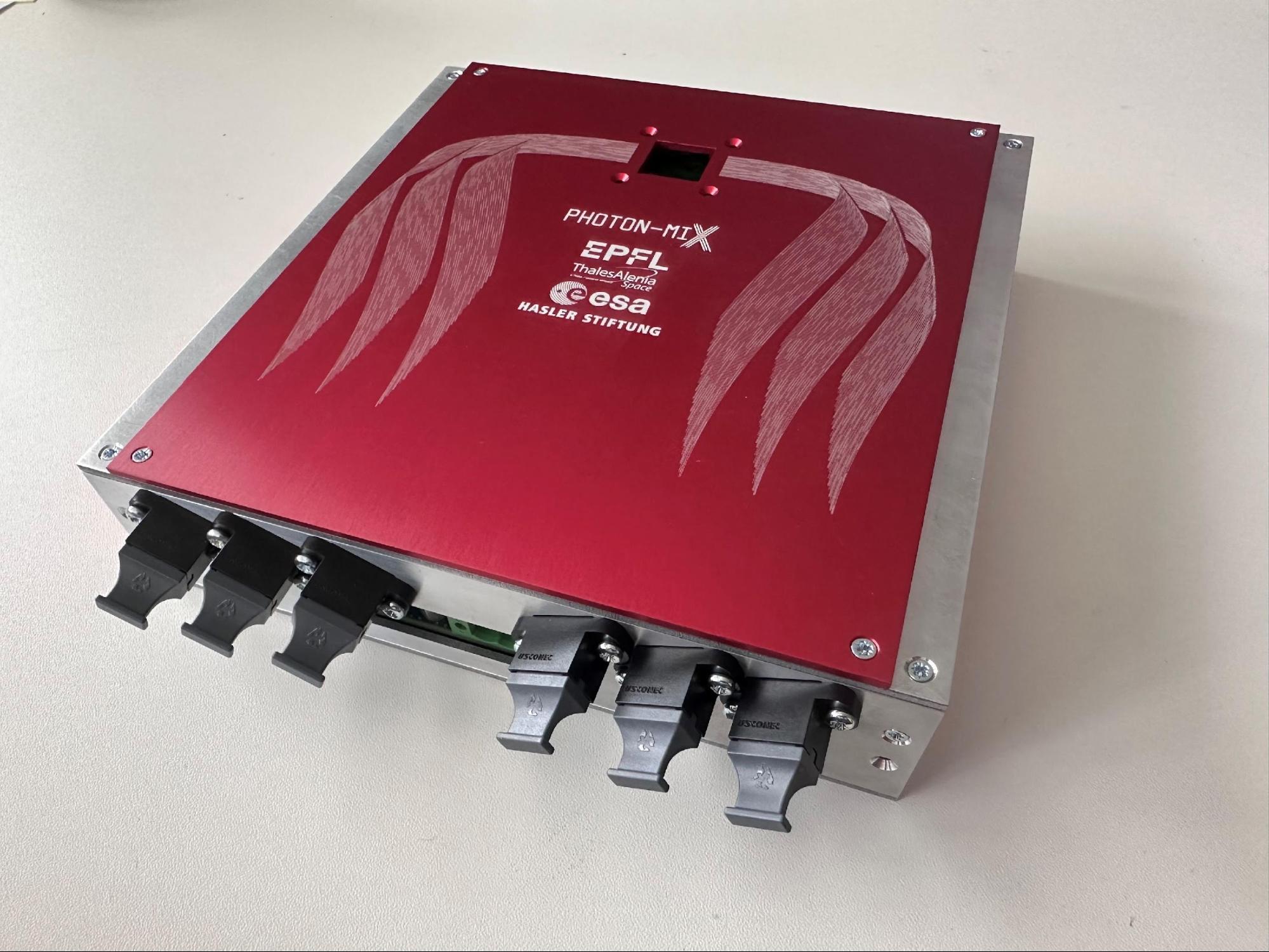
The non-volatile MEMS design based on optical switch matrix is available. The fabrication process implemented at EPFL clean room facilities and based on DUV lithography compatible with foundry process has been validated. The non-volatile MEMs switch has been integrated into a modular unit named DM, fully packaged and easy to use. The operational functionality (optical & electrical) of a MEMs switch was fully verified in a lab environment allowing to reach TRL 4.