
PAGE CONTENTS
Objectives
The goal of the activity is to develop an intelligent AI model that improves useful data rate by enabling less complex and less power consuming coding scheme with respect to current implementations. The developed algorithms can compress data using AI by reducing data replicas that are intrinsically present in the information to be transferred and mitigate possible reception errors by exploiting this intrinsic redundancy.
The applications are tested using a demonstrator testbed, showing the benefit of AI-supported data compression, comparing the obtained results with a state-of-the-art communication standard.
The testbed is composed by a Software Defined Radio (SDR) that simulates the CCSDS 131.2-B data link layer. The SDR takes input from the application layer, which is represented by the AI algorithms.
Such structure allows to test the end-to-end transmission chain, evaluating also the benefit of AI smart data compression models against different channel conditions and different use-cases or data types.
Finally, IngeniArs performs a feasibility study for deploying the AI-compressor into the GPU@SAT hardware accelerator.
GPU@SAT is a technology independent GPU soft-core developed by Ingeniars that can be embedded in space-qualified FPGA and used for space applications, including high-reliability space missions (class 1).
Challenges
The biggest challenges for the MLDR project are:
- AI-compressors: develop an AI model that is able to compress and decompress data while maintaining the best quality possible is a very challenging task. In fact, such AI models deal with different data types and noise conditions requiring a peculiar training phase that create a well-formed and quantised latent space.
- End-to-end communication simulator: build an end-to-end communication chain based on CCSDS 131.2B could require more than 1 year. IngeniArs has a long experience with such type of communication systems and already disposes of a complete CCSDS 131.2-B SDR, limiting the risks related to the simulation environment.
System Architecture
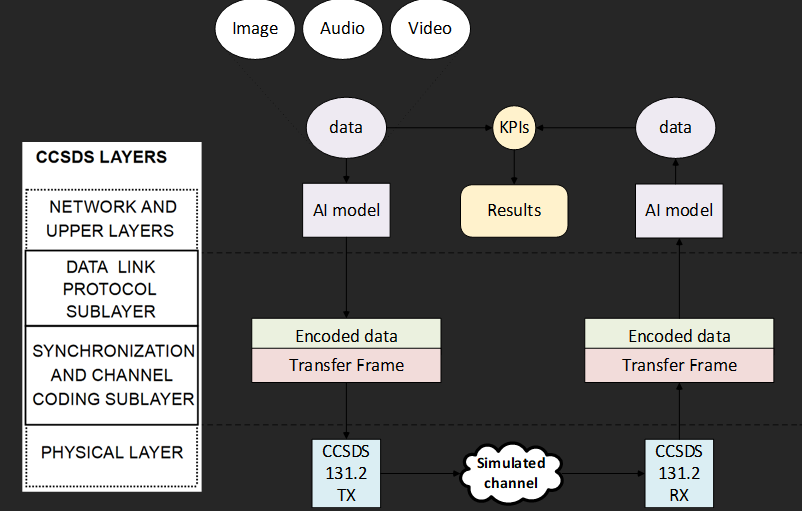
IngeniArs adopts the CCSDS 131.2-B simulator supported by GPU, which represents a fully functional end-to-end communication system.
Supporting the simulator with the AI-compression algorithm, IngeniArs can easily derive the metrics while computing the error correction rate. The errors are due to channel impairments (AWGN, doppler error, frequency error, timing error, etc.) introduced by the CCSDS 131.2-B simulator.
The two algorithms run on a dedicated computer with GPUs, which can accelerate both the CCSDS 131.2-B data link and VAE model.
Plan
N/A
Current Status
The project has already passed the SRR, and now IngeniArs is working on the preparation of the datasets as well as a preliminary selection of possible models to be adopted as reference for the final implementation. Concurrently, IngeniArs is preliminary developing the testbed. The latter is composed by three different steps:
- Encoding phase: executed by one of the AI models developed selected with respect to the type of data involved in the use-case
- CCSDS 131.2-B end-to-end simulator
- Decoding phase: executed by the decoder of the AI models used for generating the latent space.
To speed up the testing of the AI models, IngeniArs is adopting a CI/CD strategy, which allows to integrate and develop different models in short time.
PDR is forecasted for Q2 2025.