PAGE CONTENTS
Objectives
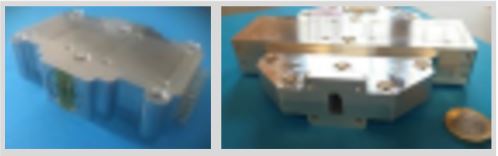
Target of the project was the identification – through electrical, mechanical design activities as well as dedicated technological developments – of both K-Band and Q-Band Spatial Power Combing Amplifiers.
Experimental characterization of SSPAs was also carried out at both frequency bands.
Challenges
Key challenges of the project are hereafter discussed.
Power amplification at microwave frequencies has been always an important subject in system design and this issue is becoming even more important today because the application frequencies are rising up to mm regions and beyond.
Power Amplifiers (PA) are very important devices for electronic communication systems, as the ones for airborne, space, and ground-based applications.
In those communication systems characteristics like reliability, size, efficiency and weight assume a very important role in the selection of the proper PA to be employed. In fact, in such applications there are evident limited space and available DC power, so that size and efficiency have to be at a maximum level of optimization. In addition, the advent of active phase array definitively considers SSPA technology the most applicable one.
High RF power levels are typically demanded to vacuum tubes amplifiers like TWT but this has the main disadvantage to use heated wires and bulky magnets or electromagnets. So, combined Solid State PA (SSPA) would be greatly appreciated if they could give at least the same order of magnitude in RF power levels, since in this case graceful degradation is increased.
Spatial power combining technique is certainly an alternative to combine many SSPA reducing to a minimum extent the combining losses. This is the RF technology utilized and optimized for the present project.
The efficiency of GaN MMICs combined with the efficiency of spatial combining yields the most efficient solid-state amplifier available. In addition it has to be mentioned that also for ground applications the proposed SPCA concept is valid, having some advantages with respect to the TWTA technology, like the intrinsically redundant thanks to a graceful degradation architecture, the high linearity, the weight, the amplifier size reduced w.r.t. the TWTA, a lower level of voltage (20-48 V) w.r.t. the ones requested by TWTA, operative life expected to be 7 years greater than the actual TWTA, possibility to place the SPC amplifier just behind the antenna avoiding complex WG routing and losses, the expected cost lower than the TWTA. Among the others, their use as active part of the Active Phased Array antenna is without any doubt of great interest.
The intrinsic weakness is the lower DC efficiency.
System Architecture
After MMICs integration, tests on SPCA working at Ka-band confirmed the expected performance. On the contrary, SPCA working at Q-Band exhibited issues that posed important limits in the achievements of the expected performance values. Additional tests on a single brazed spare MMIC confirmed the above statement.
In this respect, a specific CCN_1 to the main contract aimed at achieving optimized performance on the Q-Band SPCA has been authorized by ESA. Such CCN_1 considered the use of MMICs based on GaN on SiC technology.
In the frame of the carried out CCN_1 activity, evidence in terms of Q Band SPCA design aspects, parts integration and tests have been provided.
Measured results on the realized SPC Q-Band Amplifier making use of GaN on SiC technology confirmed the design expectations.
Plan
The main contract project started on 04.07.2020.
Overall project, inclòuding CCN_1, was terminated by 0.07 2024 The following project milestones were considered in the overall project development:
-
KoM – Kick-Off Meeting
-
PDR – Preliminary Design Review
-
CDR – Detailed Design Review
-
TRR – Test Readiness Review
-
DELTA_TRR – Test Readiness Review
-
FR – Final Review
Current Status
Measured results on the realized SPC Ka and Q-Band Amplifiers making use of GaN on SiC technology confirmed the design request. It is expected to finalize actual opportunities on some focussed amplifier design finalization after a dedicated qualification campaign.
Project Completed