PAGE CONTENTS
Objectives
This mission has the research, scientific, exploratory, and business objectives listed below:
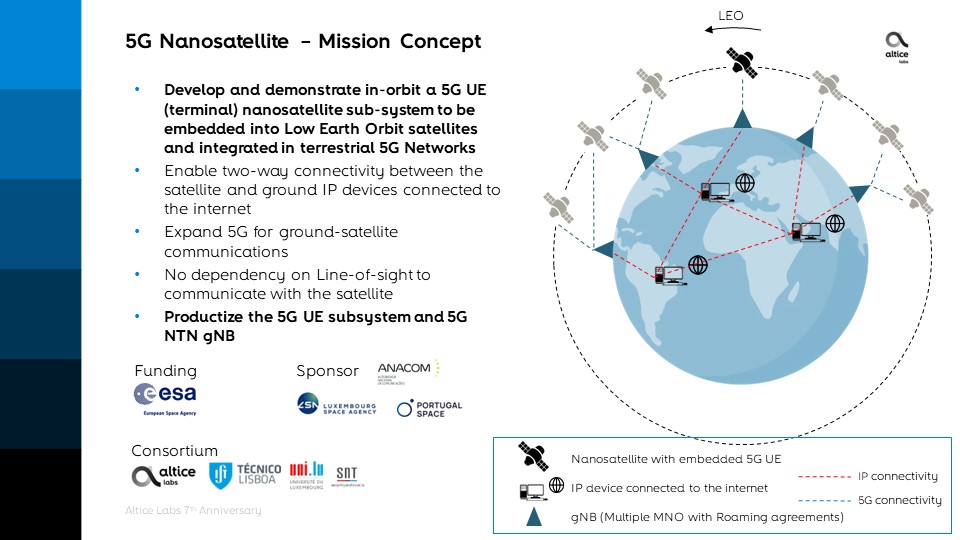
- Evaluate the performance and feasibility of having a 5G UE Terminal based on Open Air Interface, running on an AMD RFSoC embedded on a 3U cubesat orbiting at a Sun-synchronous Orbit ~500Kms of altitude.
- Evaluate in a real orbital testbed the adjustments and customisations that must be carried out to compensate the effect of Link Loss, Doppler Effect and Round-Trip Delay.
- Provide Altice Labs hands-on experience in the space industry, targeting a product that is within the technological scope of its core expertise, and with designing space grade electronics and electrical systems.
- Foster a technological, research and development and academic long-term cooperation with IST and SnT.
- Provide valuable insights to leverage the work that is currently been developed at 3GPP under the Non-Terrestrial Network (NTN) Framework.
- Productise a 5G UE sub-system + antenna that can later be re-used by other nanosatellite developers.
- Productise a 5G gNB + Antennas dedicated to NTNs.
Challenges
Main challenges customizing Open Air Interface (OAI):
- Porting the 5G stack: Implementing a 5G-NTN stack in a small satellite’s embedded system, based on OAI running on ARM, and offloading tasks to FPGA.
- Channel nonlinearity: CP-OFDM has a high peak-to-average-power ratio due to overlapping multicarrier signals causing amplitude fluctuations.
- Propagation delays: 3GPP specifications for TNs need revising for NTNs, including access controllers, power control loops, timing relationships, and hybrid automatic repeat requests.
- Doppler shift and rate: Use a non-relativistic approach for Doppler computations due to negligible speed ratios.
- Handover: The 5G UE antenna will require handovers every 3-6 minutes between gNBs.
System Architecture
Each GS will have its own gNB OAI instance running and a USRP2944 radio, Low Noise Amplifier (LNA), Power Amplifier (PA) and DUPLEXER (to split the uplink and downlink frequency bands).
The antennas will be mounted on an AZ/EL rotor which will be interfaced by a Ground Station Controller developed by Altice Labs. This controller will use the following input variables to track the satellite:
- Expected TLE obtained from celestrak.org or customized TLE.
- GNSS data (location of the GS and time reference).
- Data from a IMU attached to the antenna boom (to confirm the heading and tilt of the antenna).
- Feedback from the GNSS onboard.
The gain of the GS antenna will be ~17dBi thus pointing and tracking will be relevant.
Plan
The project is divided into several phases: Definition Phase, Technology Phase 1, Technology Phase 2, Product Phase, and Demonstration Phase.
- In the first phase, the concept of operations and the 5G UE/gNB NTN and the CubeSat architecture requirements were defined.
- In the next one, it integrates the 5G UE OAI testing and the antenna system design and testing.
- Then, Technology Phase 2 (comprising the Product Phase) covers systems qualifications testing and integration, as well as productization and final testing.
- The Demonstration Phase starts with the satellite launch and it is expected to last twelve months.
Current Status
Currently, the Definition Phase is finished and the next one (the Technology Phase 1) is about to start.