PAGE CONTENTS
Objectives
The main objectives of the activity are the following:
a) RF: the main RF goal is to design and produce three different feed chain designs, corresponding to the following frequency plans:
-
Case 1: From 37.5GHz to 51.4 GHz
-
Case 2: From 37.5GHz to 86.0 GHz
-
Case 3: From 71.0GHz to 86.0 GHz
The results are the first W-band monolithic diplexer-polarizer-antenna and the first multiband Q/V/W feed for ground applications in the market.
b) AM objective:
Laser powder bed fusion (LPBF) has proven to be the most suitable AM technology for RF components providing high resolution, design freedom and complexity, good mechanical properties, and reasonable surface finish that can be further improved by post-processing.
However, there is a significant room for improvement which directly impacts the RF performances. First, via process optimization for a specific design feature and secondly, with new generation of LPBF machines that improve features and contour resolution using pulsed-wave mode of laser as opposed to conventional continuous wave laser. In addition, new materials specifically designed for LPBF manufacturing have entered the AM market, thus providing improved material performance.
This activity aims at developing new AM end-to-end manufacturing route for Q/V/W-band passive RF hardware using advanced LPBF manufacturing with fine detailed resolution (FDR).
Challenges
The main challenges for this activity are the following:
-
Increase the precision of Laser powder bed fusion (LPBF) AM processes to be able to meet the RF specifications of Q/V/W band components.
-
Implement RF designs that are compatible for AM and also robust enough to ensure high production yield for large volumes.
-
Design for Case 2 (37.5 to 86.0 GHz) is very broadband and requires a coaxial feed with complicated architecture. Such a solution doesn’t seem to exist in the market and is more challenging that cases 1 and 3.
System Architecture
Case 1 (from 37.5GHz to 51.4GHz): a monolithic feed chain including: 1) diplexers or triplexers; 2) OMT and polarizer; 3) feed horn is baselined.

Case 2 (from 37.5GHz to 86.0GHz): a coaxial feed component, where the TX band is placed inside the inner coaxial. The TX path consists of a single-band septum polarizer with two bandpass filters connected to the ports. The RX path can consist in 1) a coaxial turnstile OMT with bandpass filters (with rejection in the TX band) and a hybrid coupler, or 2) a coaxial polarizer, and coaxial turnstile OMT with bandpass filters (with rejection in the TX band). The feed horn is to be integrated monolithically with the feed chain.
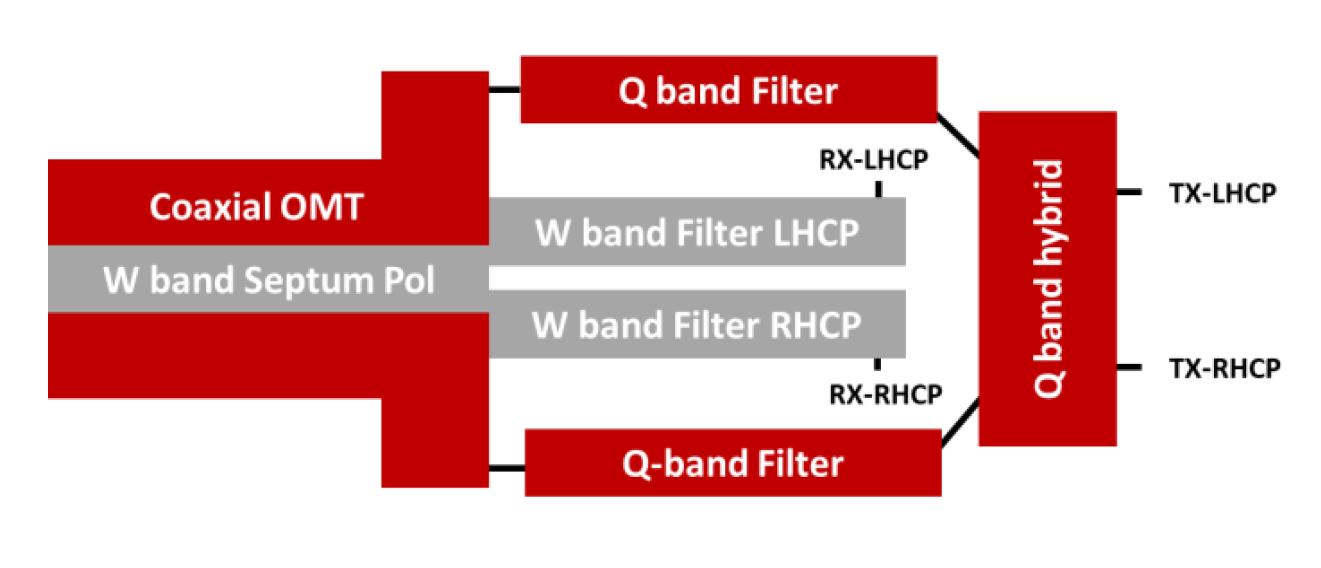
Case 3 (from 71.0GHz to 86.0GHz): a monolithic feed chain and reflector including: 1) diplexers; 2) septum polarizer (circular or linear); 3) feed horn, 4) integrated reflector is baselined.

Plan
The activity starts with a detailed state-of-the-art survey on both RF feed chains in Q/V/W bands and of manufacturing technologies used for such components (WP1). Based on the survey, a finalised technical specification is derived before the Requirements Review meeting.
Then starts the WP2 on technology selection and feasibility, led by CSEM. Different AM technologies are compared based on some benchmark RF geometries. This WP ends with a Technology Baseline Review. In parallel, prior to the completion of WP2, the detailed design and implementation plan (WP3 – led by SWISSto12) is starting, using the first inputs from WP2. WP3 ends with a Manufacturing Readiness Review / Critical Design Review of the feed chains. After the MRR, WP4 focuses on manufacturing up to the Test Readiness Review. WP5 includes all the testing and analyses of the results and is closing with a Test Review Board. After the TRB, a short WP6 is dedicated to the technology assessment and the development roadmap, leading to the Final Review of the activity.
Current Status
Currently, the requirements review meeting (MS1) has been successfully completed and the technology selection and feasibility WP (WP2) is ongoing.