PAGE CONTENTS
Objectives
New projects using the Non-Geostationary Satellite Orbits (NGSO) in higher frequencies are considered to increase the link capacities and the reduction of the number of the required ground sites. However, the links operating at higher frequencies are impaired by higher atmospheric attenuations, which causes link outages and might require additional ground stations to maintain QoS.
The main objective of the study is a system-level assessment of the best approach for implementing feeder links in future Non-Geostationary communication constellations. Three feeder link categories are under the scope of the study:
-
Typical RF feeder link using Ka frequency band (Super High Frequency SHF)
-
Future RF feeder link using V and/or W frequency bands (Extremely High Frequency EHF)
-
Optical feeder links
Different Low Earth Orbit (LEO) scenarios are implemented to simulate the different feeder link designs with a focus on topology, implementation, operations and service-level impacts.
Challenges
Transitioning to higher frequency bands increase the available bandwidth and therefore the link capacity, potentially driving to a reduction in the number of ground sites required. However, links operating at higher frequencies are impaired by higher atmospheric attenuations and might require additional ground stations to maintain availability requirements.
When optical technologies are considered for the links between the ground and space segments, this gives the system a potentially unbeatable capacity per link under the assumption of a clear line-of-sight, a limited atmospheric turbulence and a highly accurate pointing requirement with point-ahead-angle implied by such a low orbit.
System Architecture
The simulation environment easily defines, simulates and compares different system configurations. At high level, a non-exhaustive list of input parameters could be defined by:
-
Constellation pattern
-
Traffic demand and distribution
-
Payload and platform specification
-
Feeder link: data rate vs elevation angle, impairment threshold
-
Ground stations: locations, azimuth-elevation mask, number of antennas, sun exclusion angle
-
ISL topology
-
Date and duration of simulated period
-
Weather dataset
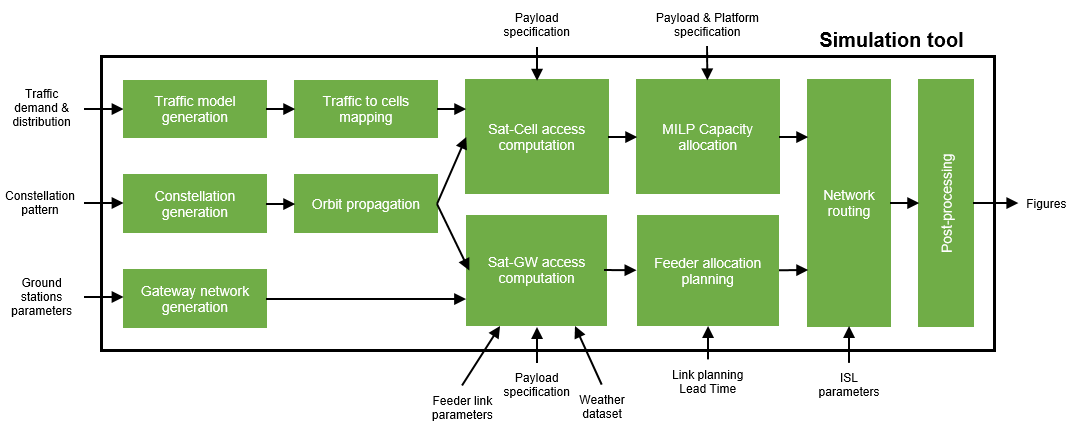
From these inputs, a functional block diagram of the simulation tool is presented here below. Functionalities of two blocks of importance are detailed below:
-
Satellite-to-GW access block does not only consider geometrical visibilities but also EPFD constraints and an access computation scheme taking into account atmospheric impairment as well as station and payload characteristics.
-
The Feeder allocation planning algorithm defines the sequence of ground stations that are connected to each satellite taking into account the handover constraints and minimizing the required number of antennas per site.
Plan
Kick-off of the project, October 2022.
Scenarios Definition Review, January 2023
-
Definition and justification of 2 constellations, traffic model considering representative of future demand.
-
Definition of a list of candidate teleport locations RF and Optical with relevant locations.
-
Definition of feeder link designs including architectures for RF and optical frequencies.
-
Trade off over representative architectures.
-
Link budget analysis considering ITU recommendations, atmospheric impairments, different elevation angles and availabilities.
Performance Review, April 2023
-
Detailed analysis and justification of representative scenarios and architectures
Final Review, 21st November 2023
Current Status
Finalized