PAGE CONTENTS
Objectives
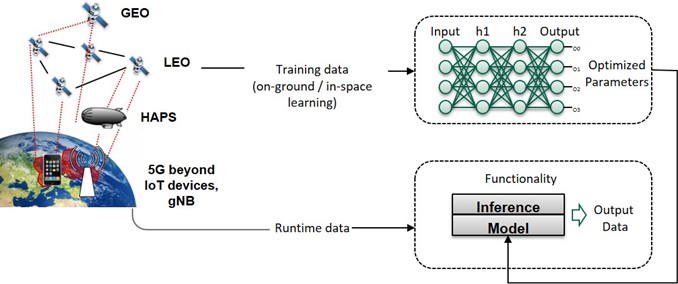
The overall goal of the project AIComS is to develop AI/ML-based SW/HW platforms for future products of an integrated satellite and 5G & beyond communication network. It focusses on the development of ML-based 5G NR Physical (PHY)-Layer components and 5G & beyond compliant ML-based routing, network slicing, and security components.
The following developments are targeted by the project activities:
- 5G Non Terrestrial Networks (NTN) Baseband Processing Platform: Development of data driven baseband technologies for 5G-NTN Radio Access Network (RAN) with different functional splits.
- 5G AI Satellite Packet Router: Development of data-driven network and service technologies.
- 5G AI Satellite Packet Router: Development of data-driven IT security concepts.
- AI based Fault Detection, Identification and Recovery (AI-FDIR) Software: Development of data driven prediction methods
- AI based Formation Control (AI-FC) Algorithms: Development of data driven formation control algorithms.
- AI based Very Low Earth Orbit, Orbit Control (AI-VLEO-OC): Communication aware development of data driven antenna beam pointing, navigation and Attitude and Orbit Control System algorithms as well as drag compensation.
It will be an outcome of the project to gain knowledge about the appropriate degree of autonomy by means of AI or how much control is still required.
Challenges
AIComS aims to replace so far model-based designed functionalities with their data-driven AI-counterparts. The key challenge is on developing and implementing AI/ML concepts for HW/SW platforms for Low Earth Orbit (LEO) satellite connectivity leading to an improved cost-benefit ratio. In this context the effect of (un-)explainable AI on the implementation of communication network functionalities and safety critical functions is challenging.
System Architecture
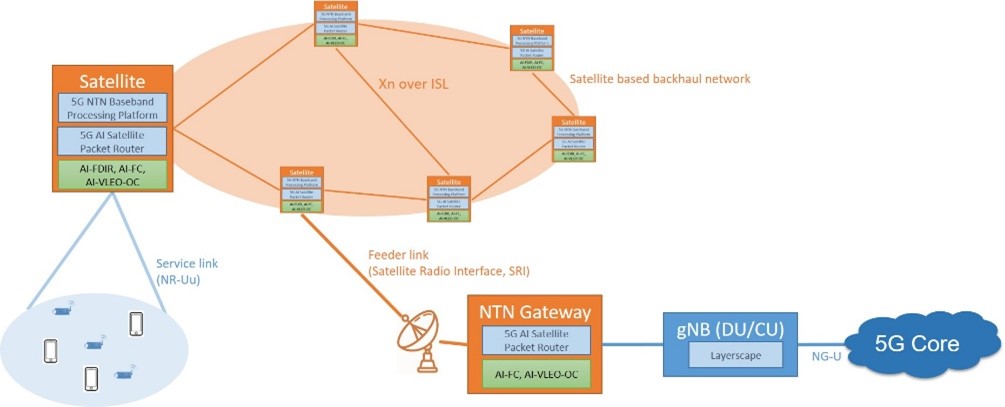
AIComS considers a regenerative satellite-based NG-RAN architecture following the ongoing discussion in 3GPP. The figure shows the assignment of the target main products to the network elements to be developed in AIComS.
Plan
The project consists of two development steps.
In the first step the basic concepts for the targeted main products have been investigated. The first step included two reviews. For MS1 the preliminary design was provided in Q2/23, whereas MS2 in Q4/23 delivered preliminary conclusions and recommendations of this development step.
The ongoing second development step targets to advance these concepts towards development, evaluation and verification of the corresponding products. This second step encompasses four reviews and is planned to last for 24 months.
Current Status
The first development step has been successfully completed. The identified use cases, scenarios and potential architectures have been reported and the basic concepts for the main target products have been investigated. Furthermore, for the main target products the hardware setups have been designed.
The second development step was kicked off February 2025. This step includes the ongoing development of Machine Learning algorithms for baseband processing and their implementation on the High-Performance Data Processing Unit (HPDPU), and the support for the deployment of DU/CU functionality on the selected Layerscape platform. For the 6G AI Satellite Packet Router networking components and security features are expanded and the work on setting up the hardware and the testbed are ongoing. Finally, the hardware-in-the-loop simulation environment for the satellite architecture tasks is being developed, acting as foundation to test the identified concepts on fault detection, identification and recovery (FDIR), formation control, VLEO flight control and beamforming.
Documents
Related Links
Companies