PAGE CONTENTS
Objectives
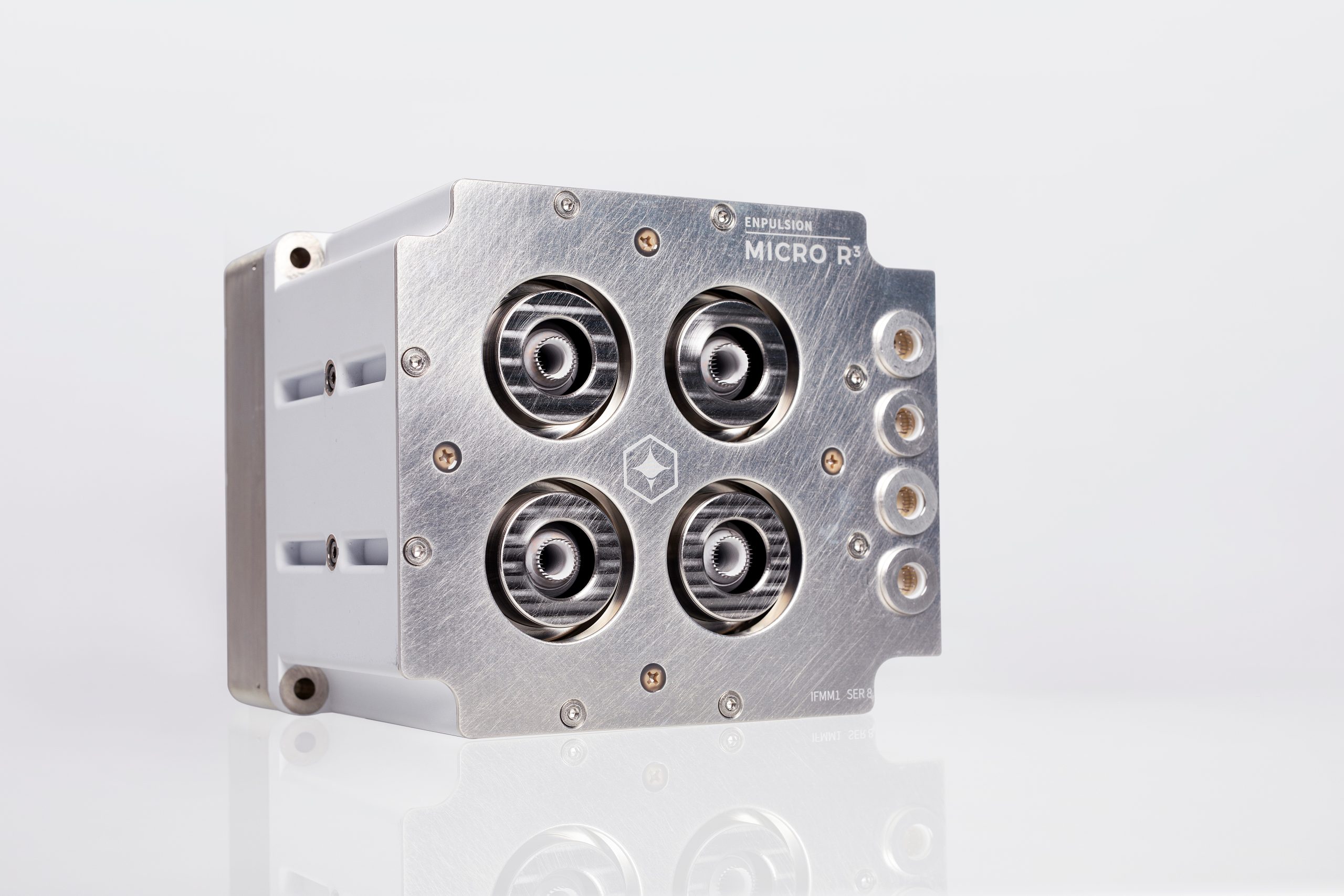
The project objectives were the design and industrialization of a 100W class electric propulsion system suitable for small spacecraft. This included review of requirements definition and maturation from proof of concept prototype to flight models.
The industrialization objectives covered improvements in production efficiency and qualification of production processes to ECSS standards.
Challenges
This propulsion system is intended to be the highest power FEEP thruster flown. The main development challenges are the total impulse density and extreme compactness of the desired system. It is also intended to operate crown emitters at a current level not attained so far.
System Architecture
An electric propulsion thruster comprising a power processing unit (PPU) and an emitter assembly (EMA). The PPU is divided into a microprocessor based control electronic and a high voltage part supplying the EMA. The EMA contains the four ion emitters, a fuel tank, neutralizer cathodes and temperature sensors.
Plan
The project has been divided into 3 main efforts:
-
The design of the thruster as a 100W compact unit which included a strong thermo-mechanical simulation component
-
The improvement of manufacturing methods both in terms of quality and product assurance but also yields.
-
A fundamental study of the operation of porous crown emitters at higher current to increase the specific impulse of the technology.
Current Status
The project has been completed and resulted in a design and production line ready for qualification model production.
Some thrusters have been delivered to customers and one is currently on orbit.