PAGE CONTENTS
Objectives
The second era of Lunar exploration is starting now. It goal is to expand humanity into the Solar System, thereby developing new markets, and new economic opportunities.
These plans have to be adequately supported by a communication infrastructure, which is currently under study (e.g. Moonlight initiative).
The Interagency Operations Advisory Group (IAOG) has conducted an internal study to define a possible overall Lunar Communications Architecture, and to identify the different communication links between the different nodes and the related frequency assignations. In this view, optical communications are introduced for several scenarios, because they can offer a great advantage in terms of support for high data rates, exploiting high efficiency modulations and leveraging upon components and system solutions developed for fiber communications.
OCRSG has the aim to:
-
investigate/ review the cis-lunar communication scenarios and architecture, also involving the Deep Space Gateway
-
perform a technological specification and preliminary design of the optical terminals required to support 2 Gbps communications in the above scenarios
-
identify the critical subunits of the optical terminals and define the associated performance requirements.
-
perform a technology survey and derive the technology roadmap for the critical technologies (e.g., optical/optoelectronic).
Challenges
The main challenges for this study derived from the extremely wide and complex context of future lunar communications. For example, it is foreseen to have in the future several constellations and missions around the moon and on its surface, but no details are yet available; e.g. the mission analysis strongly drives the optical terminals’ technical requirements and design, especially in terms of Field of Regard – FoR, pointing, etc. A strong effort has therefore been put in deriving reasonable requirements from assumptions and for general scenarios, ending up in a good compromise between tailoring and standardization.
System Architecture
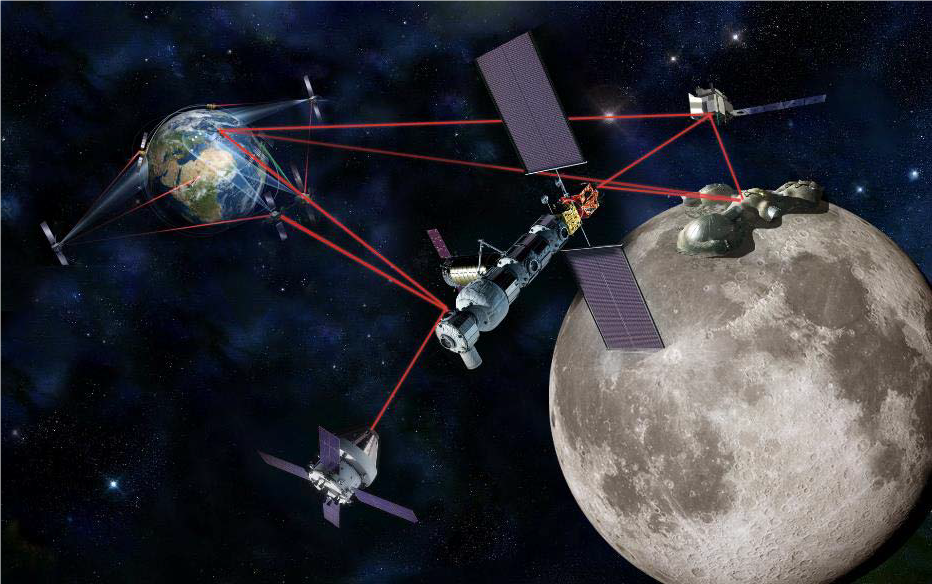
The system involves several terminals, in order to fully cover, in a reliable way, a future Lunar communications infrastructure, where optical technologies offer an advantage with respect to radio-frequency links, and in compliance with the IOAG standardization proposal.
Starting from the optical stations on Earth, the link will be established with the Moon both using Lunar orbiters (on different orbits, from the highly elliptical Gateway to the lower-altitude future service constellations – which all have to be able also to communicate with each other) and surface assets, such as fixed stations and mobile assets. To overcome the impairments on the laser signal due to the terrestrial atmosphere, also links through GEO relay satellites are studied and designed.
Each terminals’ sizing is driven by the needed field of regard (different for each scenario), telescope sizing, optical power, data rate and modulation scheme.
Plan
A detailed project plan has not been studied, as it can be prepared only based on a specific design, based on a single, or however limited, use case, linked to its mission analysis and with a precise definition of the platform’s interfaces and environmental and accommodation constraints (e.g. the extreme temperatures foreseen on the lunar surface, the lunar dust, etc pose heavy design drivers for the related terminals). However, in the final roadmap a rough estimate has been provided, assessing that this technology could be ready in the frame of 5-7 years from now.
Current Status
COMPLETED
The study started with a wide research on: Moon exploration missions, related communications scenarios, existing technologies with the aim to demonstrate where optical communications are advantageous with respect to RF technologies, for 2.1 Gbps DTE, Proximity and ISL.
A technical specification for a set of optical terminals has been derived through link budget analyses. Accordingly, a design is proposed, derived from existing TAS-CH terminals, highlighting the technological gaps between with the state-of-the-art. In next phases, a practical approach to the different identified technology gaps should be pursued, together with holistic approach to the architecture and system specification, driven by specific user needs. A revisit on the requirements on the OGS side is also strongly advised.