PAGE CONTENTS
Objectives
The objective of the study was to identify, then communicate to major European target users and stakeholders, the key technical, programmatic and financial conditions under which critical European needs for connectivity could be addressed by an autonomous, secure, high-performance, resilient and accessible satcom system.
Through this study, we propose a strong and sound contribution that can be used to lay the groundwork for the emerging initiative of a new European space flagship programme focused on telecommunications.
Challenges
The challenges of this study were twofold. First, leverage space building blocks of varying maturity in order to design an innovative and future-proof concept for the infrastructure. Second, find a satisfying balance in infrastructure design between private needs and institutional needs, providing sovereignty and security guarantees to the latter while ensuring economic competitiveness for the former.
System Architecture
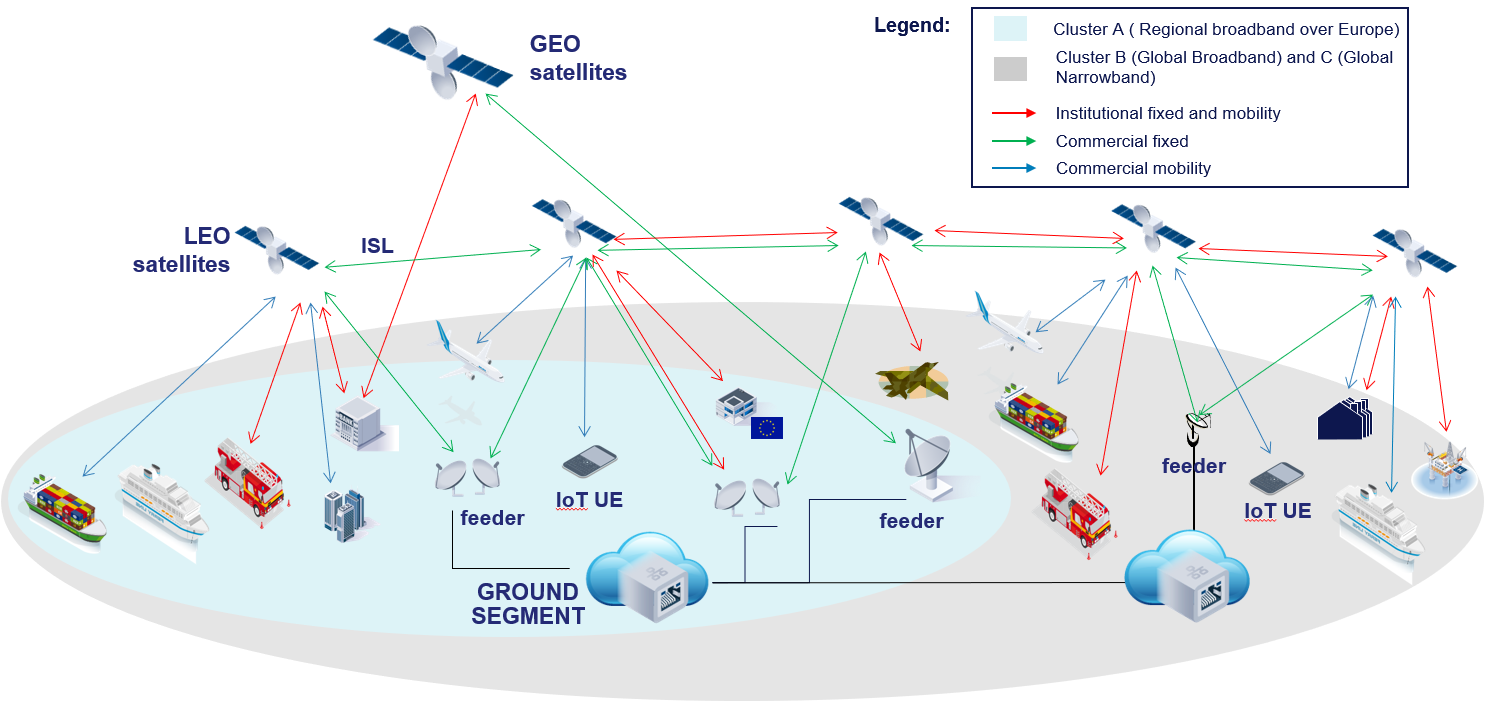
The proposed system combines satellites in several orbits in order to cover the wide range of use cases.
The GEO component comprises a committed European VHTS satellite covering Europe, complemented by 1 new additional GEO satellite for European capacity, and 1 to 2 additional GEO satellites for Rest of the World coverage.
The LEO component comprises a new narrowband constellation providing low throughput on a global coverage, as well as a broadband constellation with various options depending on the demand scenario: 100-250 satellites at ~1,300km altitude, or 450-1000 satellites at ~600km altitude. Polar coverage is studied as an option.
Plan
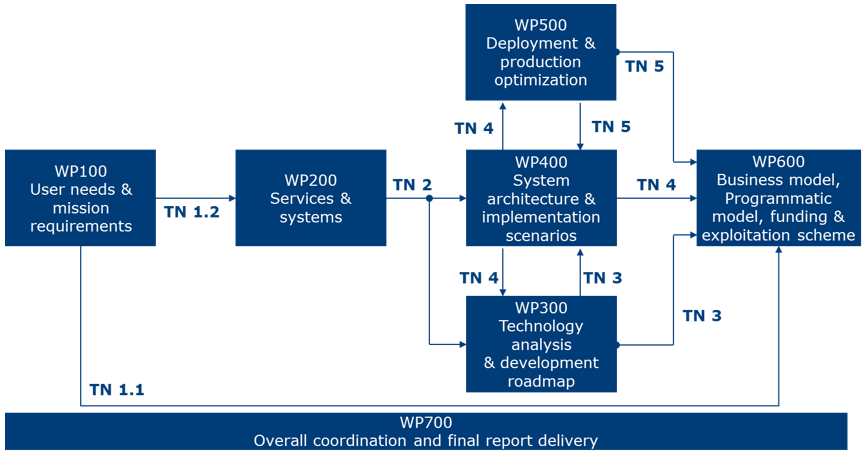
The project starts with an extensive analysis of the institutional and commercial use cases described in the ESA Artes ITT, in order to translate them into Mission Requirements, that are then boiled down to Service and System Requirements. The project team then goes into an iterative loop, studying system architecture, technology development, as well as deployment and production aspects. This loop converges on a few architecture and implementation scenarios, for which we study potential business models, funding schemes and programmatic aspects.
Current Status
The consortium has succesfully carried out all the proposed tasks, leading to a few variants of possible system architecture, the identification of the required technological building blocks, and guiding principles with respect to business model and public / private financing.