PAGE CONTENTS
Objectives
The objectives of this project are the following:
- Develop a waveguide-based solution for a transmit (Tx) direct radiating array (DRA) operating with dual-circular polarization in Ku-band based on additive manufacturing (AM).
- To achieve state-of-the-art RF performance of the antenna array while having a competitive mass budget compared to existing PCB-based solutions.
- To manufacture and test all the critical elements that compose the passive part of such an active antenna, based on AM.
Challenges
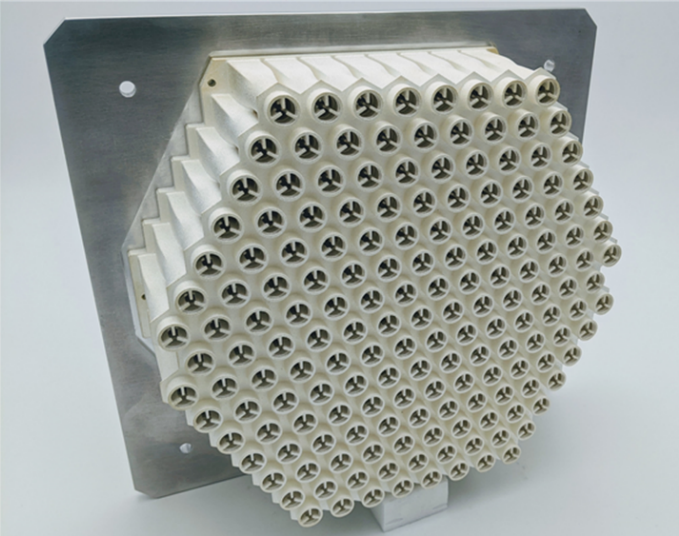
The biggest challenge of this activity is the manufacturing of a monolithic antenna array using additive manufacturing (AM). Despite the small inter-element distance on the array, the possibility to obtain a dual-circularly polarized passive antenna aperture, fed with GPPO connectors, is demonstrated.
System Architecture
The system architecture is relatively straightforward. GPPO connectors are used to feed two singe-ridged waveguides per radiating element. The ridged waveguides are then connected to a septum polarizer that generates the two circular polarizations. The (Tx) radiating element is a tri-ridged circular mini-horn. A waveguide filter able to reject the Rx Ku-band and several radio-astronomy bands up to 24 GHz is demonstrated and de-risked on a separate breadboard.
Plan
The project has two phases, one focused on the design and one of the manufacturing and testing of the breadboard. First, a Requirements Review meeting helps to select and freeze the requirements for the antenna design. Then, a detailed RF and mechanical design as well as the detailed test plan for the breadboard are developed and consolidated on the Design Review meeting. The success of the manufacturing process is then evaluated during the Test Readiness Review meeting, before the execution of the detailed test plan. All the obtained results are carefully reviewed during a Test Review Board meeting and further actions for the investigation and analysis of the results are decided. The final work package serves a dual purpose: (a) analysing the obtained results and identifying potential improvements after critically evaluating the achieved performances and (b) thinking about the future product development steps, including a roadmap and a market status evaluation. All these objectives are discussed during the Final Review meeting with the Agency.
Current Status
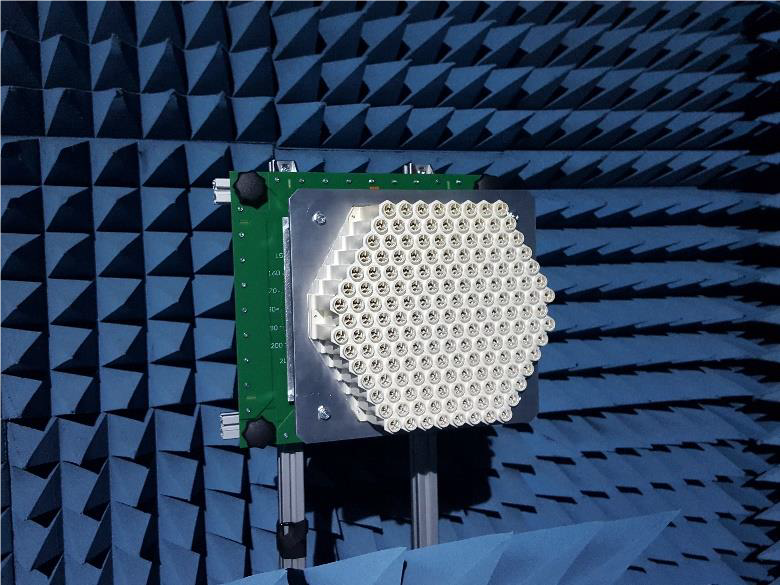
The project is completed by successfully manufacturing and testing an antenna array breadboard with 167 dual-polarized Tx radiating elements in Ku-band.
Companies