PAGE CONTENTS
Objectives
The purpose of FOLC project was to manufacture and test in laboratory environment a breadboard of the optical communication chain including:
- The optical transmitter (Tx) with its own electronics. The key enabling technologies of this piece of equipment are the distributed feedback (DFB) lasers and Mach-Zehnder modulators (MZM).
- The optical receiver (Rx) with its own electronics. The key enabling technologies of this piece of equipment are the low noise optical amplifier (LNOA) with rare earths-doped fiber, fast photodiodes and Mach-Zehnder delay line interferometer (MZDI).
- The optical booster, also known as high power optical amplifier (HPOA), with its own electronics. The key enabling technologies of this piece of equipment are the rare earths-doped fiber and high power pumping diodes.
Those elements have been first implemented and tested separately by the partners of the consortium (iXBlue and CILAS) and then combined with each other on a global system test bench (STB) to assess overall performance of the optical communication chain.
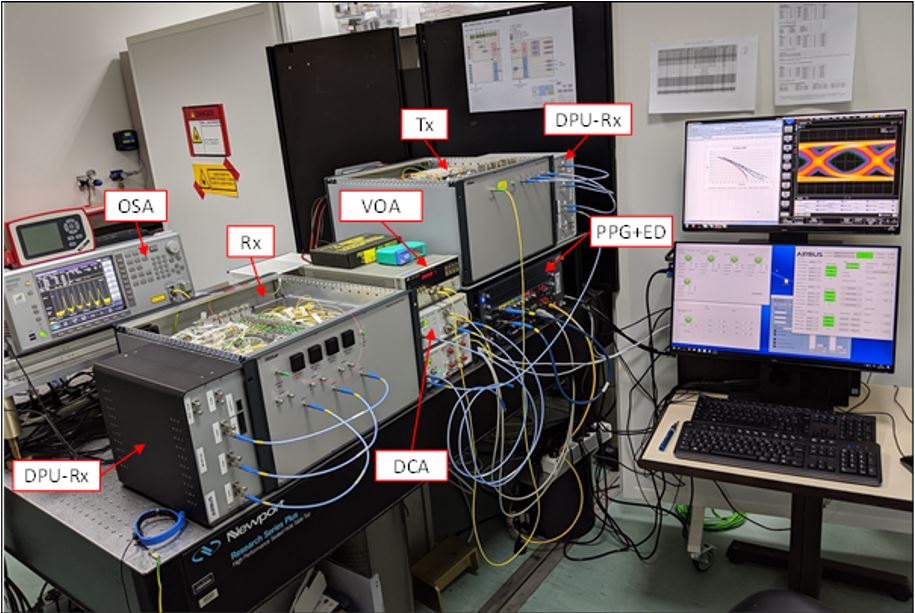
Global picture of the fibered part of the system test bench
Challenges
One of the main goals of the System Test Bed measurements was to assess the sensitivity of the optical link under several configurations (data rate, modulation, channel impairments, etc…). The sensitivity is defined as the mean received optical power (ROP) per channel (i.e. per wavelength) required to achieve a target BER. The ROP is measured right at the input of the receiver part of the transceiver.
The measurement of various configurations allows selecting the best solution at system level for the product development phase in terms of complexity / cost vs performances.
System Architecture
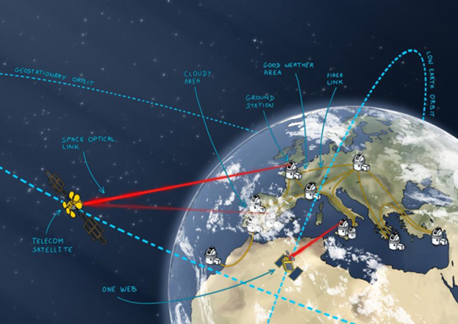
The primary use-case targeted by FOLC project was to propose a capacity ramp up based on optical feeder for the LEO OneWeb constellation. The idea was to operate a hybrid optical/RF architecture at the system level: each optical satellite is interleaved between two RF satellites. One optical and one RF satellite are therefore always in visibility of each user. The purpose of the optical satellite is to provide improved capacity if weather allows it, whereas the RF satellite ensures the system availability. No optical handover is considered in this approach, the continuity of the service being ensured by the RF satellite.
In terms of platform capacity, it is possible to increase the frequency reuse in order to quadruple the user link capacity. Thus, the proposed optical feeder has to carry 16 GHz-bandwidth in forward (from gateway to users) and 8 GHz-bandwidth in return (from users to gateway).
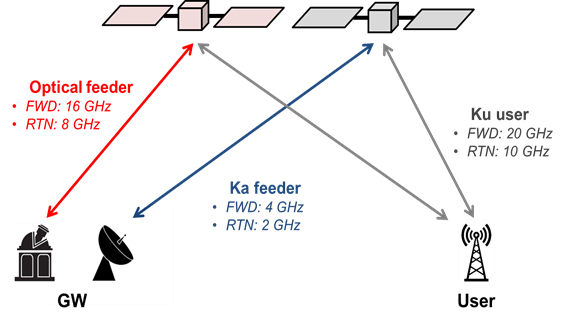
System architecture
Plan
In order to establish the input document, ie the communication items performances document, a prior work has been realized by Airbus (based on internal funding) to establish the communication chain requirements and its associated design justifications.
During FOLC project, the Rx chain, the Tx chain and the optical booster breadboards were manufactured, Integrated And Tested on partners laboratories.
Each element was then integrated and validated on the Airbus DS System Test Bed (STB). Finally, the end to end communication chain was tested, including the atmospheric emulator, the Acquisition & Rear Tracking System and the Fibre Injection Mechanism.
Current Status
The FOLC project is now finished, the final review was successfully held with ESA in July 2019. All the components of the FOLC communication chain have been manufactured and tested individually, then altogether on the System Test Bed in various configurations of data rates (10Gbps/25Gbps) and modulations (OOK/DPSK).
All the test results and lessons learned have been used to define the optimum product baseline for the product development phase, named FOLC 2, to follow this technology activity.