PAGE CONTENTS
Objectives
The objective of this activity is to develop and test a collapsible flexible hinge, based on CFRP blades, with improved damping and, most important, significantly reduced end-of-travel shock, without the risk of overshooting. The solution needs to be based on the available hinge design (i.e. UDM design). The required solutions for damping and shock reduction need to be fully integrated in the hinge design and shall not be provided by an additional mechanism, as this would jeopardize the present advantages of the elastic collapsible hinge. Therefore, integrated solutions with passive damping (no power consumption) or active damping (no power consumption) and minimal requirements to external interfaces need to be identified and fitted to the existing hinge design. Particular care has been taken to achieve the simplest design, but also to achieve manufacturing and integration approach that is as simple as possible. This easy to handle and produce approach increases the market potential of the final product in the future.
Challenges
One of the biggest challenges is very low end-of-travel shock. Together with the objective of low mass and power consumption, this addresses high requirements to the damping material. Where visco-elastic materials which representing a passive damping are strongly affected by thermal environment and active damping solutions often require high amounts of power, a well-balanced solution combining the advantages of both has to be developed. Taking the changing torque during deployment into account, the damping device should automatically balance the resistive and deployment torque in order to ensure a smooth deployment, the required low shock and to avoid overshooting.
System Architecture
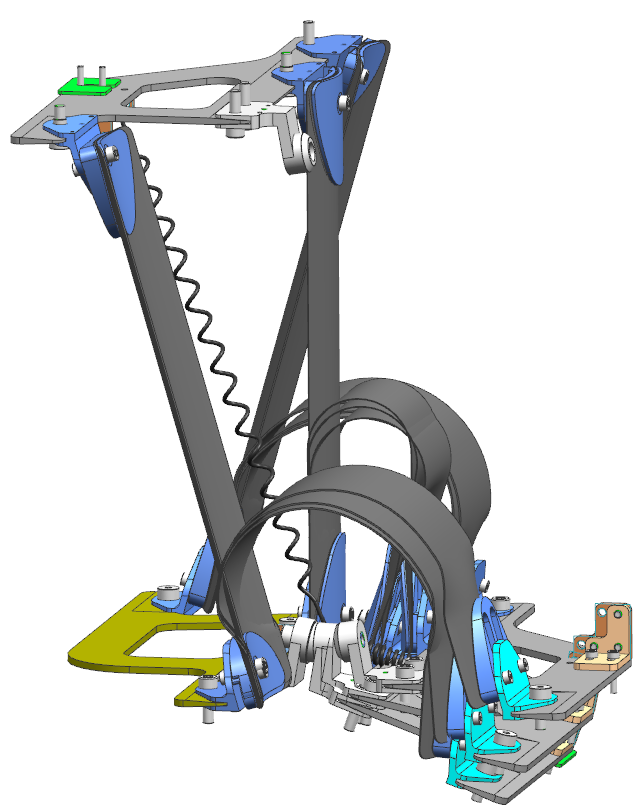
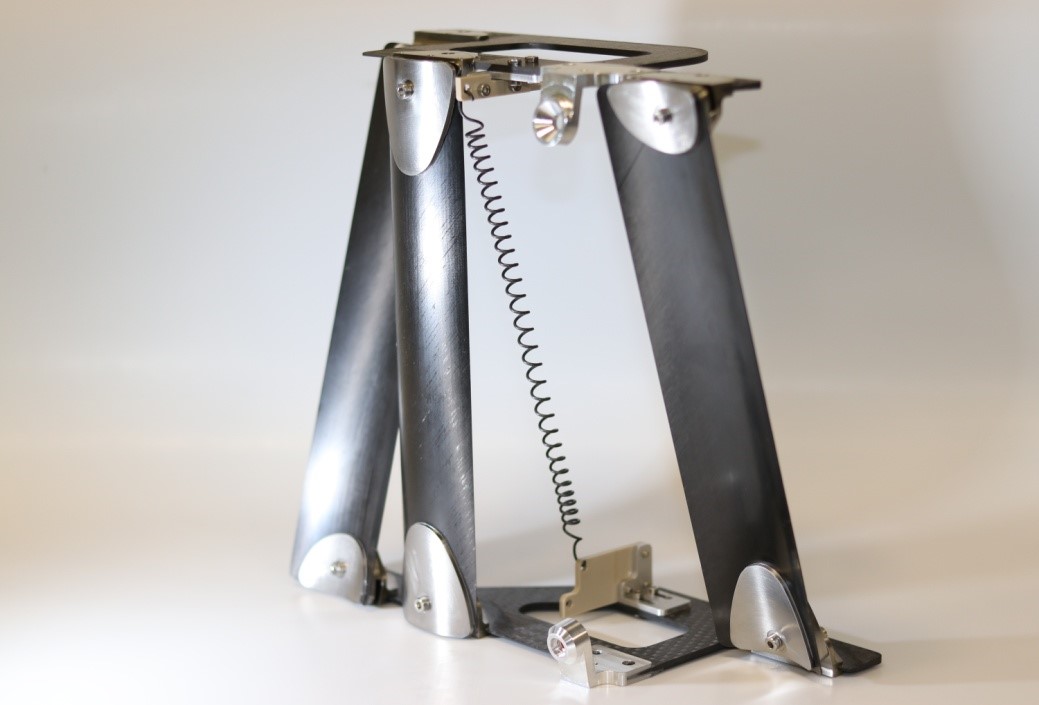
The general design of the DUDM is shown hereafter. It consists out of two CFRP interface plates with bonded titanium brackets, three CFRP blades (1 Straight Blade and two X-Blades) which are bonded and clamped with the titanium brackets and an HDRM. The arrangement of the blades results in a structure similar to a frame and provides a stiff structure in the deployed position. It allows a bending of the DUDM up to an angle of 200°.
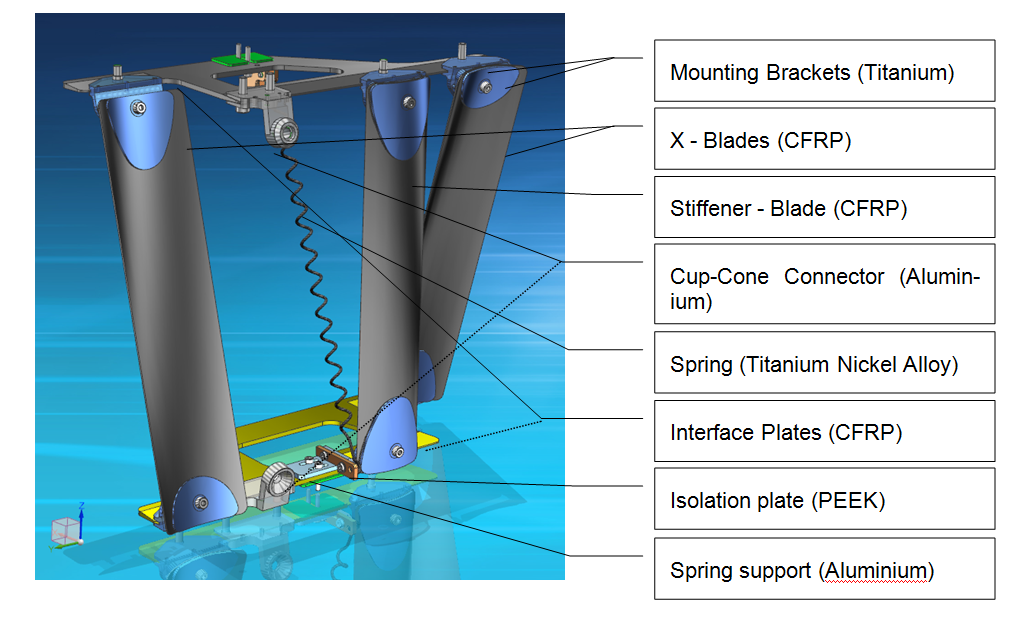
The most critical and hence most important parts at DUDM level are the blades. CFRP was chosen for the blades mainly due to the low and controllable coefficient of thermal expansion (CTE) in axial direction. This is important for low thermal distortion and high accuracy. The Mounting Brackets are made of TiAl6 in order to meet a low CTE and high stiffness. The damping spring is made of a Titanium Nickel Alloy which is isolated from the structure by plates made out of PEEK.
Plan
The project has been subdivided in:
- Task 1: “Requirements specification and Concept Trade off”, where several active and passive concepts have been assessed and evaluated with the objective to go on with.
- Task 2: “Preliminary Design” of one active and one passive concept.
- Task 3: “Demonstrator Development Plan” has defined a strict way forward through the next Tasks.
- Task 4: “Development Sample Tests” were performed to evaluate the most suitable concept which is used to enable-
- Task 5: “Detailed Design” of the selected concept.
- Task 6 and 7: has covered the Manufacturing, Assembly and Test Phase.
Current Status
A damping device has been successfully developed and a wide test campaign has been performed to validate the requirements. In addition, a new blade material has been used and an all-embracing material validation campaign was successfully performed. Thereby this damped deployment hinge is qualified up to Technology Readiness Level 5.