PAGE CONTENTS
Objectives
Telecommunication satellite systems are raising in complexity: new LEO constellation projects are under development, targeting not only low speed data collection (Internet of Things) or mobile satellite communications, but also broadband and broadcast services. Mastering technological development and the cost of these constellations and at the same time being able to assess the offered Quality of Service (QoS) is critical to secure the business case of the satellite operator.
The objective of the SCNE project is to develop a simulation tool to be able to study and assess the protocol performances of these upcoming LEO constellations, in particular routing protocols which may affect the end-to-end QoS.
- Routing solutions
- Transport protocols for broadband data delivery and web access over satellite
- Caching mechanisms
- Impact of security solutions
- Inter-satellite link characteristics, user link characteristics, and the satellite telecommunications payload functionalities at layer-2 and above.
Challenges
As the future telecommunication satellite systems are raising in complexity, more advanced simulation tools are necessitated. But, on the other hand, also the complexity of the simulation tools is increased. From this perspective we have identified a couple of challenges for the simulation tool:
- Need to both design & define the LEO satellite constellations and the data communication protocol performance.
- Run-time performance of the SCNE simulation tool. Note, that there is always a trade-off between run-time performance and accuracy of modelling, which needs to be carefully considered.
- The details of both future LEO constellation systems (satellites, orbits, air interface protocols, etc) are not known, so the simulator needs to be flexibly configurable and extensible for future needs.
System Architecture
The SCNE is composed of three main components: COTS orbital simulator (STK), open-source network simulator (ns-3) and the SCNE orchestrator.
- Commercial STK license with Professional and Communication modules for the satellite system design and orbital simulation (generation of satellite movement, visibilities, and link budget).
- Orchestrator capable of generating the STK scenario configuration files for the network simulator.
- Network Simulator (ns-3) for simulating (re-playing) application traffic and related communication protocols on top of the satellite constellation.
The SCNE architecture is presented in the following figure:
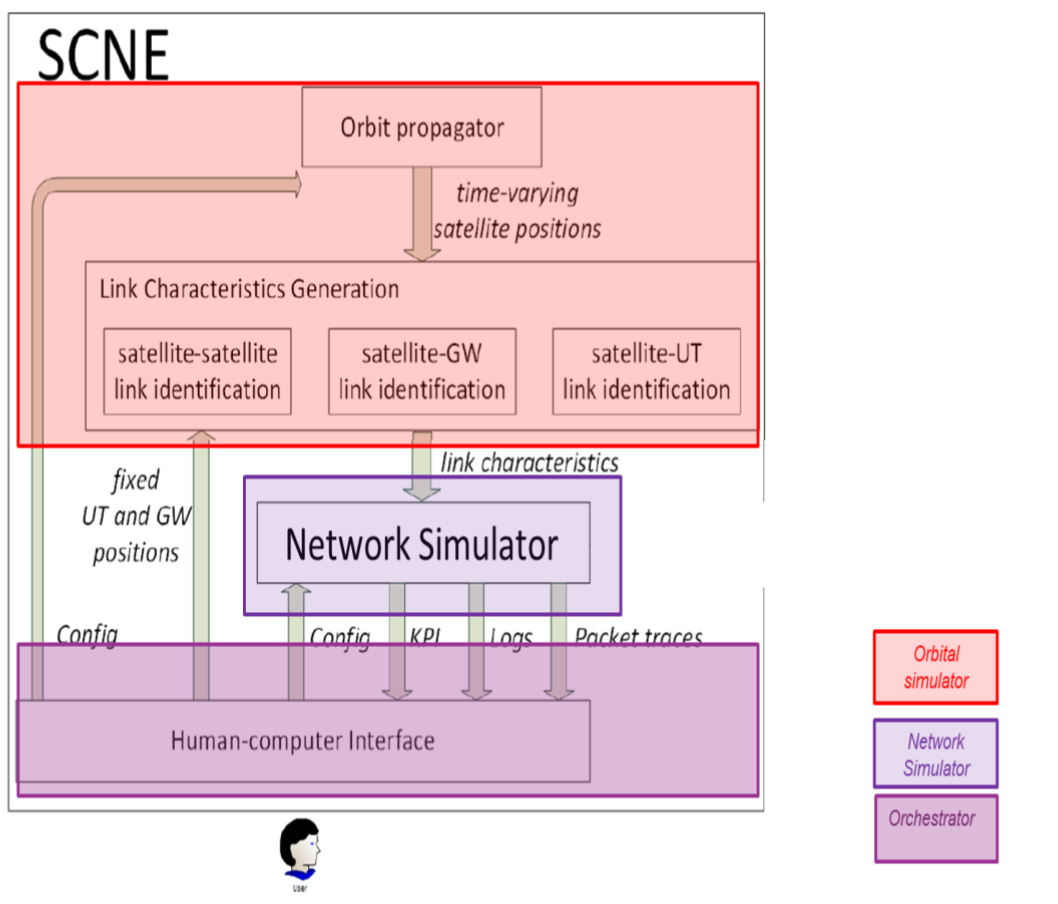
A decoupled architecture was selected:
- Create (design) the satellite scenario in STK (using GUI or scripting)
- Run SCNE Orchestrator to create the network simulator configuration files.
- Configure and run SCNE network simulator using the previously generated traces and config files
- Analyse the SCNE network simulator results
Plan
The project is composed of 6 phases:
- Requirement Specification
- High Level Design
- Detailed Design
- Implementation
- Integration
- Validation
There are 6 project milestones:
- Kick-Off Meeting (KOM)
- SRR
- Preliminary Design Review (PDR)
- Critical Design Review (CDR)
- Acceptance Review (AR)
- Final Review (FR)
The main deliverables are the SCNE (hardware + software) as well as complete documentation and user manual.
Current Status
The project Final Review was held on July 1st 2021. Project Final Presentation is targeted to be kept in September 2021.