
PAGE CONTENTS
Objectives
The high-level project objective was to provide a tailored architectural and technological solution for performance optimization of end-to-end IP-based services, when a satellite component is present in the communication path. Target scenarios are compliant to upcoming 5G use-cases.
VIBeS project outcomes allow to review the role of Performance Enhancing Proxy (PEP) agents, redesigned as a set of Virtual Network Functions, namely vPEP. In this innovative perspective, the vPEP is following a top-down orchestration approach to flexibly satisfy the requirements of each application, on a “slice” basis. The proposed approach allowed to pursue the following technical objectives:
- Rapid service innovation and then modifications through software-based deployment of functions, in order to satisfy possible evolving requirements;
- Improving operational efficiency through process and procedure automation, even allowing the possibility to transfer a PEP context to really guarantee mobility;
- Greater flexibility on applying flow-specific rules, implementing methods to discriminate traffic by type, pattern, and performance requirements.
Project objectives were verified through a Proof of Concept (PoC) real-time platform, reproducing a sub-set of significant converged 5G satellite-terrestrial scenarios:
- Satellite backhauling for traditional Web browsing from LTE/5G mobile users;
- Large-scale Web streaming services for fixed (i.e. ADSL) and mobile (i.e. LTE) users;
- Distributed M2M communications.
Challenges
The main challenge was to provide the basement technology to launch an evolved view of satellite role in current and future 5G scenarios, enabling flexibility and improved performance, through the joint exploitation of virtualization paradigms and recent Web technologies. This represented a very ambitious goal since satellite platforms were traditionally designed as stand-alone, not interoperable and application-driven systems. Challenges covers different areas:
- architecture (i.e., distributed orchestration of NFV, SFC, pairing, hybrid network slicing);
- performance (i.e., reduction of latency for interactive applications, efficient combined use of multiple links – offload, effective caching);
- validation (implementation of a flexible and fully representative of the target 5G network/scenarios PoC testbed).
System Architecture
VIBeS project addressed a system architecture where vPEP is integrated in a converged satellite-terrestrial system. The figure below depicts the general deployment model tailored to reproduce target 5G services and architectures in a PoC testbed.
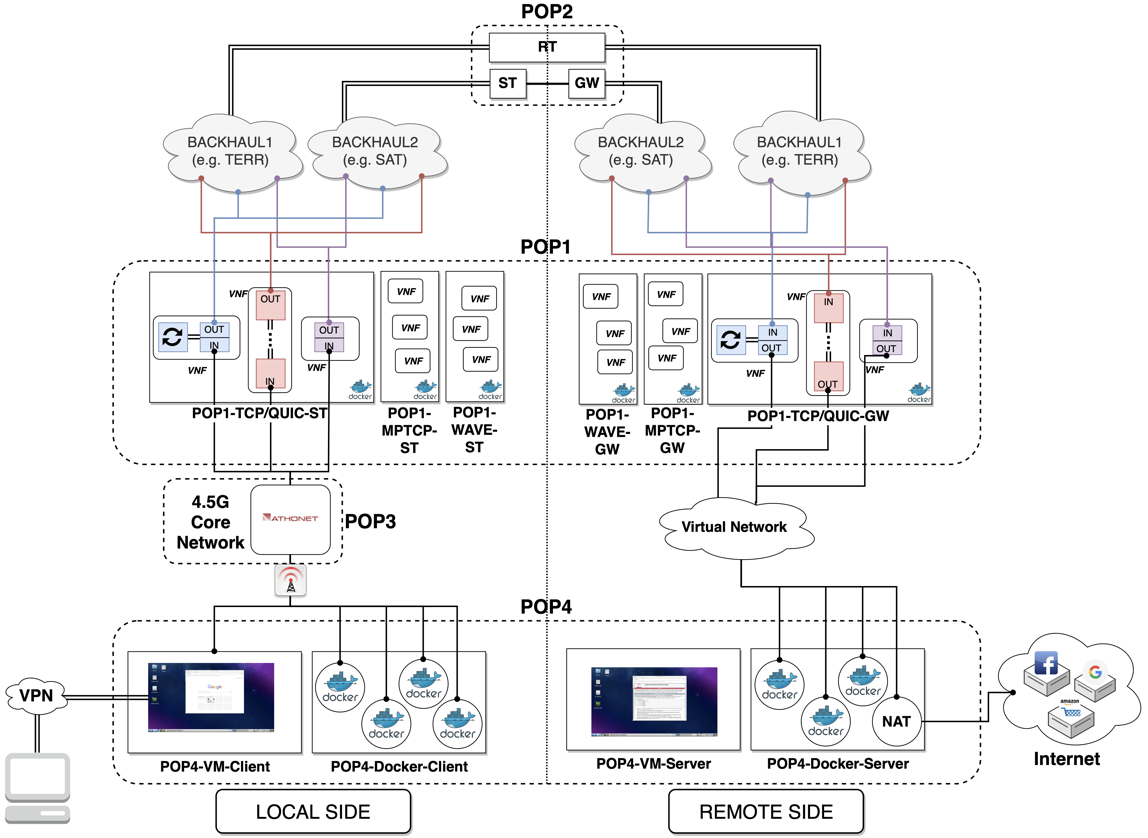
VIBeS testbed can be split into four NFV Infrastructure Points of Presence (NFVI-PoP) with dedicated hardware (network, computing and storage resources).
The vPEP-PoP (POP1) hosts a chain of orchestrated VNFs to improve target services provision over satellite-integrated communication scenarios. This component is under control of a Satellite Virtual Service Operator (SVSO).
The Satellite Baseband Infrastructure-PoP (POP2) provides the emulated physical satellite infrastructure for forward and return links. This component includes all the non-virtualized elements under the control of a Satellite Network Operator (SNO), as well as emulation of terrestrial links.
The terrestrial network PoP is composed of two macro-blocks: (1) a vEPC for mobile access through 4G radio fronthaul (POP3); (2) a core network managing connections with public Internet or local IP services (POP4). The whole testbed network resources and POPs are managed by a centralized ETSI-MANO custom orchestrator based on OpenBaton.
Plan
The project duration was 24 months (KO March 14th 2018) plus 12 months of availability of the testbed at contractor premises. The work flow was developed through three main not overlapping WP lines: WP1000 (Internet performance over satellite and Architecture), WP2000 (VNF-PEP testbed), WP3000 (Demonstration and results exploitation). Four milestones: Baseline Design Review (BDR, KO+6), Critical Design Review (CDR, KO+12), Preliminary Performance Review (PPR, KO+18), Final Review (FR, KO+24).

Current Status
The activities planned in the first 24 months were successfully concluded. The test bed is ready for use.