PAGE CONTENTS
Objectives
Fiber-optical sensors are used in many fields but are currently not yet established in spacecraft. PhWP aims to examine the use of them in spacecraft panels.
The project evaluates in detail
- AIT effort,
- mass impact,
- power impact,
- reliability and FDIR capability,
- EMC/EMI,
- costs and
- possible applications
of FOS and compares the properties with the ones of commonly used electrical sensors.
Following this, a photonically wired spacecraft panel breadboard is designed and tested.
Challenges
Fiber-optical sensors (FOS) reacts with wavelength shifts at inscribed Fiber Bragg Gratings (FBG) when suspended to temperature changes and strain. In order to use FOS for temperature housekeeping in spacecraft the FBG has to be decoupled from the surface since otherwise it is not possible to differentiate between a change in strain or in temperature.
Another challenge which needs to be faced is redundancy. PhWP aims to demonstrate fiber-optical sensor buses which also serve as means to transmit data. In case of fiber breaks at any point, the functionality of parts or all sensors and the data transmission is noto given anymore, which significantly reduces the reliability and endangers the mission. Reliability concepts when using bus networks need to be established and tested.
System Architecture
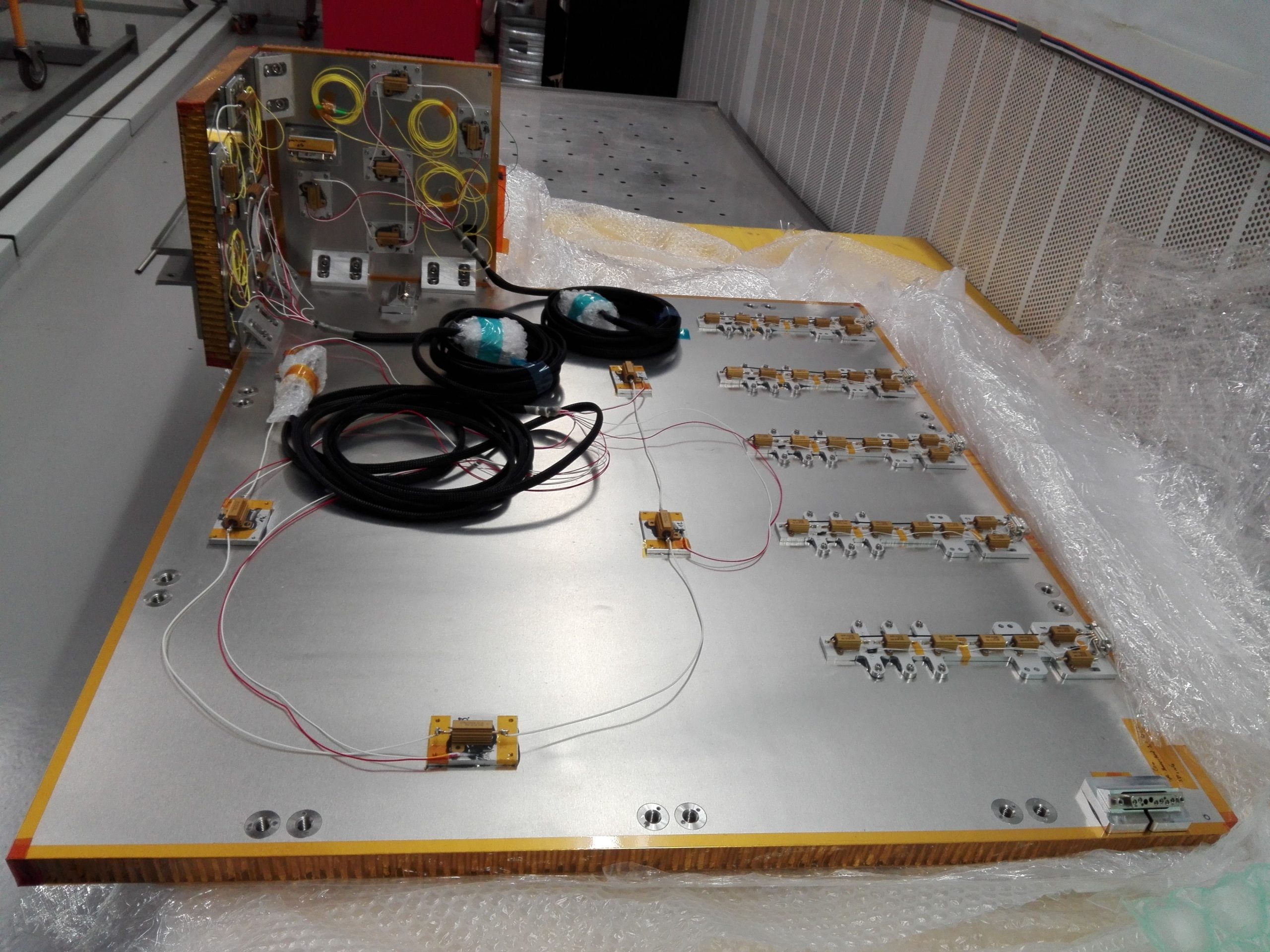
PhWP consists of three individual panels arranged in a 90° setup as show in the figure below.
The panels have the size of 90 x 90 cm and 30 x 30 cm respectively. The fiber-optical network featuring fibers for housekeeping measurements and data transmission are embedded in the panels and accessible via fiber-optical connectors for the interrogation and interconnectivity between the panels.
Plan
The PhWP project is subdivided in two steps with the goal to establish a techno-economical assessment of photonically wired spacecraft panels. In the first step a review of the photonic technology is to be carried out in parallel to survey the state-of-the-art satellite platforms w.r.t. AIT and mass parameters for housekeeping. After an architecture definition and the selection of the key components the breadboard shall be designed as initialization of step 2. The manufactured breadboard shall finally be mechanically tested in order to demonstrate the feasibility of embedding fiber-optical networks in spacecraft panels. A technology roadmap closes the project.
Current Status
The project has been completed in October 2017.
Companies