PAGE CONTENTS
Objectives
The activity objectives are to investigate the next generation of satellite OBP hosted payloads for high speed security and institutional applications and propose a technology roadmap for eventual payload development.
The main objective of the project is the study, the analysis and the implementation of some advanced techniques aimed at improving the performances of a DVB-RCS2 based system in a regenerative OBP context. These advanced techniques belong to the following areas: (i) Up-Link Improvements; (ii) ACM Functionality; (iii) Network Coding; (iv) Down-Link Pre-distortion; (v) On-board Beam-Forming; (vi) Switching Issue; (vii) Encapsulation Protocols; (viii) Radio Resource Management; (ix) Cross-layer Resource Allocation; (x) Mobility Management.
Challenges
This project intends to perform:
- An assessment of the investigated advanced techniques in a DVB-RCS2 environment and regenerative OBP context;
- The implementation of the more promising techniques in a laboratory test bed;
- A laboratory campaign of measures to validate the implemented techniques.
System Architecture
The following functional block diagram describes the architecture of the system to be developed in the project to prove the correctness and to test the performances of the studied techniques.
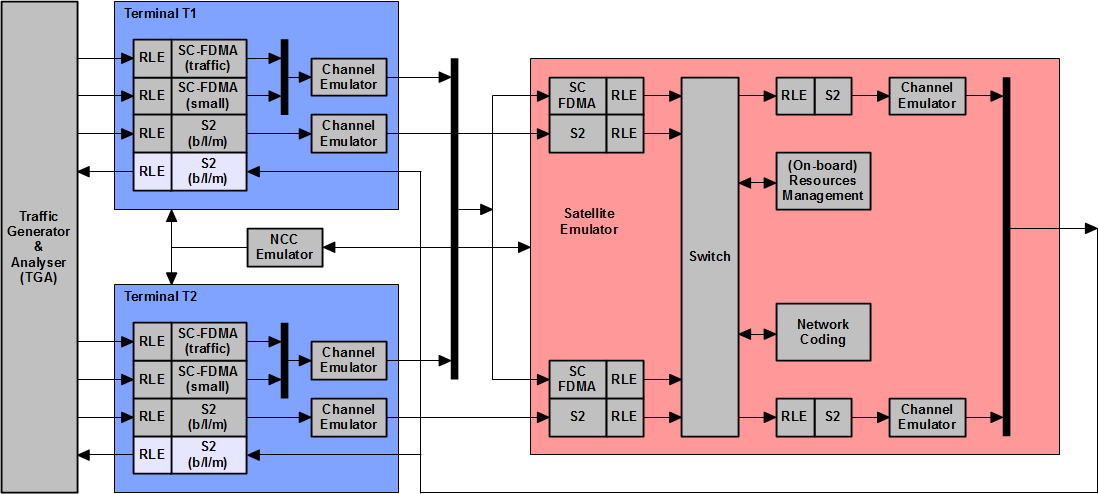
It includes three terminals which can be configured as small (DVB-RCS2 TX and DVB-S2 broadcast RX), medium or large (DVB-S2 broadcast TX and DVB-S2 broadcast RX). The main difference between the medium and large terminals is in the vehicular nature of the former which implies connections at smaller bit rate.
The Terminal T1 also provides a simulated traffic on the DVB-RCS2 frames to emulate the presence of several terminals.
Each terminal is connected to the regenerative OBP which is able to receive the uplinks, perform a packet switch and provide back data on the downlinks.
The NCC location is also object of the current study: both the possibilities of implementing it on-ground and on-board are considered.
Several types of terminal-to-terminal connection are possible: (i) small-small; (ii) small-medium; (iii) small-large and (iv) medium-large.
Plan
The project was divided into two phases:
- Phase 1, in which the project team studied and defined a mission architecture with the insertion of an OBP for high speed security applications and institutional purposes. During this phase the team proposed to use SC-FDMA access technique on the up-link to improve spectral efficiency and minimizing on-board complexity and the exploitation of Network coding to further improve down-link system capacity.
- Phase 2, in which the project team performed the detailed design, development and validation activities of all the OBP sub-systems studied in the previous phase implementing, in a laboratory environment, a prototype of the satellite emulator included in an End-To-End Test-Bed.
Current Status
The project is concluded.
The validation phase confirmed the results obtained as outcome of the studies performed in the first phase of the project. The proposed air interfaces and technique are good candidates for implementing in the next generation of the Regenerative Satellite Multimedia Systems. After the validation phase in the laboratory environments a second step should been scheduled in order to provide for an increase of throughput performances by a deeper integration between hardware and software blocks and an over-the-air validation in order to reach a sufficient maturity level (at least TRL5/TRL6) necessary to obtain a space qualified product.
Companies