
PAGE CONTENTS
Objectives
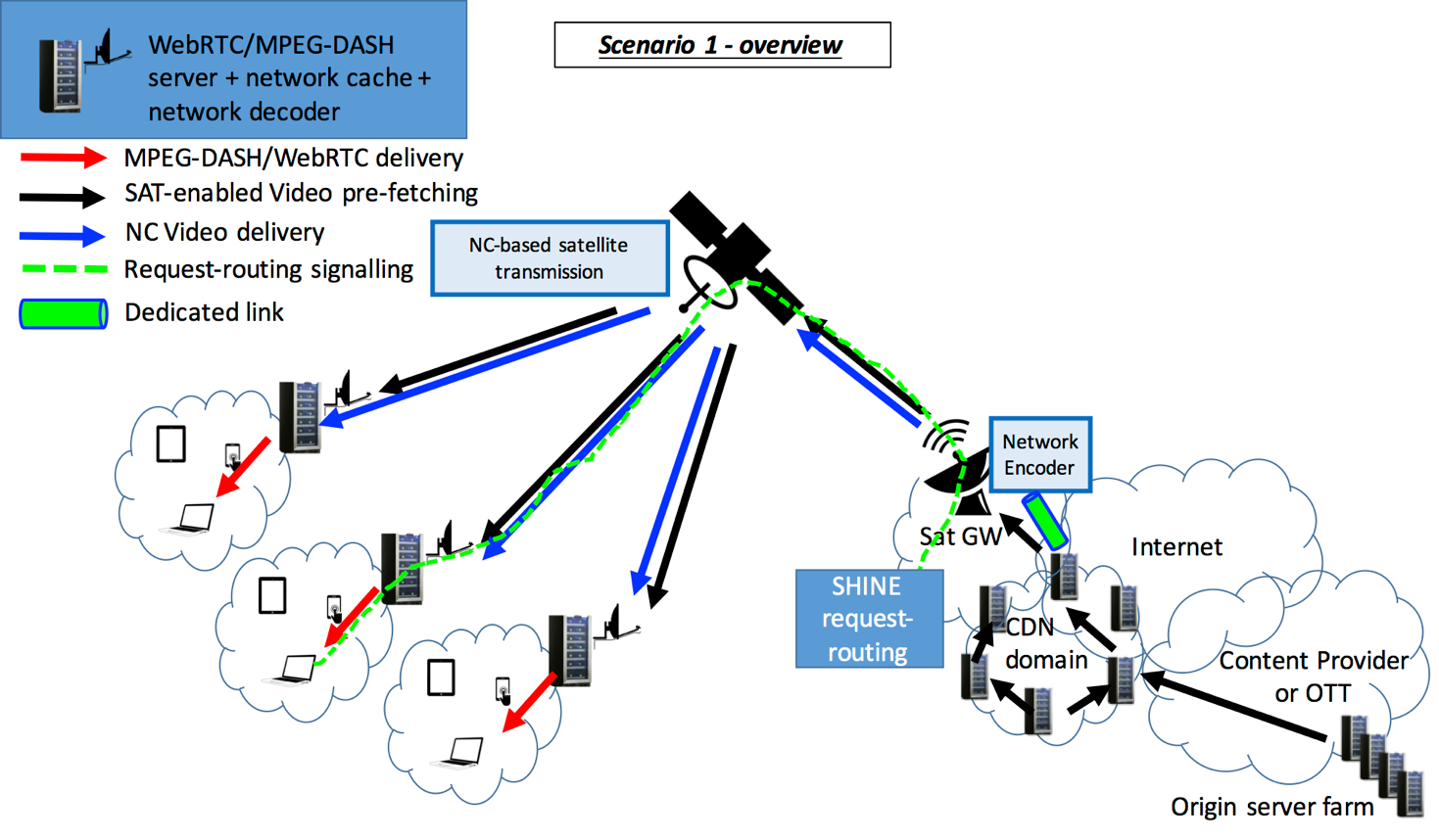
SHINE is focused around the design and implementation of an end-to-end secure infrastructure for the delivery of multimedia content over integrated satellite-terrestrial networks. The project makes use of a combination of both unicast and network-coded multicast. A number of reference scenarios are envisaged, all relying on in-network caching. The overall security architecture of the SHINE project is comprised of two main building blocks: (i) a satellite-enabled broadcast distribution backbone leveraging network coding in order to improve both performance and security of the transmissions; (ii) a MPEG-DASH/WebRTC-enabled edge distribution network. In-between such building blocks lies a middle layer associated with the secure storage of cached multimedia content chunks.
Challenges
- Define an end-to-end security architecture for hybrid satellite-terrestrial networks allowing for the effective transmission of multimedia content;
- Study the applicability of Network Coding techniques to real-world application scenarios;
- Evaluate the effectiveness of the upcoming WebRTC (Web Real Time Communications) standard when applied to the streaming of multimedia content;
- Perform a comparative analysis between MPEG-DASH and WebRTC, taking into account both performance and security features.
System Architecture
A high-level view of the SHINE architecture is reported in the picture below.
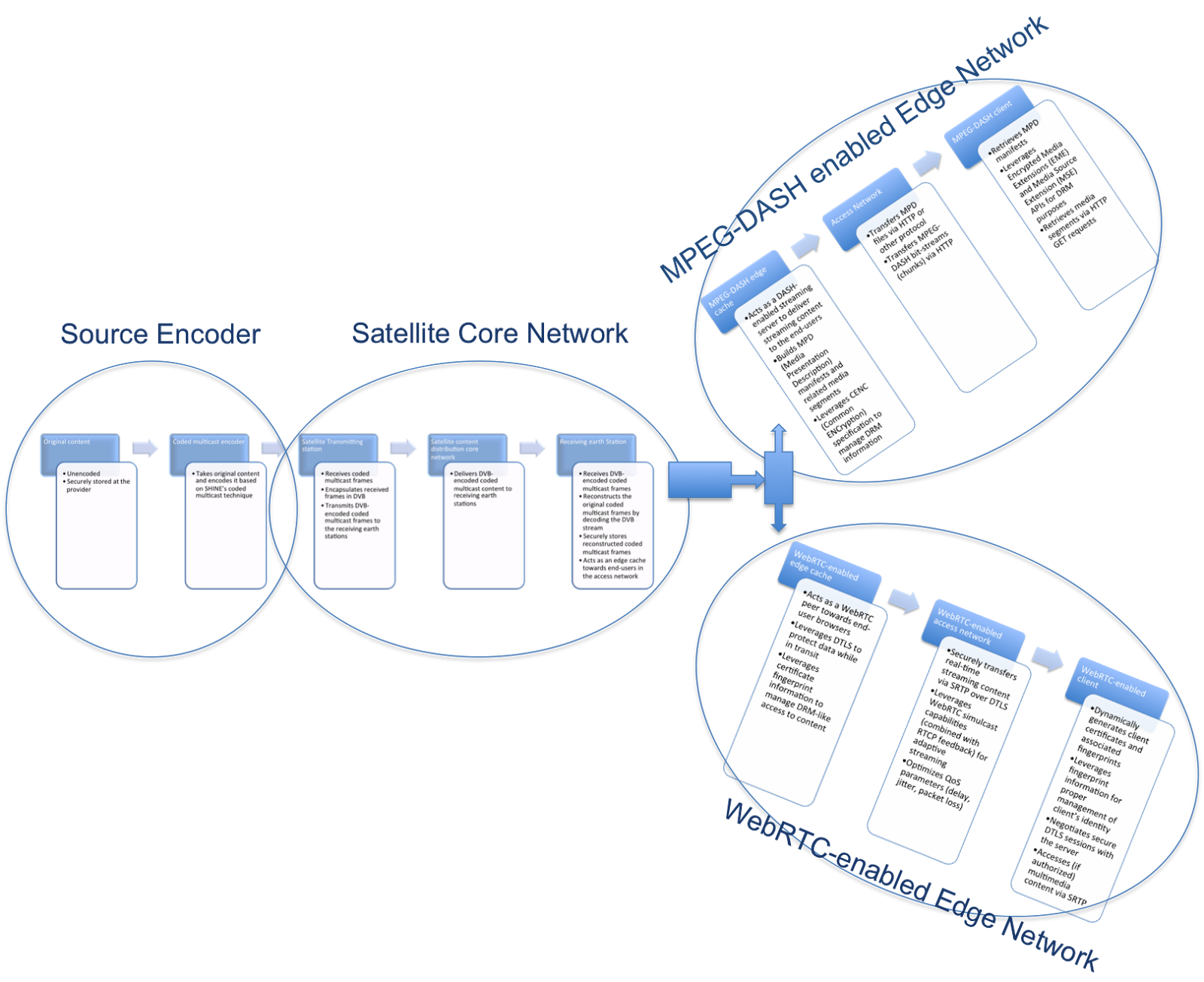
The picture highlights the main logical components of the architecture, in terms of macro-blocks and related functionality. Namely, we identify the following elements:
- a source encoder block, taking on the responsibility of properly encoding the original content in order to allow fro the subsequent coded multicast transmission over the satellite network;
- the core satellite-enabled communication infrastructure, looking after DVB-enabled transmission of coded multicast frames from the content provider to the edge caches, both during the cache population phase and during the steady-state operation of the CDN;
- two different “flavours” of edge access networks:
- a WebRTC-enabled access network, included in the architecture in order to demonstrate SHINE’s operation in the presence of this novel real-time communication infrastructure at the edges of the overall content delivery architecture;
- an MPEG-DASH enabled access network, included in the architecture in order to demonstrate SHINE’s capability of leveraging such a well-assessed web-based distribution approach, as well as to practically disclose its potential for interoperability with companion initiatives fostered by ESA like, e.g., SCORSESE (https://artes.esa.int/projects/scorsese ).
Plan
The project starts by identifying the main usage scenarios, while performing a critical review of both security and satellite technologies. We then move to the specification of the overall architecture for the secure delivery of multimedia content in a hybrid satellite-terrestrial network environment. Work is conducted by embracing an engineering approach, which brings to the definition of a testbed for the practical demonstration of satellite-assisted in-network caching scenarios.
Current Status
The project has just started (February 1st 2017). Preliminary activities have already been conducted and work is currently in full swing for the completion of the tasks associated with the identification of usage scenarios, as well as with the critical review of state-of-the art security and satellite technologies.